









MONTGOMERY, Alabama – From the pulpit of the historic Dexter Avenue Baptist Church, Hillary Clinton on Tuesday called for a continuation of the civil rights movement kicked off here by Rosa Parks and Dr. Martin Luther King, Jr., 60 years ago. She also told a roomful of black lawyers that the criminal justice system, riven with racial discrimination, should work on the side of “love.”
The event marked the 60th anniversary of Parks’ arrest for refusing to give up her seat to a white man, igniting a crusade to end racial segregation on public buses. Dr. King organized the Montgomery Bus Boycott as a young pastor from this church basement in 1955.
Clinton praised Parks for the iconic role she played in the boycott.
“It’s always struck me how, depending on the way you look at it, Rosa Parks either did something tremendous or something rather humble,” Clinton said, pointing out how often history is made with an ordinary act “by seemingly ordinary people doing something extraordinary.”
RELATED: Clinton basks in glow of women senators — with one absence
Wearing a commemorative white flower and black ribbon on her blazer, Clinton spoke about the challenges young black men face today.
“We can’t go on like this. We’ve got to change,” Clinton said after referencing her meeting with the mothers of several African-American men shot and killed by law enforcement officers. She also called the need for new gun control measures “a national emergency.”
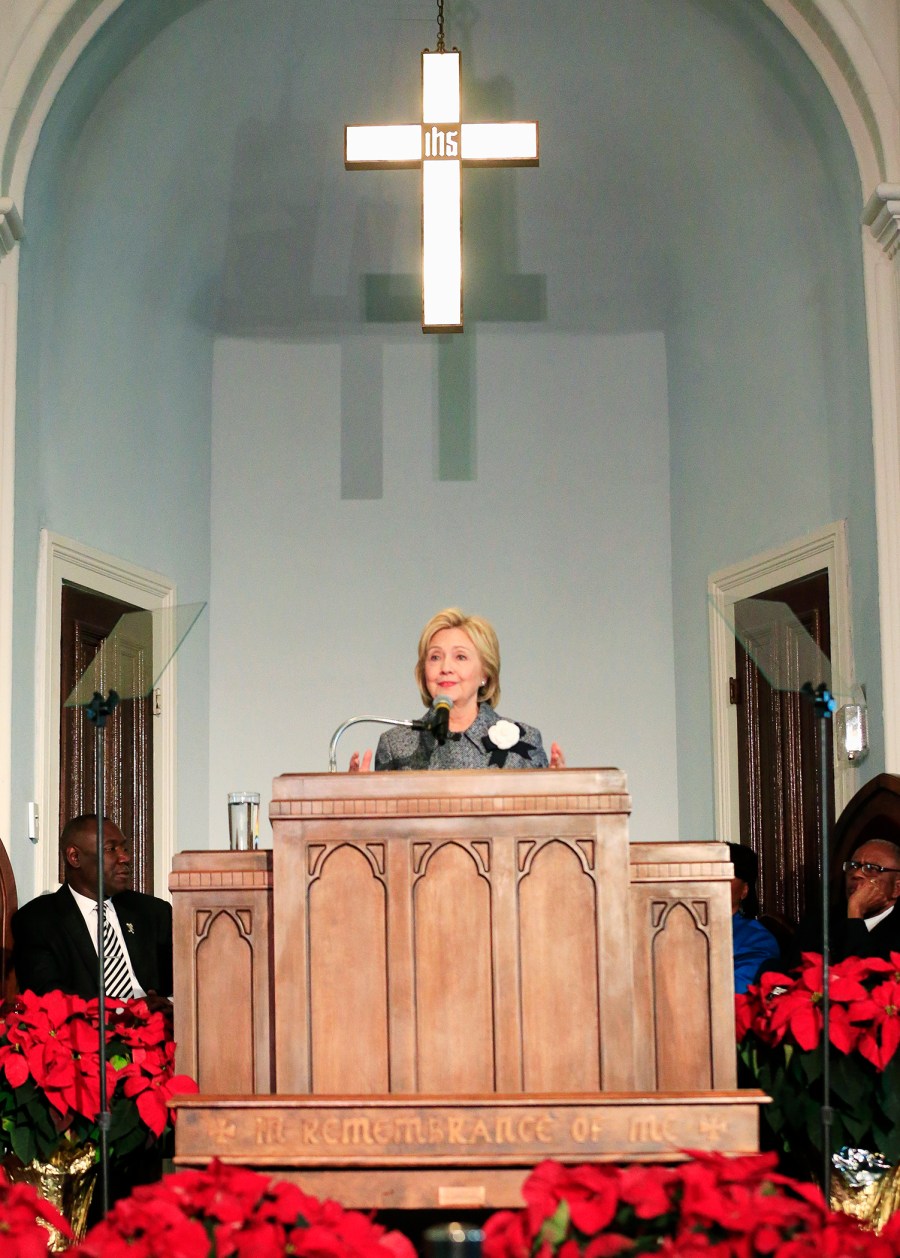
The speech was part of an event hosted by the National Bar Association and Tuskegee History Center that focused on the role lawyers played in the bus boycott and civil rights movement.
“It took the courage of so many, and among the most courageous were the lawyers who took on the challenges in the courts and in the streets,” Clinton said of civil rights leaders who were also attorneys, noting that she is herself a “recovering lawyer.”
“They knew that segregation was a distortion of justice, not an expression of it. They also knew that sometimes lawmakers get it wrong and when that happens, it’s up to lawyers and judges to make it right.”
Several prominent lawyers, politicians and activists spoke before Clinton, including Fred D. Gray, who was Parks’ lawyer six decades ago. He called attention to Claudette Clovin, the 15-year old who helped pave the way for Parks’ action by refusing to give up her seat several months earlier.
And Gray was one of several here to connect the Civil Rights Movement to the election of Barack Obama and then to the potential election of the nation’s first woman president. He earned her a standing ovation inside the church as he called “the next president of the United States of America.”
Benjamin L. Crump, who represented the families of Trayvon Martin and Michael Brown after their deaths, and serves as president of the NBA, called Clinton, “the very definition of a trailblazer.”
“When she takes that oath in November, she’s going to continue to fight for the least of you, for my little girl Brooklyn’s dreams and your little girl’s dreams,” Crump told the packed room of civil legal rights activists. This was Clinton’s second visit to Alabama this election cycle. She gave a voting rights speech in Birmingham in October. Alabama will hold its Democratic presidential primary on March 1, along with other states with large black populations like Georgia and Arkansas. The praise for Clinton from black leaders here would be difficult for Sen. Bernie Sanders to match. Her chief rival for the Democratic nomination has struggled to make inroads among black voters, who will likely decide the contest in states like Alabama, where 56% of the electorate that turned out to vote in the 2008 primary was nonwhite. A week ago, Sanders visited two black baptist churches in North Charleston, South Carolina, where he acknowledged he was largely unknown among the parishioners. He gave a five-minute version of his stump speech focused on income inequality, reminded his audience to bring a warm coat if they ever visit Vermont and asked voters there to keep an open mind about him. A recent NBC News/SurveyMonkey online poll found Clinton barely edged out Sanders among white voters, and had a modest lead among Hispanics — but dominated Sanders among black voters, leading him by a 54 percentage point margin. Clinton, a practicing Methodist, seemed comfortable at the pulpit as she quoted Psalms — “This is the day the Lord has made. Let us rejoice and be glad in it,” she said — and crossed her arms to join hands with those on stage to sing Civil Rights era staple “We Shall Overcome” after her remarks. And while she moved through her familiar talking points about race and criminal justice, she added an unusual poetic flair. “Justice is really love in calculation. Justice is love correcting that which would work against love,” she said. “This isn’t just about strengthening ties between police and citizens, although that is very important,” Clinton continued. “It’s about strengthening ties across society… It’s about how we treat each other, what we value together.”
Alex Seitz-Wald
Monica Alba Recommended


