








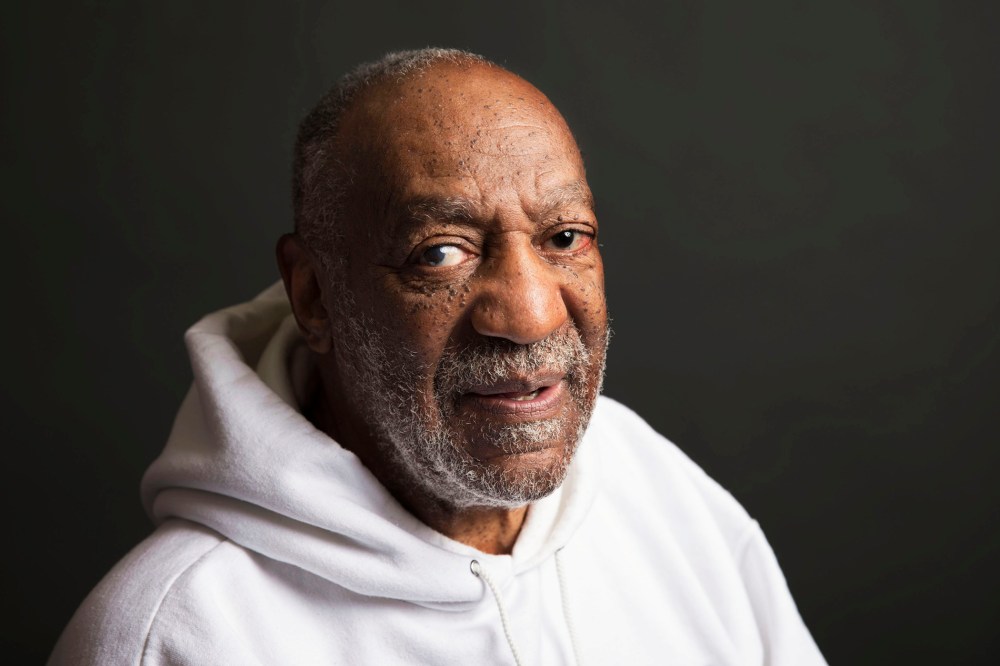
There is no question that comedian Bill Cosby had a historic and influential impact on the world of television. There is also no doubt about the fact that several dozen women have accused him of sexual assault, and while the former sitcom star has vehemently denied the allegations, their very existence has forced a complicated conversation about if he can or should be honored for his accomplishments.
According to The New York Times, the National Museum of African American History and Culture, which opens at the National Mall this September, will include nods to Cosby’s groundbreaking work on “I Spy” and “The Cosby Show” within a larger exhibit entitled “Taking the Stage.” The decision not to include references to Cosby’s accusers has been singled out for criticism.
On March 31, the musuem’s director, Lonnie G. Bunch told MSNBC in a statement that there are “many misconceptions and mistaken notions” about the exhibit featuring Cosby, and that “this is not an exhibition that ‘honors or celebrates’ Bill Cosby but one that acknowledges his role, among many others, in American entertainment.”
RELATED: Why Bill Cosby criminal charges could be a teachable moment
“Some people feel that the Smithsonian should eliminate all mention of Bill Cosby as a result of recent revelations. We understand but respectfully disagree. For too long, aspects of African American history have been erased and undervalued, creating an incomplete interpretation of the American past,” he said. “This museum seeks to tell, in the words of the eminent historian John Hope Franklin, ‘the unvarnished truth’ that will help our visitors to remember and better understand what has often been erased and forgotten.”
“Like all of history, our interpretation of Bill Cosby is a work in progress, something that will continue to evolve as new evidence and insights come to the fore. Visitors will leave the exhibition knowing more about Mr. Cosby’s impact on American entertainment, while recognizing that his legacy has been severely damaged by the recent accusations.” he added.
Meanwhile, the Smithsonian, which is overseeing this project, has had to fend of critics in the past for not divesting themselves from Cosby, who has contributed substantially to their National Museum of African Art. Last summer, the Smithsonian put up a sign telling visitors that it did not condone Cosby’s alleged behavior, but the question of how or if Cosby the man can be separated from Cosby the artist is till a topic of contention, particularly since his real-life persona and fictional one were conflated more often than not in the public’s consciousness.
“His body of work has had and continues to have a significant impact on the culture,” Daily Beast editor-at-large Goldie Taylor, who penned a viral cover story on the Cosby legacy for Ebony magazine in November, and is a sexual assault survivor herself, told MSNBC on Monday. “However, it is crucial that we view that work and its creator with a clear lens. And that means evaluating his role in the larger society in its fullness.”
In the aftermath of allegations that emerged in late 2014 and continued throughout last year, Cosby has seen his life’s work largely marginalized. Universities cut ties with him. Production deals were canceled or shelved indefinitely. TV Land even stopped re-runs of “The Cosby Show,” which provoked a rebuke from former cast-member Malcolm Jamal-Warner, who described the cancellation as “taking money out of my pocket.”
“There’s no one that has been calling for Woody’s movies to be pulled off the air,” he said during an appearance on “The Real” earlier this month. “Roman Polanski is still celebrated. Stephen Collins’ show still comes on. So it’s just interesting how it’s very unbalanced. They were trying to take Mr. Cosby’s star off the Hollywood Walk of Fame. And I am in no position to defend him because I can’t. But nor will I throw him under the bus.”
As the first black actor to be honored with a Prime-time Emmy award (for “I Spy”) and the star-creator of arguably the most popular sitcom of the 1980s, which changed the way African-Americans were portrayed on television, Cosby’s creative legacy matters — particularly in the black community. The ambiguity many blacks feel about him now was tackled recently in a critically acclaimed episode of NBC’s “The Carmichael Show.” The episode, titled “Fallen Heroes,” charts the stages of regret and denial many African-Americans felt in the aftermath of the deluge of accusers who have come forward in the last two years. The show’s star — comedian Jerrod Carmichael — grapples with whether or not to see Cosby in concert, and whether enjoying his comedy equates with supporting him against the allegations of assault. Over the course of the episode, Carmichael makes the case for talent trumping morals, while expressing his own discomfort with still enjoying Cosby in light of the allegations. “People get in trouble all the time. It’s removed from that. Those accusations have nothing to do with comedy. If you were a dramatic actor, same accusations. If you were a musician, same accusations. So the accusation has nothing to do with comedy,” Carmichael told Vulture this month. “None of the accusations talk about his jokes. The accusations are associated with a man in power abusing it.” He later said: ” … As a person who enjoys music how do you reconcile listening to Michael Jackson? As a person who enjoys any art, anything — it’s the struggle of categorizing. How you reconcile an abusive father who provided? How do you reconcile an alcoholic mother who cooked dinner every night? You compartmentalize. That’s all you can do.” Author and political analyst Earl Ofari Hutchinson believes that when it comes to the National Museum of African-American Culture he believes that should follow the model of Holocaust museums, which call out atrocities, not just heroism. “Cosby, not Cosby the accused rapist, but Cosby the pioneering and ground breaking actor, comedian and writer’s contributions to the African-American experience or integral to African-American history and likewise can’t, nor shouldn’t be denied,” he told MSNBC on Monday. “This is a part of African-American history that generations are entitled to know. And Cosby for better and worse is part of that history.”
Adam Howard Recommended


