








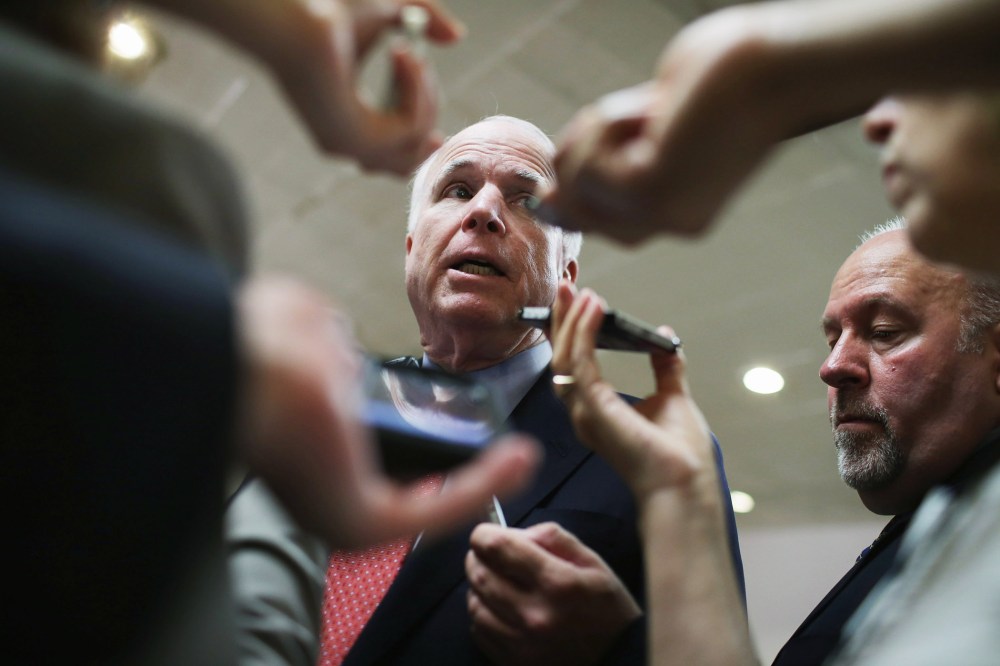
Republican Sen. John McCain of Arizona — who has spent the last decade championing American military intervention in Iraq — offered a solution Friday to the current crisis there: Bring back Gen. David Petraeus.
Never mind that Petraeus is no longer serving in the U.S. military, having given up his well-decorated uniform in 2011 for a short-lived tenure as President Obama’s Director of the CIA.
Before he earned his fourth star, when Iraq was still being sold as a “cake walk,” Petraeus was hailed as some kind of prophet. During the invasion, he repeatedly posed a “riddle” to a seasoned military reporter traveling with the 101st Airborne Division: “Tell me how this ends.”
The answer can be found in every national security headline in the last two weeks: thousands of veterans unable to get medical attention, a military willing to draft a clearly unstable young man to round out the ranks for the Afghan surge; an Iraqi nation awash in sectarian violence and on the brink of collapse.
McCain and his political allies are already calling for air strikes in Iraq, but most in Congress have shied away from calling for troops to go back. After nearly 13 years since the U.S. went to war in Afghanistan, after a war in Iraq that lasted eight years, it’s easy to see why. More than 6,800 U.S. service members have been killed in Iraq and Afghanistan, and close to 1 million have been treated for injuries. Among civilians, there have already more than 100,000 documented casualties and likely thousands more that have gone unrecorded.
Petraeus was lauded for his ability to pose a question that seems so obvious but that almost no one in the former administration of George W. Bush thought to ask. The fact is that the United States went to war in Iraq, utterly unprepared and on a premise that turned out to be false. In order to invade a country that size, troops and resources were pulled too early from Afghanistan, another war with a hazy conclusion.
Few who pushed for war and more troops and more war, bothered to invest in the Veteran’s Administration to prepare for the millions of men and women who would need care.
On Friday, McCain and Sen. Lindsey Graham called for US action in Syria. The president rejected that idea last year, in part because of fears of becoming embroiled in another open-ended sectarian conflict
Earlier that day Obama made clear that enough American lives had been sacrificed. “We will not be sending U.S. troops back into combat in Iraq,” he said. “Over the past decade, American troops have made extraordinary sacrifices to give Iraqis and opportunity to claim their own future.”
The president took three questions but was done by the time a reporter shouted out one more on Bowe Bergdahl, the American soldier who was capture by the Taliban in 2009 and spent five years in captivity before being freed in a prisoner exchange on May 31.
Berghdal returned to the United States Friday, to continue the military’s reintegration process and receive more treatment. As the 28-year-old recuperates in a hospital in San Antonio, debate continues over the deal to trade five Taliban fighters for Bergdahl. Many critics of the trade – some of them members of Congress, others veterans – suggested it was a weak move to swap five militants for an alleged deserter. But newly released emails and diaries from Bergdahl show a young man clearly struggling with mental health issues, one that should likely never have been sent to fight. Bergdahl would not have been the only soldier to enter the service with such issues. A study published in March found that approximately 1 in 5 soldiers has suffered from some sort of mental illness before they enlisted in the military. The armed services lowered their acceptance standards while both wars were raging, and If Bergdahl is discharged and is not disqualified from receiving VA benefits, he’ll join thousands of soldiers facing long waits for care at medical centers that lack enough doctors and nurses to provide adequate treatment. The Senate passed a bill aimed at reforming this system, but it is a small step, years too late. As Mother Jones reported in May, the Bush administration was aware of system-wide problems getting veterans care and did nothing. Those administration officials might have been too focused on the surge, or at dampening the horror over conditions at Walter Reed hospital, where patients lived in crumbling buildings and endured Kafka-esque bureaucratic ordeals to get treatment. Or on the continuing fallout from torture at Abu Ghraib prison and at CIA black sites, or the detention of innocent men at the Guantanamo Bay, where the five Taliban traded for Bergdahl spent more than a decade without charge. As for McCain’s would-be savior, David Petraeus, his tenure at the CIA ended – in scandal, naturally – when news broke that he had an affair with his biographer. And as far back as 2008, experts and reporters have been dismantling the myth of the surge, the strategy McCain still believes is the reason the U.S. “had it won” in Iraq. That confidence in Petraeus could explain McCain’s insistence that the U.S. leave troops in Afghanistan, where Petraeus oversaw operations after the resignation of disgraced Gen. Stanley McChrystal. Most of those scandals continue to haunt U.S. foreign policy — along with the fallout from drone strikes — a new option for endless war that House Speaker John Boehner endorsed Friday. In a week when Berghdal came home, the VA remained leaderless and Iraq stared down at collapse, the answer to Petraeus’ 2003 question seemed to coalesce perhaps for the first time. In an interview for her book, former Secretary of State Hillary Clinton said she made a mistake when she voted for war there as a U.S. senator. Some of her former colleagues aren’t there yet.
Meredith Clark
Meredith Clark is a freelance writer and editor. She was previously a senior news producer for "Patriot Act with Hasan Minhaj," a reporter with MSNBC.com, the digital politics and culture editor at Glamour and a senior news and politics editor at Refinery29. She has written for Vulture, Rolling Stone, Self, Marie Claire, Cosmopolitan, The Daily Beast and Bustle. Recommended


