The Rachel Maddow Show WEEKNIGHTS 9PM ETMorning Joe WEEKDAYS 6AM ETDeadline: White House with Nicolle Wallace Weekdays 4PM ETThe Beat with Ari Melber Weeknights 6PM ETThe Weeknight Weeknights 7PM ETAll in with Chris Hayes TUESDAY-FRIDAY 8PM ETThe Briefing with Jen Psaki TUESDAYS – FRIDAYS 9PM ETThe Last Word with Lawrence O’Donnel Weeknights 10PM ETThe 11th Hour with Stephanie Ruhle Weeknights 11PM ET
Bush facing backlash over comments on Asian immigrants
Less than one day after attempting to clarify his use of the term “anchor babies,” Jeb Bush could face additional backlash on the campaign trail.
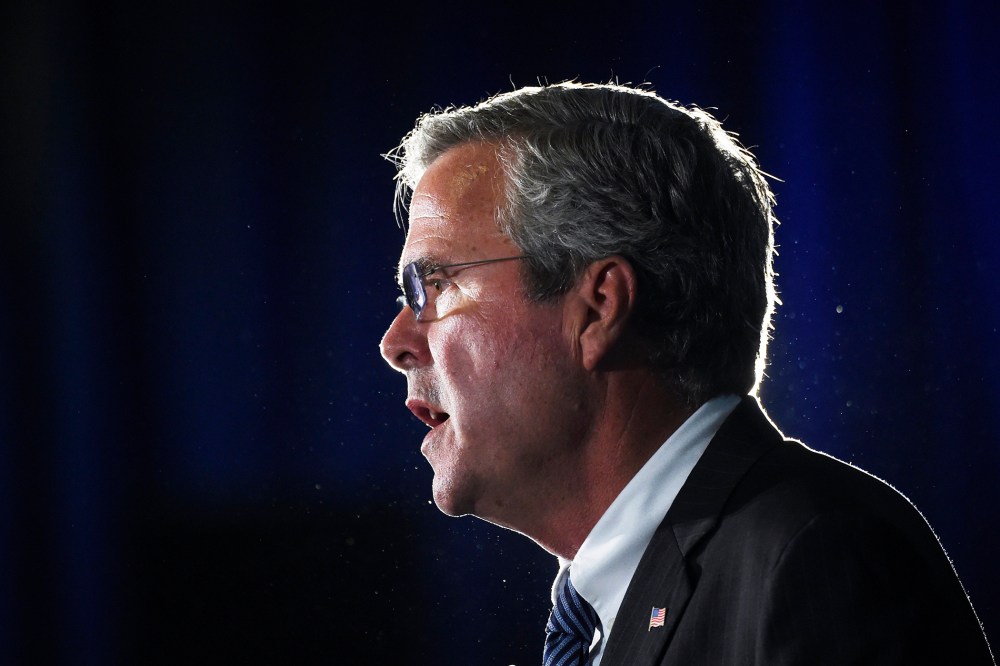
Republican presidential candidate, former Florida Gov. Jeb Bush speaks during a town hall meeting on Aug. 17, 2015, in Columbia, S.C.AP
By
Traci Lee
Republican presidential candidate Jeb Bush is facing fresh backlash Tuesday after attempting to clarify his use of the term “anchor babies” during a campaign stop in McAllen, Texas.
The former Florida governor, touring the U.S.-Mexican border area on Monday, defended his past use of the term, saying he was originally referring to a “specific, targeted kind of case” known as “birth tourism,” where mothers travel to the United States to win citizenship for their unborn children.
“Frankly, it’s more related to Asian people coming into our country, having children in that organized effort taking advantage of a noble concept which is birthright citizenship,” Bush said.
The issue has gotten fresh attention in recent days after Republican front-runner Donald Trump laid out an immigration plan that would, among other things, end automatic birthright citizenship for children born in the U.S. to undocumented immigrants.
In a statement Monday following Bush’s remarks, the National Council of Asian Pacific Americans condemned the association of the term “anchor babies” with Asian American and Pacific Islander communities:
From the Chinese Exclusion Act of 1882 and legislative attempts to overturn United States v. Wong Kim Ark to now calling us “anchor babies,” Asian American and Pacific Islander communities continue to be discriminated against as part of larger anti-immigrant rhetoric.
We urge lawmakers to instead focus on developing humane legislative solutions to reform our broken immigration system. Any debate around immigration reform should align with our values of equality and fair treatment and promote the human rights and dignity of all people.
The NCAPA is a coalition of more than 30 national Asian Pacific American organizations around the country.
California Congresswoman Judy Chu, chairwoman of the Congressional Asian Pacific American Caucus, echoed the NCAPA’s call to re-focus the conversation. “No matter which ethnic group you’re referring to, ‘anchor babies’ is a slur that stigmatizes children from birth,” Chu said in a statement Tuesday. “The problem with our immigration system is not birthright citizenship. The problem is a broken immigration system that forces families to live apart or live in fear. We need a conversation that leads to a solution on visas and naturalization and seriously considers how we can integrate the 11.5 million undocumented immigrants already living and contributing here. All that is accomplished through talk of anchor-babies – be they from Latin America, Asia, Europe, or Africa – is to use xenophobic fears to further isolate immigrants. It’s time for our country to return to a substantive discussion on immigration.”
Senator Brian Schatz (D-Hawaii) also released a statement directly targeting Bush: “Jeb Bush’s comments regarding the children of Asian immigrants are derogatory and offensive. He should immediately retract his statements and apologize to the Asian community for his insensitive behavior.”
On Twitter, student Jason Fong started the hashtag #MyAsianAmericanStory, which was tweeted about and retweeted hundreds of times, including retweets from writer and activist Jose Antonio Vargas and New York Times columnist Charles Blow.
“I was bothered by the scapegoating of immigrants and the exclusion of AAPI Americans to the debate,” Fong wrote in an email to MSNBC. “I think it is important to include Asian American stories to the debate because they are American stories about immigration and they are vital to our history.”
Fong added, “I think that the response to the hashtag shows that many AAPI care about issues and must be included in the conversation.”
My grandfather immigrated from China to Cuba and then to NYC in 1943. #MyAsianAmericanStory
Bush’s recent comments on immigration are part of what some are seeing as sharp turns to the right as Donald Trump continues to lead the field.
“Bush’s comments highlight the ways that Donald Trump’s moves on immigration are putting pressure on more moderate candidates,” Karthick Ramakrishnan, professor at UC Riverside and immigration policy expert, told MSNBC.
“In 2013, Jeb Bush noted that Asian Americans are the ‘canaries in the coal-mine’ for Republicans, meaning that Republicans should be worried about having lost Asian American support over the years. Unfortunately, Bush seems to have lost sight of his own advice. His comments are getting widely noticed among Asian American voters, and could hurt the GOP’s chances in the presidential election,” Ramakrishnan added.
A 2015 report from the UCLA Center for the Study of Inequality and Asian Pacific American Institute for Congressional Studies found that the Asian American electorate is one of the fastest-growing electorates and is expected double by 2040.










 — Erika Lee (@prof_erikalee) August 25, 2015

