








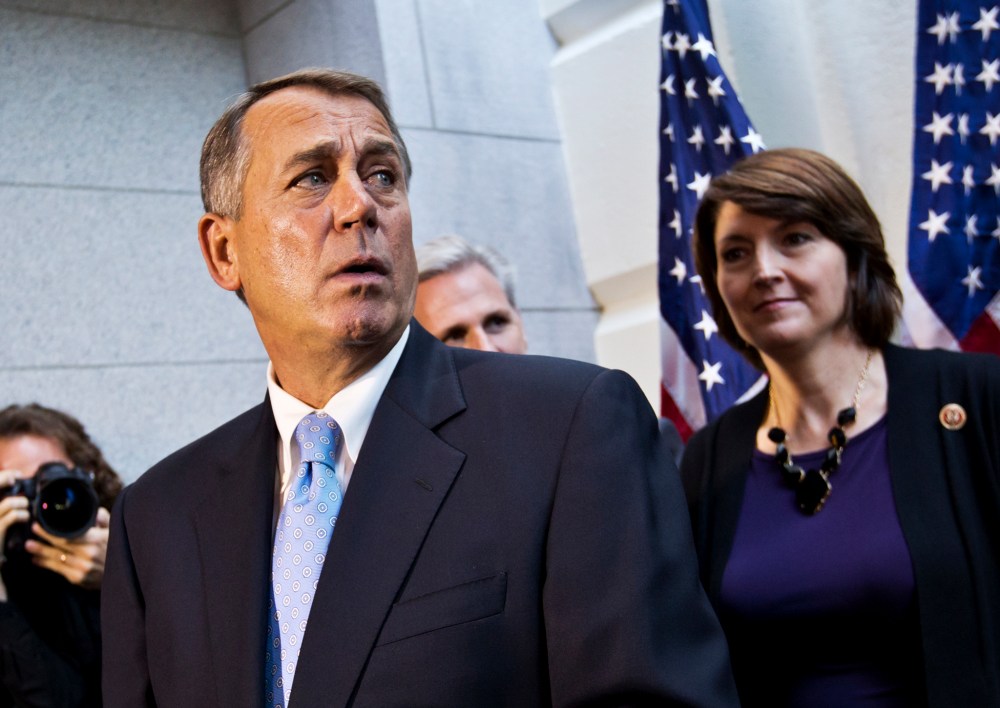
John Boehner was gearing up to have his conference to take a vote Tuesday evening, but pulled the plug abruptly.
“We felt blindsided by the news from the House,” Harry Reid said on the Senate floor. “Let’s be clear: The House legislation will not pass the Senate.”
The Senate has now hit the pause button on talks while the House rangles.
“We’re in very dangerous territory,” Senator Chris Coons, Democrat from Connecticut, told MSNBC after a lunch meeting with his caucus.
Republican Senator Lindsey Graham of South Carolina suggested Democrats help Boehner out with his dilemma and relent on some of their demands, even if it was the Speaker’s fault things had reached the current point.
“We really did go too far. We screwed up,” Graham said. “Their response is making things worse.”
Rather than move toward Democrats, Republicans in the House are digging in, calling for more concessions. Republican leaders, after reviewing ideas to make the deal more appealing to their rank-and-file, appear to be moving forward with a new plan that would fund the government through December 15 — one month earlier than the Senate proposal — raise the debt ceiling until February 7, and slash health insurance benefits for federal officials. It would keep an income verification system for Obamacare subsidies crafted by the Senate.
An earlier version floated by Boehner Tuesday morning would have included a two-year suspension of a medical device tax included in the Affordable Care Act, but that idea appears to be dead after failing to excite conservatives. Instead, the newest edition includes a stricter version of the Vitter amendment, which now cuts Capitol Hill staffers’ health benefits and not just members of Congress and top cabinet officials.
But just like the version of Boehner’s proposal floated Tuesday morning, Republicans would get only minor Obamacare changes in exchange for raising the debt ceiling and reopening the government. Conservatives want much more.
The differences between the Senate and House plans may not seem like much on policy grounds, but Democrats and the White House see the Boehner’s approach as incompatible with crucial principles they’ve articulated throughout the shutdown and debt ceiling fights. The Senate plan was crafted as an equal exchange of Democratic and Republican priorities in keeping with Obama’s vow not to pay a ransom for reopening the government and raising the debt ceiling. Boehner’s plan, while a huge departure from his initial call to defund Obamacare, cuts the one sop to Democrats (reinsurance delay) and ups all the Republican demands. Democrats fear even the slightest unilateral concession to Republicans will enshrine the House’s policy of debt ceiling brinksmanship as a governing norm
The administration’s opposition, therefore, is not surprising. But the bigger problem for Boehner is that his plan might not fly with House conservatives either.
Ted Cruz’s band of anti-Obamacare warriors threatened to bring down the government and crash the economy unless they killed or mortally wounded the health care law. Boehner’s plan, even after its latest tweaks, doesn’t achieve anything more than a ding in the armor. “Both plans are financially irresponsible, both kick the can down the road,” conservative Congressman Mo Brooks of Alabama said after the House GOP’s Tuesday morning meeting. If the Tea Party revolts against the current House plan, Boehner will have little choice but to accept the Senate’s humiliating terms of surrender with Nancy Pelosi supplying the votes. In short, the final act of the shutdown is looking a lot like the opening scene. Boehner is scrambling to find a way — any way — out of the mess his conservative members created without looking like he sold them out. His problem now is the same as it was before the shutdown: there isn’t one. “Obamacare is fully implemented despite a government shutdown,” Republican Congressman Dennis Ross, an opponent of the shutdown strategy, told reporters on Tuesday. “I’m not sure how much more Mitch McConnell could have done other than what he did do.” Boehner knows he needs to end the standoff, which is dragging the party down to record levels of unpopularity in polls, and end the debt ceiling crisis, which is already dragging down the economy. But so far neither the House nor the Senate plans solve the puzzle Boehner’s struggled to solve since taking the Speaker’s gavel: how to placate his conservative members while still passing necessary legislation. There’s no magical combination of Obamacare tweaks that will keep the shutdown from being remembered as a failure, both by the conservative Republicans who backed it and the moderate Republicans horrified by it. Additional reporting by Suzy Khimm
Benjy Sarlin Recommended


