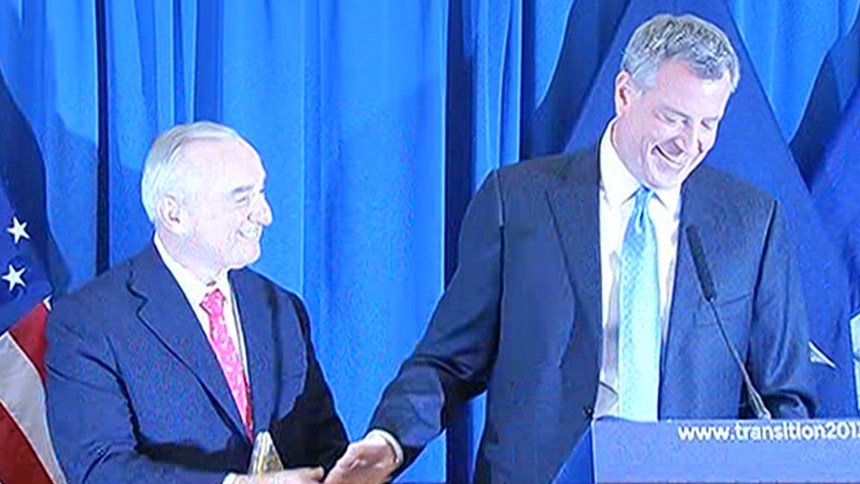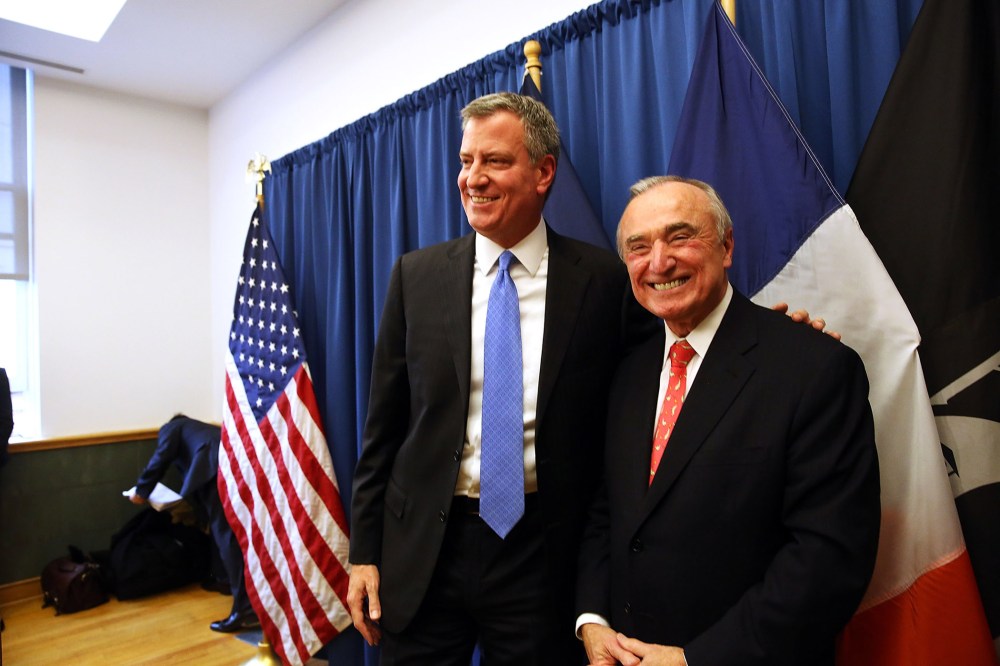
New York Mayor-elect Bill de Blasio on Thursday gave Rudy Giuliani’s police commissioner, William Bratton, his old job back, nominating him to succeed Ray Kelly at the helm of the New York Police Department.
Bratton’s association with former New York Mayor Giuliani, his support of the dubious “broken windows” theory of policing, and his qualified defenses of stop and frisk have some critics of the NYPD wondering if de Blasio intends to fulfill promises he made to stop racial profiling by police.
But groups that have been fighting stop and frisk for years sound cautiously optimistic that changes to the controversial policing policy will still be made.
“I think that what we have to not lose sight of here is that in appointing Bill Bratton as commissioner, the mayor-elect has not backed away in any way, shape, or form from the policy positions that he took during the course of his campaign,” says Donna Lieberman, executive director of the New York Civil Liberties Union. “The police commissioner works for and reports to the mayor, and we fully expect that the mayor is going to hold the police commissioner accountable.”
More than 80% of New Yorkers who have been stopped over the past 10 years have been black or Latino. New York Mayor Michael Bloomberg has defended the policy as effective at preventing violent crime, but nearly 99% of the stops yielded no weapons. In August, in response to a lawsuit filed by the Center for Constitutional Rights, Judge Shira Sheindlin declared stop and frisk as practiced by the NYPD unconstitutional and ordered the department to submit to reforms and a federal monitor.
That ruling was blocked when an appeals court raised questions about Sheindlin’s impartiality as a judge. De Blasio has vowed to withdraw the appeal, and civil liberties groups are confident that they can come to an arrangement similar to the one Sheindlin ordered.
Despite his ties to Giuliani, Bratton may be better prepared to handle an overhaul of the NYPD than he might appear. After running the NYPD, Bratton led the Los Angeles Police Department through court-ordered reforms monitored by the Justice Department. The LAPD had its own toxic relationship with racial minorities in the city, but a 2009 study showed that crime continued to decline even as police abuses were reined in and relations with city residents were improved.
“It’s interesting, because Bill Bratton’s record is varied on these issues implicated by stop and frisk,” says Darius Charney, an attorney with the Center for Constitutional Rights.
“When he was in New York the first time, he was a proponent of the broken windows style of policing, which we think was a major cause of the excesses of stop and frisk that we’ve seen in recent years,” Charney added. “His record in LA was very promising in terms of showing a willingness to work with the federal monitor to make the changes in the LA police department to bring its practices more in line with the Constitution, which [is] the same thing he’ll have to do here.” Bratton has defended stop and frisk as “a basic tool of policing.” The Supreme Court has found that stopping and frisking can be constitutional–but it depends how the policy is implemented. “The challenge is to do it appropriately,” Bratton said in 2012, according to DNAinfo. “Applied in the right way, in the right moderation, [chemotherapy and radiation] will cure most cancers. [Stop and frisk] is an intrusive power … but applied in the right way, it can have the effect of reducing crime.” De Blasio is often described as having promised to “end” stop and frisk, but it’s more accurate to say that he has promised to “reform” it. Bratton may be uniquely qualified help the city to do that. Though his record of reducing crime in New York is overstated–crime was already falling nationwide and in the city when he and Giuliani came into office–Bratton’s reputation as a legendary crime-buster could help neutralize conservative warnings that ending racial profiling will turn New York City into a dystopian nightmare. All of this depends on de Blasio keeping his promises. But for now, at least, the groups opposing stop and frisk don’t see the Bratton’s appointment as a sign that he won’t.
Adam Serwer Recommended