








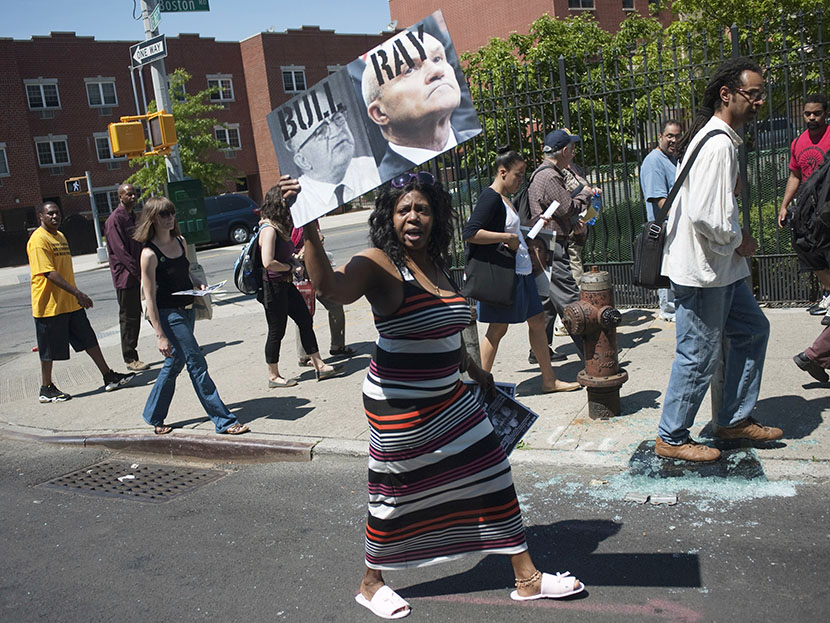
Defenders of New York’s “stop-and-frisk” policy rarely offered more than a token defense against the charge that the policy amounted to racial profiling. Instead, they argued that the policy was effective.
That strategy might have worked in the court of public opinion, but it didn’t work in Judge Shira Scheindlin’s court. Monday, following weeks of trial, Scheindlin ruled that the city of New York had violated the constitutional rights of New Yorkers with “an unwritten policy of targeting ‘the right people’ for stops.” Those “right people” chosen by the New York police department for extra scrutiny turned out to be black and Latinos who made up to 80% of those stopped. In 2011, the number of stops of young black men actually exceeded the number of young black men in the city. Crime has gone in New York over the last decade, but it’s also been dropping everwhere else.
Scheindlin’s ruling doesn’t mean the city has to cease stop-and-frisk entirely. But it does have to bring the policy in line with the Constitution. That is, the police can no longer base stops on thinly veiled justifications for racial profiling. Scheindlin has appointed a monitor, Peter Zimroth, a former Manhattan District Attorney, to oversee changes to the department.
New York City Mayor Michael Bloomberg accused the judge of not giving the city a “fair trial,” and vowed to appeal the ruling. “Given the judge’s public comments and media interviews throughout the case, this decision was certainly not a surprise,” Bloomberg said in a press conference Monday. The mayor touted the program’s success as helping the NYPD become “the poster child” in driving crime down to record-lows. Police Commissioner Ray Kelly said he was disturbed and offended by the notion that the NYPD engages in racial profiling. “That simply is recklessly untrue,” Kelly said.
While the NYPD insisted it was just focusing on high-crime areas, blacks and Latinos were more likely to be stopped regardless of the racial makeup of the neighborhood or its crime rate. Between 2004 and June 2012, the NYPD conducted 4.4 million stops, and 2.3 million frisks, the judge’s ruling noted, and out of the 2.3 million, almost 99% of the frisks failed to yield a single weapon. The most frequently cited justifications for stops were that the individual was in a “high crime area” or had engaged in “furtive movements.” Yet police who testified in the trial included “hanging out in front of [a] building, sitting on the benches or something like that” when describing such movements.
As the day of Scheindlin’s ruling approached, defenders of stop-and-frisk ascribed ever more magical qualities to its effectiveness. In an op-ed for the Wall Street Journal, Kelly implied that the entire drop in New York’s murder rate over the past decade was due to stop-and-frisk, including 2012, a year in which stops actually decreased. Bloomberg similarly said that “5,600 men, women and children who are alive today who would not be” if not for stop and frisk. The mayor later implied that critics of the policy were racist, because they clearly didn’t care about stopping violence in minority communities. He included the Center for Constitutional Rights, the legal group that just prevailed in its stop-and-frisk lawsuit against the city filed on behalf of minority plaintiffs, in his criticism. Everyone wants to be safe from crime, they just don’t want to give up basic rights in the process.
An effort to instill fear
Defenders of stop-and-frisk often justified racial profiling in the same breath that they insisted it was not occurring.
“The sad reality is on the streets of our city, 90% of murder suspects and murder victims are black and Latino. And black and Hispanics are the overwhelming majority of suspects in other violent crimes,” Bloomberg said in April. Later, Bloomberg implied that it was whites who were unfairly treated by stop-and-frisk, saying, “we disproportionately stop whites too much and minorities too little.” Kelly, for his part, wrote in the Journal that it was “disingenuous” and “incendiary” to accuse the NYPD of racial profiling, then insisted that “the race of those stopped highly correlates to descriptions provided by victims or witnesses to crimes.” Attempts to argue that stop-and-frisk was not racial profiling seemed to inevitably segue into a defense of racial profiling. Only 13% of the those millions of stops in the stop-and-frisk case were even based on descriptions on the subjects. The argument that all blacks and Latinos should be subject to increased suspicion because many criminal suspects are black and Latino isn’t just unconstitutional, it concedes that the policy itself is based on racial profiling. And as Scheindlin wrote, “The Equal Protection Clause does not permit the police to target a racially defined group as a whole because of the misdeeds of some of its members.” The judge clearly took note of the efforts to defend stop-and-frisk’s effectiveness. “In their zeal to defend a policy that they believe to be effective, they have willfully ignored overwhelming proof that the policy of targeting ‘the right people’ is racially discriminatory and therefore violates the United States Constitution,” Scheindlin wrote. “While it is true that any one stop is a limited intrusion in duration and deprivation of liberty, each stop is also a demeaning and humiliating experience. No one should live in fear of being stopped whenever he leaves his home to go about the activities of daily life.” But “living in fear” seemed to be exactly what Bloomberg and the NYPD were going for. Bloomberg himself insisted that stop and frisk was a deterrent because “If you think you’re going to get stopped, you don’t carry a gun.” That’s the most benign explanation of the potential deterrent effect of stop and frisk. State Senator Eric Adams, a former police officer himself, testified that Kelly told him the NYPD focused on young blacks and Latinos because “he wanted to instill fear in them, every time they leave their home they could be stopped by the police.” Kelly denied he ever said such a thing, but not in court. Scheindlin writes that she finds Adams’ testimony credible, because of “the City’s failure to offer any rebuttal evidence regarding Commissioner Kelly’s statement at this meeting.” Inspiring fear in criminals by targeting anyone who shares their racial background was the sometimes unstated subtext of stop-and-frisk, and the reason why many support racial and ethnic profiling from street crime to the war on terror. It’s also why stop-and-frisk was so clearly unconstitutional. “The goal of deterring crime is laudable,” Scheindlin wrote, “but this method is unconstitutional.” Defenders of stop-and-frisk seemed to know that from the beginning. They just hoped that if they could convince people it worked, it wouldn’t matter.
Adam Serwer Recommended


