








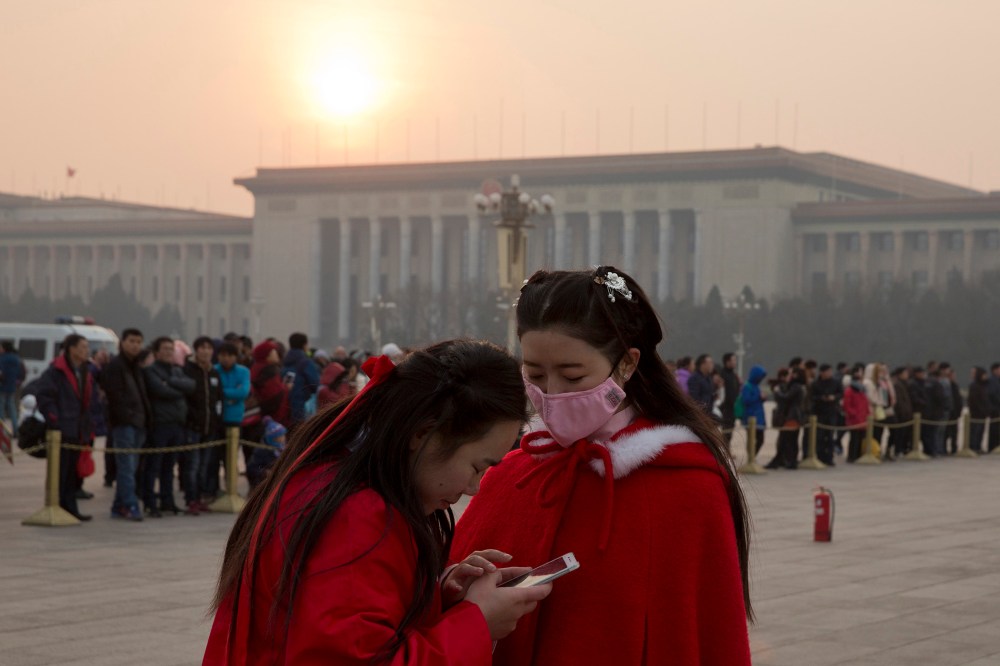
BEIJING (AP) — Beijing was enveloped in eye-watering, throat-irritating smog on Saturday as the second red alert of the month went into effect in the Chinese capital, forcing many cars off the roads and restricting factory production.
A wave of smog settled over the notoriously polluted city of 22.5 million overnight and is forecast to last into Tuesday because of a lack of strong winds.
Smog red alerts, the most serious in a four-tier warning system, are triggered when high pollution levels are forecast to last more than 72 hours.

Levels of PM2.5, the tiniest and deadliest airborne particles, rose to as high as 331 in some parts of Beijing on Saturday and are predicted to top 500 in the coming days – more than 20 times the level considered safe by the World Health Organization.
As a result of the red alert, schools were ordered closed and half the city’s cars forced off the roads each day. Barbecue grills and other outdoor smoke sources have been banned and factory production restricted.
While some balked at the inconveniences, most Beijingers appeared to support the measures after a lengthy stretch when the government was seen as largely ignoring the smog problem.
“I think (the government) is doing a better job than before,” Beijing resident Ma Yunan said. “In previous times, the government would not issue red alerts even when the haze was very serious. Now they are publishing alerts beforehand for us to get ourselves prepared and the alerts are accompanied with some measures.”
Although the smog warning system was launched two years ago, Beijing had not issued a red alert until Dec. 7, drawing accusations that it was ignoring serious bouts of smog to avoid the economic costs.
The smog in Beijing is largely blamed on coal burning power plants, industrial pollution and the booming number of vehicles. The city’s geography worsens the problem because mountains on three sides trap smog, and cold winter air presses down on it to keep it from clearing. While waiting for promised plans to cut coal pollution to take effect, residents of Beijing and other polluted cities in northern China adapt by wearing face masks and equipping their homes with air filters. China, the world’s biggest carbon emitter, plans to reduce hazardous emissions from coal-fired power plants by 50 percent over the next five years, and says its overall emissions will peak by about 2030 before starting to decline. Scientific studies attribute 1.4 million premature deaths per year to China’s smog, or almost 4,000 per day.
Associated Press Recommended


