








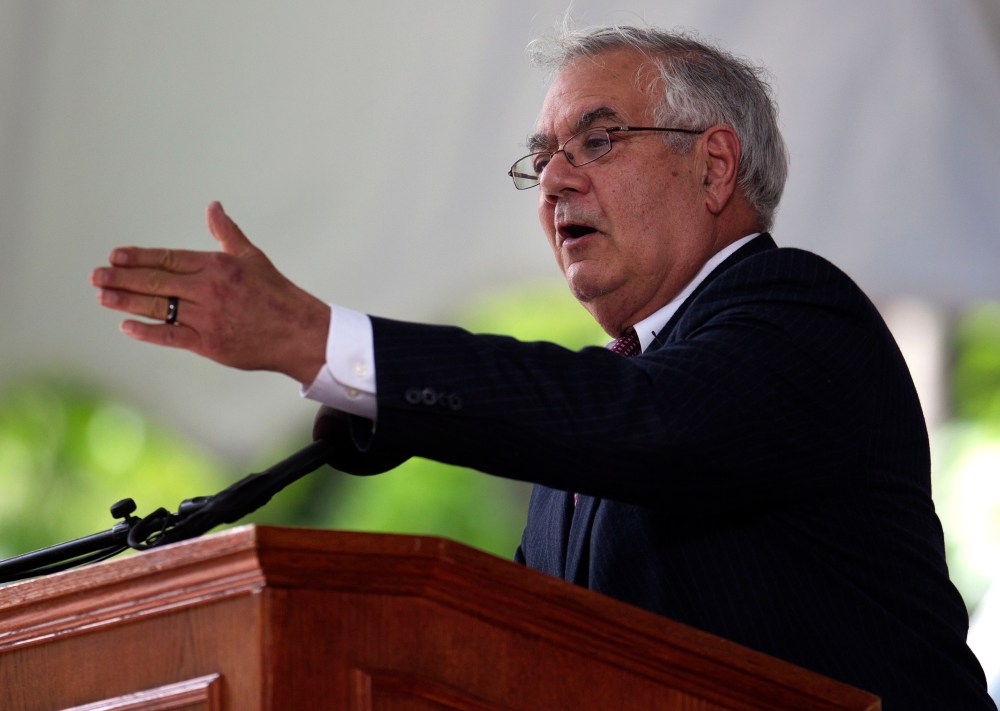
Rep. Barney Frank is slamming the Obama administration’s decision not to prosecute a British-based banking giant accused of abetting money laundering for fear of destabilizing the financial system. The Massachusetts Democrat is just the latest figure to express outrage over the move.
Thursday morning, Frank released a letter sent to Attorney General Eric Holder, calling for increased prosecutions of financial crimes. “I ask that there be a series of consultations involving law enforcement officials and regulators with the goal of increasing prosecutions of culpable individuals as an important step in seeing that the laws that protect the stability and integrity of our financial system are better observed,” Frank wrote.
“We have received the letter and are reviewing it,” the Justice Department told msnbc.com.
The letter came just over a week after the Justice Department announced it wouldn’t prosecute HSBC for enabling Mexican drug gangs to launder money, and helping Iranian interests to evade U.S. sanctions. Instead, it offered a settlement in which the bank would pay a fine of $1.9 billion—about four weeks’ worth of its pre-tax profits.
In public comments on the HSBC settlement, Lanny Breuer, the head of the Justice Department’s criminal division, said a prosecution could threaten the bank’s ability to operate in the U.S., and potentially destabilize the financial system more broadly. In other words, the government acknowledged that some banks are simply too big to prosecute.
“If you prosecute one of the largest banks in the world, do you risk that people will lose jobs, other financial institutions and other parties will leave the bank, and there will be some kind of event in the world economy?” Breuer asked in an interview with The Washington Post.
In a statement accompanying his letter, Frank directly took on Breuer’s argument.
“Officials of the Administration have argued with some basis that instituting criminal proceedings against financial institutions can be destabilizing, and have instead opted for civil proceedings against acknowledged violators of laws that are important for the maintenance of the stability and integrity of our financial system,” Frank wrote. “But these constraints do not apply to prosecution of the individuals who have perpetrated these acts, and this should be vigorously pursued. From the standpoint of deterrence, prosecuting individuals is preferable as this raises few if any questions about institutional stability. ”
Frank, who’s retiring at the end of the year, joins a chorus of critics of the administration’s position. In a series of scathing blog posts, William Black, a professor of law and economics at the University of Missouri-Kansas City and a prominent financial industry critic, has derided the decision not to prosecute as a “betrayal.”
“It’s hard to believe that DOJ will ever get a clearer case of a massive bank’s “top management” deliberately designing a compliance system to fail so that they could maximize their bonuses through massive money laundering,” Black wrote this week. “The pass that Breuer gave to HSBC—and its officers—demonstrates the ability of [Systemically Dangerous Institutions] to commit fraud with impunity from the criminal laws.” And Neil Barofsky, who served as inspector general of the financial bailout, was just as harsh. “DOJ’s actions with regards to HSBC are beyond unfair,” he wrote in The New Republic. “They are downright terrifying for weakening the general deterrence for megabanks, both foreign and domestic, which could rationally interpret yesterday’s actions as a license to steal.” The HSBC decision isn’t an anomaly. Last week, a similar deal with the British bank Standard Chartered worth $327 million was announced. The deal stemmed from charges that Standard Chartered had dealings with companies doing business in Iran and Sudan. Several other major banks have reached settlements with the Obama administration in connection to billions of dollars of suspicious deals. And of course, the Justice Department under Attorney General Eric Holder has yet to hold a single high-ranking financial executive criminally accountable for the near collapse of the financial system. Wednesday, the Justice Department announced criminal charges against two former UBS traders for allegedly conspiring to manipulate LIBOR. Asked at a press conference whether the charges signaled an increased willingness to prosecute individual actors at major banks, Breuer was noncommittal. “We’re going to continue to assess each case individually,” he said. “We’ll look at the underlying conduct of the banks and the players and that’s how we’ll try to resolve the matters.”
Zachary Roth Recommended


