








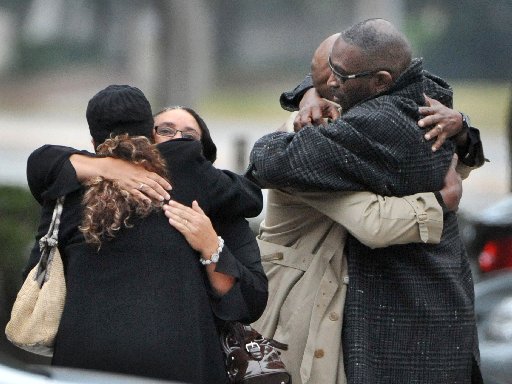
The attorney for the family of Jordan Davis, the unarmed black 17-year-old shot and killed last Friday by a white gun collector in Florida, said the case isn’t about race as many have asserted. Rather, he said it’s about love, hate, and hard lessons learned from another high profile and racially charged killing.
In a rare interview since Davis’ killing on Nov. 23, John Phillips, a personal injury and wrongful death attorney in Jacksonville, Fla., talked with msnbc.com about the teen’s tragic death, the somewhat cheerless pas de deux between lawyer and the media in such cases, and the comparisons Davis’ killing have drawn to the case of Trayvon Martin.
“This isn’t a race case. It isn’t about black and white, it’s about love and hate,” Phillips said. “The main thing right now is trying not to make it too, not to foster any hate. That’s a lot of what came out of Trayvon.”
Davis’ killing, and his killer, Michael Dunn’s claims of self-defense, have resurrected the not-so-deeply buried bones of the Martin case, in which George Zimmerman claims he also killed Martin in self-defense.
Both cases seemed to have evolved into mandates on race relations and the state’s controversial Stand Your Ground laws, which give people wide discretion in the use of lethal force.
But the cases also speak to the way loved ones, concerned citizens, and oddly, even lawyers have used social media to push their respective agendas.
Martin’s family was ubiquitous on the cable news and in newspapers across the country in the aftermath of the shooting. Zimmerman’s defense set up a website to “counter misinformation,” Facebook and Twitter pages, and used the web for fundraising.
But the media was also used to attack Martin’s character and reveal Zimmerman’s violent past. A white supremacy group even hacked Martin’s personal Twitter account.
Phillips said he’s moving cautiously and is wary of overexposing Davis’ family.
“Otherwise you’re just exposing your soul every time,” Phillips said in a telephone interview from his Jacksonville office. “The media starts off like a little fish that has to eat the bigger fish, that has to eat the bigger fish. At some point that fish might get so big it turns and bites you.”
“With Trayvon it took 17 or 18 days before it took off as a big national story,” he added. “This one became a story within two or three days and that just spontaneously interrupts the family’s grieving and mourning when you have to be worried about a press conference.”
Phillips said he respects Benjamin Crump, the attorney representing Sybrina Fulton and Tracy Martin, Martin’s mother and father, but said he learned a tough lesson in watching how the media and supporters of Zimmerman pounced on the family so publicly.
“They gave us a dry run of what could happen here. It gave the family a basis of understanding of how you aren’t a public figure, how you have not in any way wanted to become a public, but how you can become roped and pulled into it whether through social media or any other media,” Phillips said.
Crump said he has also been in contact with the Davis family and that he is open to helping in any way that he can. He said that while there are similarities in the cases, including sketchy assertions of self-defense, the two cases are worlds apart in the way they’ve played out in the media in the aftermath of the killings.
“It’s a little different what he’s got,” Crump said, referring to Phillips. “He’s got an arrest. With Trayvon Martin they weren’t going to arrest Zimmerman. Martin’s parents had to be present in the media to say that authorities are not going to arrest the killer of their unarmed child. They were forced to do interviews to get simple justice. [Jordan’s family] got an arrest without having to do that.”
Michael Dunn, 45, allegedly shot and killed Davis after a verbal altercation over loud music playing from the SUV that Davis and three of his friends were sitting in at a Jacksonville gas station, according to police.
There was some sort of verbal exchange, the police said, then Dunn took out a handgun and fired several shots at the teens. Two bullets struck Davis. Dunn fled the scene and was later arrested 175 miles south in Satellite Beach, where he was charged with second-degree murder and attempted murder.
He has pleaded not guilty and his lawyer has told reporters that Dunn feared for his life, believed the teens were armed, perhaps gang members, and that he reacted “as any responsible gun owner” would have reacted. Despite Phillips plea to avoid the race trap, the case is rife with racial overtones. Robin Lemonidis, Dunn’s attorney, told reporters that Dunn saw a shotgun barrel poke from behind a cracked window of the teens’ vehicle. “And it’s–all he sees are heavily tinted windows, which are up and the back windows which are down, and the car has at least four black men in it,” Lemonidis said. “And he doesn’t know how old anybody is, he doesn’t know anything, but he knows a shotgun when he sees one.” But Phillips, who is white and a friend of the Davis family, said that the killing is less about racial animus and more about hate and one person killing another without provocation. “To me it’s kind of the state of the world now, the criminal defense attorney is spewing hate before the young man is even in the ground,” Phillips said. He called Davis a “good kid” who was home schooled by his mother in Georgia before moving in recent years to live with his father, Ron Davis, in Jacksonville. The elder Davis retired from Delta airlines after 20 years, Phillips said. “Jordan was loved by both parents. It is both a beautiful story and a tragedy,” he added. “I honestly believe if this doesn’t shake up this country nothing will. If this doesn’t say, why, why are we so in to instant gratification… why are we so callous that we react without an action. It’s just awful.” Phillips said the young man’s death has fogged over the joy of holiday planning. The office holiday party, DJ and all, is scheduled for today. And the Toys for Tots drive that has filled his office with a sea of bright colors and soft, fuzzy things, seem less warm and fuzzy given the case. On Friday, Phillips’ added that after 12 years of personal injury and wrongful death cases, ” this is perhaps the most wrongful death I’ve ever worked on.”
Trymaine Lee
Trymaine Lee is an NBC News correspondent. Recommended


