








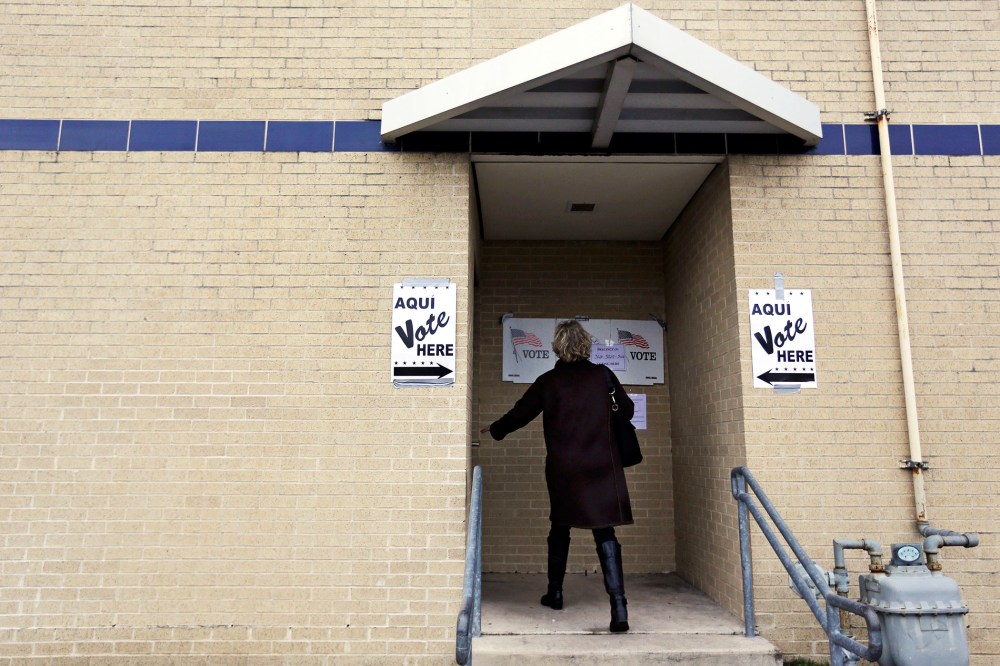
The laws sound innocuous, even boring. Requiring photo identification to vote, or hospital credentials to perform an abortion. Changing building requirements for clinics, or schedules for elections.
But seen together, state measures that have swept the nation in recent years restricting access to voting and to abortion could represent some of the keenest successes of the conservative movement and the Republican Party.
The bulk of these restrictions have been passed since Republicans took control of a slew of state legislatures in 2010: Voter ID laws were passed in states like Texas, North Carolina, and Wisconsin, along with cuts to early voting in several more. Medically unnecessary restrictions have also been placed on abortion clinics in all three of those states, and similar laws threaten to close clinics in Louisiana, Alabama and Oklahoma.
Many of the laws intentionally push the legal envelope, and are now wending their way through the federal courts.
Texas has been ground zero for both crusades. In 2011, the state passed the nation’s strictest voter ID law, dubbed a “poll tax” by Attorney General Eric Holder, which is currently being challenged in federal court. In recent years the state has also passed restrictions on voter registration drives. Texas is also the living laboratory for the right’s attempt to end legal abortion. It is the only state where a federal appeals court has allowed about half of the state’s clinics to close. Doctors, thanks to opposition to abortion at local hospitals, were unable to comply with the requirement that they have admitting privileges there.
But the striking parallels go well beyond the Lone Star State.
On both abortion and voting, key progressive achievements thought to have been decisively settled decades ago during an era of relative liberal supremacy are now under threat.
“These are two of the most significant movements to roll back rights going on in the country right now,” said Wendy Weiser, director of the Democracy Program at the Brennan Center for Justice. Combined, she said, efforts to restrict voting and abortion rights “go contrary to the general trajectory of American legal history, of rights expanding…and I think that should be alarming to people.”
The 1965 Voting Rights Act (VRA) appeared to settle the question of access to the ballot for good. But the law was badly weakened by the Supreme Court last year in Shelby County v. Holder, a ruling that smoothed the path for a sequence of restrictive state voting measures—including Texas’s — to advance in its wake.
A woman’s right to end her pregnancy until fetal viability was asserted by the Supreme Court in Roe v. Wade in 1973. But the court subsequently watered down the right with later decisions that have left lower court judges with relatively free rein.
Strategically, the campaigns around each issue have been similar, too. In both cases, conservatives have largely taken a piecemeal approach, patiently chipping away at their targets instead of going for everything at once.
Having neutered a key piece of the VRA last year in Shelby, they’re now looking to narrow the law’s most important remaining provision. In the Texas voter ID trial, lawyers for the state have explicitly argued that the VRA should cover only intentional discrimination, not actions that have the effect of discriminating—a change that would make the law all but useless.
Similarly, by forcing clinics and doctors out of business rather than trying to ban abortion outright—futile under the Roe decision—they’re gradually making it harder and harder for women, especially those who are poor and live in rural areas, to get an abortion.
“It’s a ‘death by 1000 cuts’ strategy,” said Heather Gerken, a professor at Yale Law School. “For both of these rights, you’re not allowed to ban it. So in each instance you’re just making it harder than it would be otherwise.”
Then there are the justifications given to support these restrictive laws: Both the anti-voting and anti-abortion campaigns use reasonable-sounding but bogus rationales to obscure their real aims.
Supporters of voter ID laws frame their efforts as designed to prevent voter fraud, even though expert studies make clear that in-person voter impersonation—the only kind of fraud that an ID requirement prevents—is virtually nonexistent. And abortion opponents claim they’re motivated by the threat to women’s health posed by sub-standard clinics—despite the fact that abortion is already an extremely safe procedure, and the American Congress of Obstetricians and Gynecologists say laws shutting down clinics make women less safe, not more.
“In both cases,” said Weiser, “the public argument hasn’t been direct and on honest terms about what’s really at stake.” That sleight-of-hand doesn’t just muddy the public debate and invent a public crisis, it also puts the courts in a difficult position. Generally speaking, said Gerken, judges defer to legislators about the motive behind a law. “As long as there could be a reasonable explanation for it, then you’re allowed to do it,” she said. “The trouble with [restrictions on] voting and abortion is that there is almost always an unreasonable explanation for it,” Gerken continued. “And that puts the courts in this bind.” Even the legal standard by which these laws are being judged is often similar, with their challengers pointing to their impact on low-income people and people of color. The current test for whether an abortion restriction is constitutional is if it places an “undue burden” on women—which can be in the eye of the beholder. In the recent Texas abortion clinic case, a demographer and sociologist testified to the particular burdens on low-income women, particularly Latina women, who would have to travel at least 250 miles for an abortion if the law were to go into effect. In Texas’s voter ID trial, meanwhile, the plaintiffs have put on witnesses who are experts on travel times and on calculating economic costs, in an effort to show that having to obtain an ID as an unreasonable burden—the issue on which the case will likely turn. Some courts are even applying legal theories developed to bar racial discrimination—a doctrine now under threat, of course—to abortion cases. To keep Mississippi’s last abortion clinic open, the Fifth Circuit Court of Appeals recently drew on a 1938 Supreme Court decision against a Jim Crow-era policy, which said Missouri couldn’t bar an African-American man from attending a whites-only law school, just because he could theoretically go to another state. In 2012, Mississippi had passed an admitting privileges requirement the clinic was unable to comply with, but argued women could just go out of state for an abortion. The Fifth Circuit said the state could not delegate the constitutional rights of its citizens to another state, as Missouri had tried to do to black residents in 1938. Less explicitly, in striking down Alabama’s admitting privileges law in August, district court Judge Myron Thompson focused on the violence, including bombings and murder, that Alabama abortion providers have been subject to over the decades. Yale law professor Reva Siegel argues that Thompson was implicitly evoking decades of Southern aggression against African Americans who attempted to vote, which eventually helped give rise to the Voting Rights Act. “I think that the judges that are trying to resolve constitutional rights in the south around questions of abortion are putting them in the context of protection of race equality in the south,” said Siegel. “You could say these judges are evoking the nation’s memory, of the kinds of intimidation leveled at individuals exercising their constitutional rights.” One thing is clear from the comparison: Neither of these onslaughts happen in a vacuum—these are deliberate and premeditated strategies. They begin with model legislation from groups like American United for Life, or with dubious scholarship from leading supporters of voting restrictions, then get adopted by enthusiastic legislators in each state. When they end up in court, they’re taken up by advocates skilled at employing far-reaching legal claims aimed at further shifting the terrain in a conservative direction. “Rather than thinking that these are just inevitable outcomes that happen naturally, it was a strategy that somebody employed,” said Weiser. “If people understand that, they might be better able to push back against it if they disagree with it.”
Zachary Roth
Irin Carmon Recommended


