








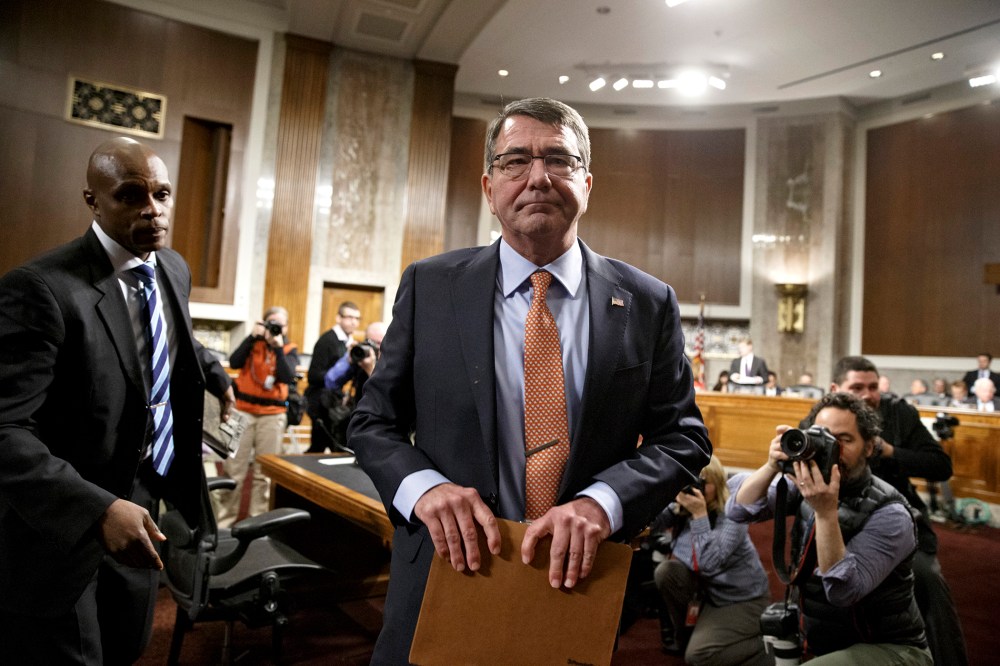
The likely next secretary of defense said he supports arming Ukrainians in their fight against Russian-backed rebels.
“We need to support the Ukrainians in defending themselves,” Ashton Carter said at his confirmation hearing in front of the Senate Armed Services Committee, adding: “I am inclined in the direction of providing them with arms, including . . . lethal arms.”
The Obama administration has so far held off on providing weapons for fear of escalating the conflict. But a growing chorus of voices from inside and outside the Pentagon has been urging the White House to change that policy, with Russia aggressively backing the rebels.
Carter, 60, a physicist and former Defense Department no. 2, is widely expected to be confirmed in place of the outgoing Defense Secretary, Chuck Hagel. At one point during her questioning, Sen. Kelly Ayotte (R-N.H.) slipped up and addressed the nominee as “Secretary Carter.” Ayotte quickly corrected herself: “Soon-to-be Secretary,” she said.
Related: Obama nominates Ashton Carter for defense secretary
Still, Carter’s endorsement of the Obama administration’s Syria strategy—arming and training moderate rebels to take on the Islamic State of Iraq and Syria (ISIS) and ultimately the Assad regime —prompted an angry reaction from Sen. John McCain (R-AZ), the committee chair.
“Training young Syrians … and sending them into Syria to be barrel-bombed by Bashar Assad — the morality of that along … is in contradiction to everything the United States ever stood for or fought for,” said McCain.
And McCain slammed the strategy of cooperating with Iran to fight ISIS as “idiocy.”
In a separate exchange, Carter acknowledged and stressed the threat presented by Iran.

“I believe we have two immediate substantial threats in the Middle East. One is ISIL and one is Iran,” Carter said, using an alternative acronym for ISIS. “There is an issue looming over all this which is the role of Iran in the region … that is a serious complication.”
Questioned by Sen. Roger Wicker (R-MS), Carter said the challenges in the middle east and Ukraine are no reason to reconsider the administration’s strategy of a “re-balance” toward a focus on the Asia-Pacific region.
“While ISIL and events in Ukraine are terribly important in their own regard and require a lot of attention…we have to remember that half the population of the world and half its economy is in [the Asia-Pacific] region.”
“The world needs to know the U.S. can do more than one thing at once and we can keep our commitments there,” Carter said. Separately, Carter urged senators to reverse the hundreds of billions in automatic cuts to the defense budget that were set out in the sequester agreement between Congress and the White House. But he also pushed lawmakers to find savings by eliminating waste and inefficiency in the budget. “The taxpayer cannot comprehend, let alone support, the defense budget, when they read of cost overruns, lack of accounting and accountability, needless overhead, and the like,” he said. “This must stop. Every company, state, and city in the country has had to lean itself out in recent years, and it should be no different for the Pentagon.” Just last week, the Joint Chiefs of Staff had painted a different picture before the same committee, warning darkly that cuts to the military budget could leave the U.S. unable to effectively defend itself. Under questioning by Sen. Kirsten Gillibrand (D-N.Y.), Carter stressed his concern about the ongoing problem of military sexual assault, which Gillibrand has drawn attention to in recent years. “I have the same passion you do,” on the issue, Carter told the senator. “These are violations of honor and trust,” Carter added. “We’ve got to root it out.” And Carter appeared to nod to the frequent Republican criticism of President Obama for not listening to the counsel of Pentagon officials when he assured lawmakers he would give the president “my most candid strategic advice.”
Zachary Roth Recommended


