








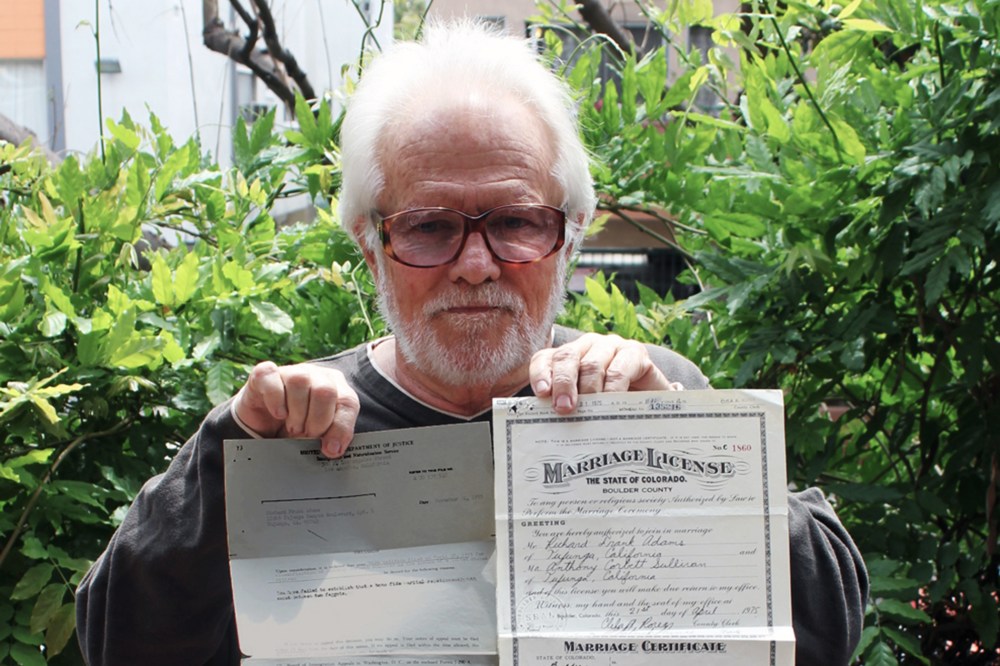
Nearly four decades before the nation’s highest court ruled in favor of gay rights activist Edie Windsor, clearing the way for federal agencies to begin recognizing same-sex marriages, another arm of the U.S. government had this to say about a lesser-known pioneering couple:
“You have failed to establish that a bona fide marital relationship can exist between two faggots.”
That was all the former Immigration and Naturalization Service (INS) wrote in a single-sentence green card denial to Richard Adams, a U.S. citizen, who had requested permanent residency for his Australian spouse, Anthony Sullivan. The two were among a half-dozen same-sex couples to obtain marriage licenses from the Boulder County clerk’s office in 1975, well before Colorado enacted its ban on such unions. They went on to sue (and lose) in the first federal case against the U.S. government seeking recognition of a same-sex marriage — something that would not be won until the Windsor ruling of 2013. Adams did not get to see that landmark decision, however, having lost another battle — this time, to cancer — six months before.
On Monday, 39 years to the day after the two were married, Anthony Sullivan asked the Los Angeles Field Office of U.S. Citizenship and Immigration Services (USCIS) to reopen his late-husband’s petition for a marriage-based green card. The 72-year-old has lived in the shadows without lawful status for years — unable to travel outside the country, and always with the threat of deportation hanging over his head. But now, Sullivan is requesting that USCIS retroactively approve his green card application and automatically convert it to a widower’s petition, allowing him the opportunity to live out the rest of his life legally in the place he calls home.
“We want what I consider to be a dark chapter in the history of immigration services to be corrected,” said Lavi Soloway, Sullivan’s attorney and cofounder of The DOMA Project, to msnbc. In denying Adams and Sullivan’s request for a green card, “INS used an epithet that most of us would never imagine saying,” he continued. “Anthony and Richard, who were together as a couple for 41 years, didn’t deserve that. Nobody deserves to be treated that way.”
Should Sullivan be successful, it would mark a major victory to his decades-long quest for permanent residency in the United States. But it would also bring much longed-for validation to his relationship with Adams and to thousands of other same-sex couples cast aside by years of anti-gay policies, now fading into history.
“This was the first time that a gay couple walked into federal court and demanded to be treated equally under the law,” said Michael Sisitzky, staff attorney at Immigration Equality, to msnbc. “It was a really groundbreaking case. Unfortunately at the time, it did not end as well as the Windsor case did.”
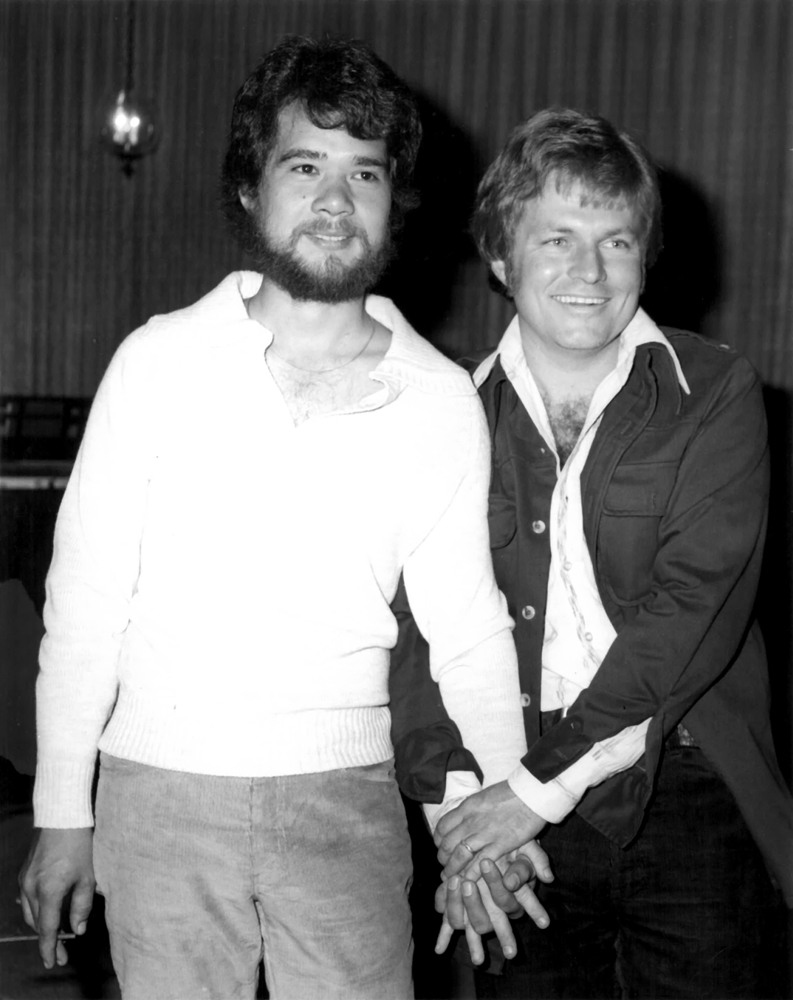
Last June, in United States v. Windsor, the U.S. Supreme Court struck down a central provision of the 1996 Defense of Marriage Act, which limited nuptials to unions between one man and one woman. Since then, eight federal judges have overturned part, or all of similar bans at the state level based on the high court’s legal reasoning. Additionally, federal agencies — including the State, Defense, Treasury, and Homeland Security Departments — have all updated their policies to begin treating every marriage equally, including those between gay couples. Public opinion has shifted dramatically, too, with a majority of Americans now in favor of the idea, according to a recent survey by the Public Religion Research Institute.
Based on these trends, Sullivan’s legal team is confident their motion to reopen his green card application will be successful.
“We’re in a different time,” said Soloway. “The Supreme Court ruling last year established that the Constitution’s guarantee of equal protection extends to married same-sex couples. What that means is that the constitutional rights of Richard and Anthony in 1975 were violated. Our motion today gives the administration and the country an opportunity to repudiate that denial, and those words, and the idea that you could belittle and diminish people that way.” Still, current immigration law may continue to pose challenges for Sullivan. In the Immigration and Nationality Act, as Sisitzky explained, a surviving spouse of a U.S. citizen can proceed with their petition for permanent residency as long as that petition was pending at the time of death. In this case, the petition had already been denied when Adams passed away, meaning Sullivan’s team would first have to get it reopened before moving forward — a process that invites added discretion on part of the USCIS. “Richard and Anthony’s case is a very clear example of what kind of impact timing has,” said Sisitzky. “Had the DOMA decision come down while Richard was still with us, he could have filed the standard kind of petition, and there wouldn’t be the uncertainty with the widower process. There are countless other families who completely uprooted themselves because they couldn’t see a future. Many families left the country, went into exile, and are now facing the prospect of having to apply for really complex waivers.” Additionally, because less than half of the U.S. has legalized same-sex nuptials, gay binational couples face the added challenge of having to travel in order to obtain the necessary marriage certificate for a green card application. In these situations, health concerns and interior checkpoints become a problem. “This issue is not over yet,” said Tom Miller, director of “Limited Partnership,” the forthcoming documentary about Sullivan and Adams. “In certain states, foreign partners can come in, marry, and get a green card. But in all those other states [where marriage is limited to heterosexual couples,] it’s still illegal. When the U.S. Supreme Court rules that all states should have recognition of gay marriage, then this issue will go away. That hasn’t happened yet.”
Emma Margolin
Emma Margolin is a reporter at MSNBC.com. Recommended


