








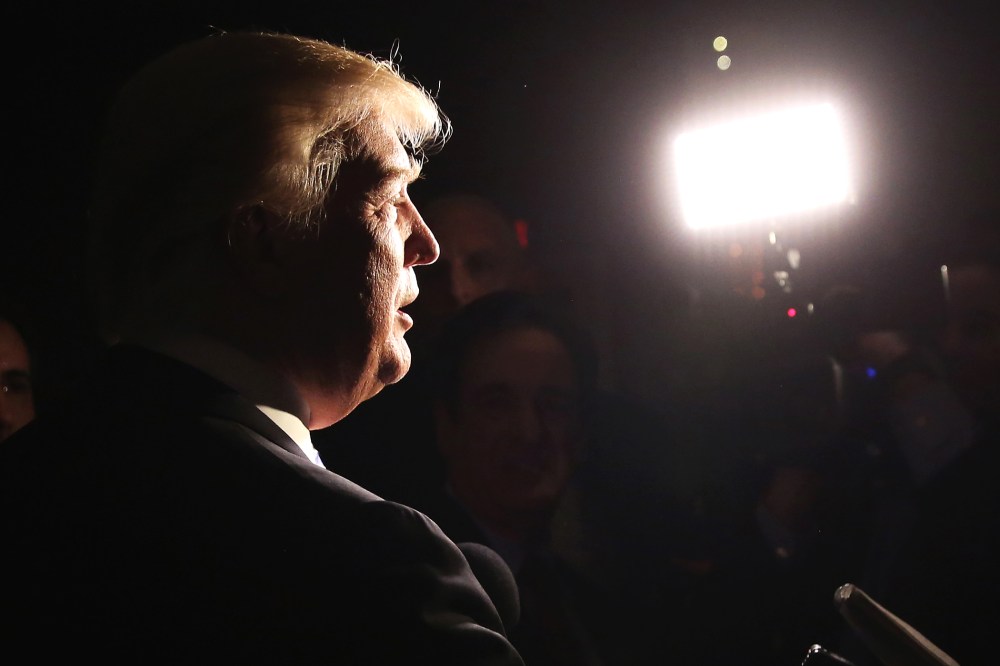
After tiptoeing gently around Donald Trump for weeks, Republican leaders and conservative commentators are confronting him over his behavior in increasingly personal — and even moral — terms.
“When a candidate under the Republican banner would abandon the tradition of magnanimous leadership of the presidency, when he would seek to demonize millions of citizens, when he would stoop to attack POWs for being captured, I can only ask as [Joseph Welch] did of Senator McCarthy, ‘Have you no sense of decency, sir?’” Texas Gov. Rick Perry said in a barn burner speech on Wednesday denouncing “Trumpism” as a “cancer” on the GOP. (A spokeswoman for Trump declined to respond.)
RELATED: Rick Perry: Trump’s candidacy a ‘cancer on conservatism’
“When is Donald Trump going to stop embarrassing his friends, let alone the whole country?” News Corp CEO Rupert Murdoch, one of the most influential figures in conservative media, tweeted on Saturday.
The answer: Not anytime soon. Trump has so far proven immune to public disapproval, responds to all criticism with overwhelming force – he gave out Senator Lindsey Graham’s cell phone number in a speech after Graham called him a “jackass” – and has a large personal fortune that means he doesn’t have to rely on anyone for fundraising.
When is Donald Trump going to stop embarrassing his friends, let
alone the whole country?
— Rupert Murdoch (@rupertmurdoch) July 19, 2015The billionaire real estate mogul’s unmitigated boorishness is fascinating in just how much it upsets the political system we normally take for granted. So much of the current order is undergirded by an unspoken sense of shame — an environment where even the most megalomaniac politicians are expected to apologize for offensive behavior or even resign when they face enough criticism from their allies. In this setting, Trump’s total disregard for these barriers is something akin to a superpower.
This is, of course, the key to Trump’s appeal as well as his biggest liability. For a subset of conservative voters who view even the slightest concession of respect to your political opponents as capitulation, Trump’s unrestrained trolling is a breakthrough. He’s Neo bending The Matrix to his will.
Watching the unfolding mayhem, I’m reminded of a conversation I had in college in the early 2000s with a friend from Europe who had never visited the United States until then. We often talked politics and my attempts to explain the day’s biggest news story would regularly boil down to some variation of “If this is true, it will be embarrassing for the party,” or “This could really embarrass that candidate.” One day, she became exasperated. “Stop saying ‘It’s embarrassing,” she said. “Why does it matter?”
It was a provocative question. Sometimes there are concrete political consequences to public disapproval — lost elections, lost votes in Congress, lost donors or endorsements. Just as often, however, scandalized politicians or staffers abandon ship long before it reaches that point rather than suffer through more indignity.
RELATED: Making sense of Donald Trump’s bump in the polls
Public shaming from Democratic leaders is what compelled a politician as brazen as Anthony Weiner to leave Congress after posting a lewd photo on Twitter and lying about it — even though he could have won re-election if he went rogue and stayed. Shame is what compelled Herman Cain, another circus presidential candidate, to leave the 2012 race amid multiple allegations of sexual harassment despite still enjoying a significant base of support on the right.
Republicans%20can%20only%20go%20so%20far%20in%20ostracizing%20Trump%20as%20long%20as%20he%20can%20credibly%20threaten%20to%20run%20as%20an%20Independent%20%E2%80%94%20a%20nuclear%20option%20that%20would%20likely%20doom%20whoever%20wins%20the%20Republican%20nomination%20in%20the%20general%20election.’ Lara Brown, an associate professor at George Washington University’s Graduate School of Political Management, has spent years researching the role of scandals and campaign rhetoric and argues that party leaders have grown even quicker during the last decade to apply public pressure to members whose behavior drags down the party. The electorate is more polarized and fewer voters split their tickets, meaning any damage to the national party’s brand — whether it’s from a presidential candidate or a backbencher whose inflammatory quotes spread on social media — threatens to hurt candidates up and down the ballot. “All politics have become national, and national party brands are much more on the minds of party elites,” Brown told msnbc. “Party leaders engage in something of a public shaming in an effort to protect the national party’s reputation and that’s a somewhat recent development.” A prime example is Todd Akin, the 2012 Missouri Senate candidate who national Republican leaders disowned and unsuccessfully tried to push out of the race over his comments on rape and pregnancy, for fear that he would tarnish candidates around the country. Their fears proved justified: He ended up losing his race by a wide margin while another GOP Senate candidate, Indiana’s Richard Mourdock, lost in an upset after stumbling through a similar question on rape exceptions for abortion raised by the Akin story. RELATED: Donald Trump escalates war with Lindsey Graham Trump now threatens to pull an Akin on a presidential level by wrecking the party’s image with immigrant communities its leaders have struggled to court or, more generally, projecting a lack of seriousness to swing voters. The party wasn’t able to convince Akin to fall in his sword in 2012 even though they had significant leverage over him in the form of advertising money and party backing. In Trump’s case, he doesn’t need the party’s money, he’s impervious to appeals from any Republican elders, and he benefits from bad press almost as much as good press, if not more. And, despite Perry’s best effort on Wednesday, Trump will definitely not be convinced he’s in the wrong morally. Making matters worse, Republicans can only go so far in ostracizing Trump as long as he can credibly threaten to run as an Independent — a nuclear option that would likely doom whoever wins the Republican nomination in the general election. What Republican leaders are left with is a candidate with no regard for the political rules of the road and a party with no authority to enforce them. It’s like watching Batman interrogate the Joker in The Dark Knight — he slams his head on the table, throws him against the wall, and threatens him with worse only to watch him respond with laughter: “You have nothing, nothing to threaten me with!” In the end, only Trump can stop Trump.
Benjy Sarlin Recommended


