








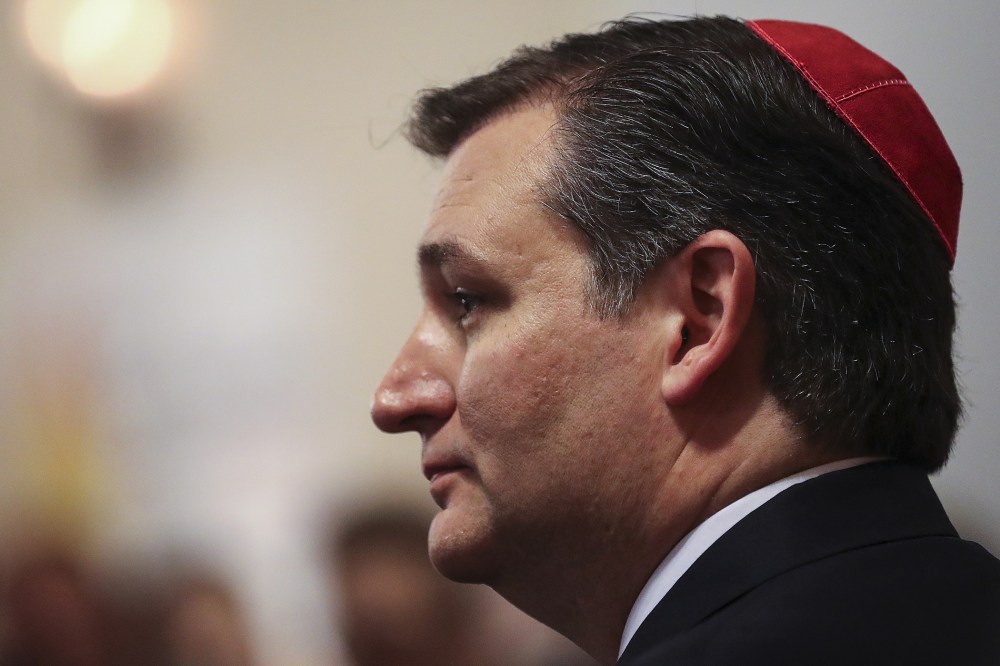
The sea of black hats and yarmulkes parted as Ted Cruz’s SUV turned into the driveway of the Chabad Neshama Center in Brooklyn’s Brighton Beach.
Indeed, few entrances could have been more fitting for the Republican presidential candidate arriving to make matzo with a groups of kids two weeks before before Passover, a holiday commemorating the Jewish people’s exodus from Egypt.
As he stepped out of the car and into the neighborhood nicknamed “little Odessa,” the roughly 100 or so Orthodox Jews gathered outside erupted in cheers and chants of “Jews for Cruz.”
It’s a crucial slice of support on which Cruz hopes to capitalize during New York’s April 19 primary.

To many, the effort must look like a waste of time. How could Cruz, a Southern Baptist, do well enough among Jewish voters, who overwhelmingly support Democrats, that he overtakes Donald Trump in Trump’s home state?
But Cruz isn’t trying to win the state: he’s trying to peel off as many delegates as possible in order to try and force a contested convention. If Trump is unable to reach a majority of delegates nationwide, the convention puts the nomination in the hands of thousands of party insiders who would vote again and again until one candidate reaches a majority. So while Trump is still the odds-on favorite to win the state, Cruz’s deliberate, delegate-oriented campaigning might just dull the blow.
The Texas senator is targeting the state’s heavy Orthodox Jewish population, its most conservative districts upstate and those New York City districts with the fewest registered Republicans.
To be sure: Cruz is already swimming upstream in New York. He made his disdain for the state quite clear back in January, running an ad against Trump that mocked his “New York values.”
“He may have been trying to make an ideological attack, but instead, he attacked him for where he comes from, and that’s how New Yorkers took it,” New York-based Republican strategist John McLaughlin said. “He definitely made a mistake attacking them — it may have been a good idea somebody thought about in Iowa, but it hasn’t gone away.”
The New York Daily News cover told Cruz to take the “F U Train” after campaigning here on Wednesday, and the state’s longtime Republican congressman Rep. Peter King slammed him, saying New Yorkers considering voting for Cruz “should have their head examined.”
RELATED: 10 most scathing NYC tabloid covers this election season
Still, the state’s delegate allocation rules and quirky congressional districts may work in Cruz’s favor.
“There’s parts of NYC where there’s virtually no Republicans voting. By congressional districts, you can pick off a delegate with 2,000 votes,” Republican strategist Susan Del Percio of New York told MSNBC, noting that New York’s 8th Congressional District – where Brighton Beach is – is in a district with just 27,000 registered Republican voters. Cruz’s campaign strategy signals his interest in these sparsely conservative districts. He campaigned on Wednesday in the Bronx, where there’s just 17,000 Republicans in the state’s 15th District, and after making matzo, Cruz headed to meet with Brooklyn business owners at a Marriott near the Brooklyn Bridge. That’s in the state’s 7th District, which has 19,000 registered Republicans.
Low turnout is typical in the Empire State’s Republican primaries. While this year’s close race will surely get voters to the polls, the state’s primary is unusually early this year. Strategists predict that turnout could be anywhere from 10 to 30 percent, meaning that thousands or maybe even hundreds of Republican voters could decide these delegates’ fate.
While the state’s overall winner gets 14 delegates, New York doles out the other 81 delegates proportionally: A candidate who wins a majority of the vote earns all three of that district’s delegates. It’s a key threshold for all the candidates — if the winner gets under 50 percent of the vote, the second-place candidate earns a delegate too.
“Even though it’s considered Trump’s, the threshold to get delegates is 50 percent,” McLaughlin said. If Trump “doesn’t get 50 percent in the 27 congressional districts, though he may win, he’ll only gets two delegates.”

The third delegate? It’ll go to Cruz if he can come in second in those districts.
Meanwhile, Trump has cleared his schedule to focus on his home state of New York.
“It’s almost as if he’s admitting that if he doesn’t get enough delegates in New York, it’s going to be an open convention. That’s why he’s putting a priority on New York — he’s trying to seal the deal. He knows if he can’t sweep it, it’s going to be an issue,” Del Percio said.
A Trump aide told NBC News that while the front-runner currently needs to reach a high bar of 58 percent of all the delegates going forward to reach a majority, “after we win New York, that number drops to 52 percent. And Ted Cruz’s number goes up to almost mathematically impossible.”
But Cruz is doing everything he can to thwart Trump’s path to the nomination.
“We’re reaching out to the community — obviously the Jewish Orthodox community is really important here,” said Catherine Frazier, Cruz’s press secretary, when asked to elaborate on the campaign’s outreach efforts in New York. “We have a congressional district chair in every district in New York and people here on the ground organizing, working, making connections every day.” RELATED: What I saw at Donald Trump’s homecoming rally Since he arrived in the Senate, Cruz has been aggressively courting the support of Jewish voters, particularly those who are Orthodox and far more conservative than the rest of the Democratic-leaning demographic. At a 2014 dinner for In Defense of Christians, a group that raises awareness about persecuted Christians in the Middle East, Cruz walked off the stage after the crowd started booing his pronouncement that Christians have no greater ally than Israel. “If you will not stand with Israel, then I will not stand with you,” Cruz said. Rabbi Zev Reichman, who came in from Englewood, New Jersey, with his son to see Cruz at the Chabad Neshama Center Thursday, remembers that moment as a turning point in Cruz’s relationship with the Jews. “For the Jewish community, that showed that he gets it,” Reichman said. “He loves freedom and freedom-loving people, and the Jewish community loves him in return.” Though Orthodox Jews make up only 10 percent of all American Jews, according to a 2013 Pew survey, they account for a larger share of the Jewish population in New York. In 2011, USA-Federation of NY found that the fraction of New York Jews who identify as Orthodox increased from 27 percent in 2002 to 32 percent nine years later. Most Orthodox Jews are Republican, the Pew survey found, presenting an important opportunity for Cruz to pick up GOP delegates in a primary state where they are awarded proportionally by congressional district. “I presume part of why he’s doing this is he’s hunting for delegates,” said Nathan Diament, head of the Orthodox Union, of Cruz’s matzo-making excursion. “He could pick up a few delegates in Brooklyn if he runs in key areas. The Orthodox community and Russian immigrant community in Brighton Beach are areas that would be ripe for him to do that.” Compared to other neighborhoods in Brooklyn, Brighton Beach is not especially Orthodox. But watching Cruz shout “holy matzo” as he described the signature holes in the unleavened bread or don a red yarmulke emblazoned with “Cruz 2016,” it was clear whom he’s courting. Outside the Cabad Neshama Center, many of the Orthodox Jews gathered in front said they liked Cruz’s positions on Israel, ISIS and the Constitution. “He’s a principles guy,” said Moshe Lebowitz of Williamsburg, Brooklyn. “I believe he has real values — strong family values, strong moral values,” said Daniel Kestenbaum of Borough Park, Brooklyn. “I was very impressed how he stood by Israel.” Many were anxious about the alternatives. “I think he’s telling the truth,” said Isaac Grazi, who waited for Cruz with his wife and four kids. “That’s more than I can say for the other guys who are left.”
Jane Timm
Emma Margolin
Emma Margolin is a reporter at MSNBC.com. Recommended


