








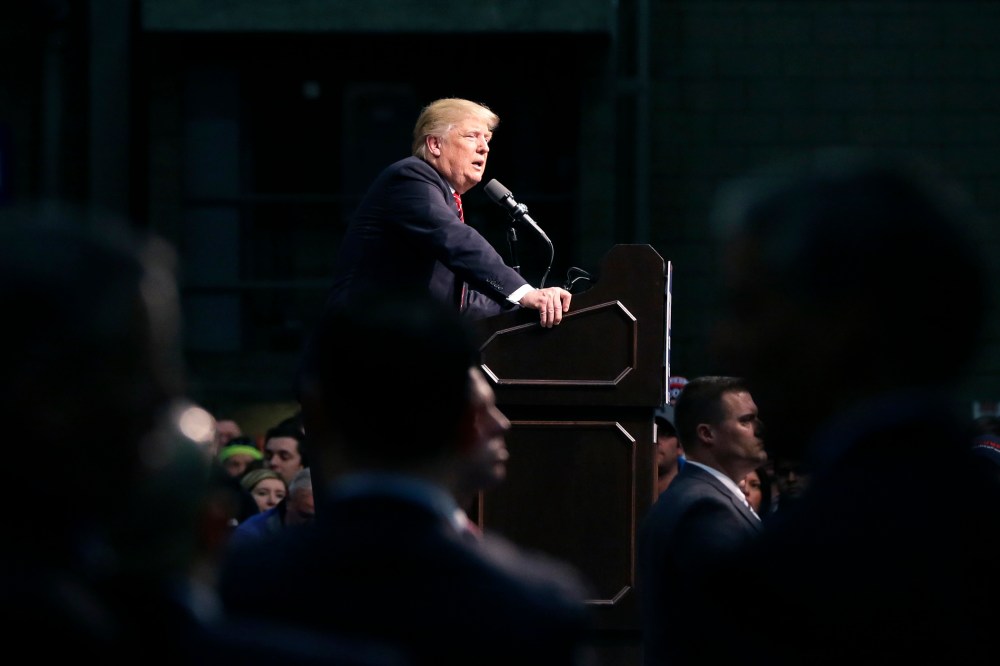
WASHINGTON – Donald Trump, known for his total disregard of political and social pieties, will address one of the most sensitive election-year forums in America on Monday: The American Israel Public Affairs Committee.
AIPAC, the pro-Israel group, works hard to maintain an air of bipartisan unity at its events even as conflicts over Iran between the Obama administration and the Netanyahu government in Israel have raised tensions. Vice President Joe Biden addressed the group on Sunday and Democratic candidate Hillary Clinton spoke Monday morning. Trump and his remaining GOP presidential rivals Ohio Gov. John Kasich and Sen. Ted Cruz were scheduled to speak Monday evening.
Trump’s relationship to Israeli politics and the American Jewish community is complicated.
A major question mark heading into Trump’s AIPAC speech is how he’d manage the Israeli-Palestinian conflict as president. The GOP front-runner has portrayed himself as enthusiastically “pro-Israel,” but has broken from other Republicans in promising to be a “neutral” negotiator in an effort to reach a peace deal.
“I’m a negotiator. If I go in, I’ll say I’m pro-Israel and I’ve told that to everybody and anybody that would listen,” Trump said at a Republican debate March 10. “But I would like to at least have the other side think I’m somewhat neutral as to them, so that we can maybe get a deal done. Maybe we can get a deal. I think it’s probably the toughest negotiation of all time. But maybe we can get a deal done.”
RELATED: Group of rabbis plan boycott of Trump speech
The GOP has shifted harder to the right on Israel in recent years and Cruz has excoriated Trump’s position, arguing that Palestinian terrorism and intransigence should prompt the US to openly side with Israel. Clinton, with her long record of public support for Israel, critiqued Trump’s stance in her speech Monday morning.
“We need steady hands, not a president who says he’s neutral on Monday, pro-Israel on Tuesday and who knows what on Wednesday because everything’s negotiable. Well, my friends, Israel’s security is non-negotiable,” Clinton said.
One influential hawk who appears to have warmed to Trump is casino billionaire Sheldon Adelson, who funds a variety of pro-Israel causes. As the Israeli political press has noticed, Adelson’s tabloid Israel Hayom – which often serves as a mouthpiece for his politics – has featured glowing coverage of Trump in recent days.
Within Israel, though, Trump’s far right rhetoric and proposals regarding Muslims have earned him tough criticism from across the political spectrum. Israeli lawmakers in multiple parties, including Netanyahu’s own Likud, condemned Trump for denigrating the country’s large minority of Muslim citizens after he called for an indefinite ban on Muslims entering the United States.
The outcry forced Netanyahu to publicly distance himself from Trump in December. Trump cancelled a planned trip to Israel shortly afterwards amid warnings from national security experts that his visit would inflame tensions in the region even further.
Trump was booed the same month at a Republican Jewish Coalition forum in Washington when he refused to say whether he considered Jerusalem to be the capital of Israel. He backed away from that position in January in favor of moving the American embassy to Jerusalem, a controversial decision because many peace proposals assume that Jerusalem will be divided between Israelis and Palestinians. No country currently keeps its embassy in the city.
At the RJC event, Trump also raised eyebrows with a series of jokes about business leaders and Republican donors in the room that drew laughs from the audience but flirted with stereotypes.
“You’re not going to support me because I don’t want your money,” Trump told the crowd. RELATED: Trump draws boos, applause as GOP candidates court Jewish Republicans The Anti-Defamation League, a group that combats intolerance and has been strongly critical of Trump’s rhetoric, defended his remarks at the time, however, noting that he was referring to specific acquaintances in the room. Trump is a lifelong resident and longtime celebrity in New York, the center of Jewish life outside of Israel. His daughter Ivanka Trump converted to Judaism after marrying publisher and real estate developer Jared Kushner, a fact Trump supporters raised in his defense after he waffled on disavowing the KKK and retweeted apparent neo-Nazi supporters. The Jewish vote has tilted towards Democrats for decades, though, and there’s a strong progressive and activist streak within the community. Dozens of rabbis are planning a walkout at AIPAC to protest Trump’s campaign from the left. “He embodies ‘Sinat chinam,’ senseless hatred,” Rabbi David Paskin of Palm Beach Gardens, Florida, one of the protest’s organizers told the Associated Press. “We are against the ugliness that has engulfed this election season. And he has driven much of it, from his comments about Mexicans and Muslims to the violence at his rallies.” Biden, without mentioning Trump by name, used his speech on Sunday to make a similar point about tolerance. “As the Jewish people know better than any other people, any action that marginalizes one religious or ethnic group imperils us all,” Biden said. “It is incumbent on all of us to stand up against those who traffic in pernicious stereotypes, who seek to scare and divide us for political gain, because the future belongs to the bridge builders, not the wall builders.”
Benjy Sarlin Recommended


