








As he prepares for a trip to Saudi Arabia, President Obama finds himself firmly wedged in the midst of a debate over legislation that many of the families of victims of the September 11th attacks and some lawmakers say could help clear the way to hold that nation’s government responsible in court.
A bipartisan group of lawmakers have a bill before Congress that would for the first time let Americans sue foreign countries if they are found to be responsible for terror attacks on U.S. soil — all with an eye toward buttressing the 9/11 families’ efforts.
Saudi Arabia counters that if congressional efforts to hold that nation’s government liable for the attacks are successful the Saudis will sell off $750 billion in American assets. Adel al Jubeir, the current foreign minister, delivered the threat of economic retaliation on behalf of his government.
RELATED: Will Saudi Arabia punish US over 9/11 bill?
The debate reflects a big disagreement between two allies and a great deal of mutual distrust.
The situation is troubling to the Obama administration. White House spokesman Josh Earnest told reporters on Monday that he can’t say whether the legislation or the matter of declassifying the 28 pages of the 2002 congressional report will come up between Obama and the Saudis in the upcoming trip.
However, “the fact that it’s been in the news more recently might change that equation,” Earnest said on Thursday. He also couldn’t say whether Obama has read the pages.
Director of National Intelligence James Clapper is working on declassifying the report and has expressed a desire to have it done by the end of the year.
In the meantime, the administration opposes the structure of a congressional bill aimed at removing immunity for governments that sponsor terrorist acts that kill U.S. citizens on American soil.
On Monday, Earnest told reporters it was hard to imagine the president signing the bill as currently drafted echoing Secretary Kerry’s remarks before the Senate Appropriations committee in February.
“In our current form, we’d be very troubled by it because what it would do is really expose the United States of America to lawsuit and take away our sovereign immunity and create a terrible precedent in its current form,” Secretary John Kerry told members of the Senate Appropriations committee in February.
At its core, the controversy centers on a long-held belief by many of the 9/11 families that Saudi Arabia played a role in the attacks: 15 of the 19 terrorists were Saudi.
The 9/11 Commission concluded that it “found no evidence that the Saudi government as an institution or senior Saudi officials individually funded” the attacks. However, some critics point out that the phrasing was written in a way as to leave open the possibility of a connection.
The Saudi government has always denied any involvement and has called for the 28 pages to be released.
“It is an outrage to any sense of fairness that 28 blank pages are now considered substantial evidence to proclaim the guilt of a country that has been a true friend and partner to the United States for over 60 years,” Prince Saud Al-Faisal, who was then Saudi Arabia’s foreign minister said in a statement back in 2003.
However, a bipartisan group of lawmakers — led by Sen. Chuck Schumer, D-New York, and Sen. John Cornyn, R-Texas,— are pushing legislation that would make clear that foreign nation’s shouldn’t receive immunity if implicated in terrorist attacks against the U.S. This could clear the way for the families of the victims of the September 11th attacks to press forward with lawsuits against the Saudis.
Assistant Secretary of State Anne Patterson has been up to Capitol Hill to express the administration’s concerns about this proposed legislation with members of Congress.
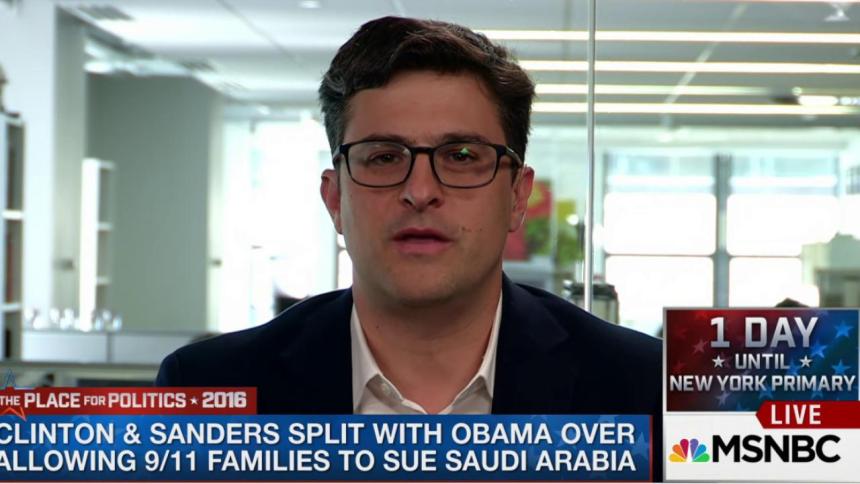
These types of actions worry some of the 9/11 families. “You have to start to ask yourself why in the world does Saudi Arabia have so much influence on our country and on the laws we’re trying to make,” said Terry Strada, whose husband Thomas, 41, was in the World Trade Center North Tower when it was hit. She was left to care for their three children and try to explain why their father died. And a cadre of legislators, including former Sen. Bob Graham, the former chairman of the Senate Select Committee on Intelligence and co-chair of the bipartisan joint congressional inquiry into intelligence failures surrounding the attacks, has made clear that they feel the 28 pages should be declassified. “Unless the president can come forward and give the American people some reasons to believe that our national security is in jeopardy because this country that has funded the ISIS, funded these types of terrorist groups in the past, I think we should all come clean. I don’t see any reason why those 28 pages should not be fully released,” said Rep. Charlie Rangel, D-New York. Tension over the Saudi matter became a campaign issue when both Democratic presidential candidates former Secretary of State Hillary Clinton and Sen. Bernie Sanders were asked about it Sunday on “This Week”. Neither candidate seemed aware of the legislation and later both issued statements endorsing the Schumer/Cornyn bill — splitting from the administration. This was especially notable for Clinton, who was in essence disagreeing with Kerry, who has strongly testified against the bill. Though the administration has supported Saudi Arabia on such efforts as the war in Yemen, relations have strained in recent years. Tension with the White House goes back to the ouster of former Egyptian President Hosni Mubarak, the decision not to retaliate against Syrian President Bashar Assad after he had violated the President’s red line on chemical weapons and the Iran nuclear deal for Tehran to curb its nuclear program in exchange for the easing of economic sanctions The administration says broader concerns — rather than just the relationship with Saudi Arabia — are at play: U.S. troops could lose their immunity if the Saudis or other countries retaliate. “Our concern is about an important principle of international law. The whole notion of sovereign immunity is at stake,” Earnest told reporters on Monday. “It could put the United States and our tax payers at significant risk.” This article first appeared on NBCNews.com.
Andrea Mitchell
Andrea Mitchell is chief Washington correspondent and chief foreign affairs correspondent for NBC News.
Abigail Williams
Halimah Abdullah Recommended


