








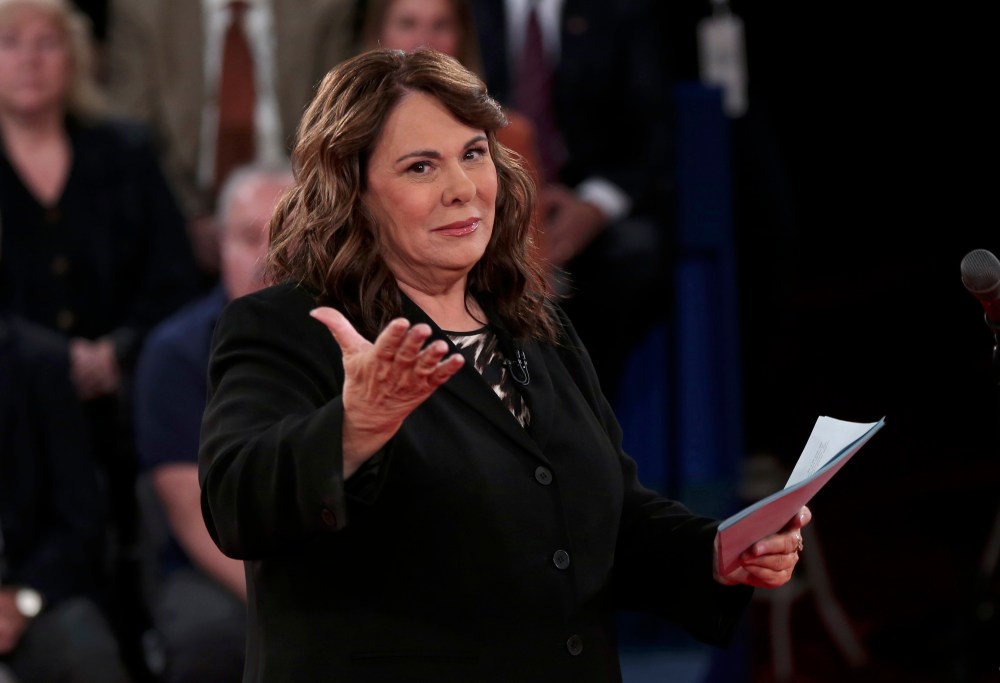
In the view of many conservatives, CNN’s Candy Crowley committed an “act of journalistic terror,” as Rush Limbaugh put it, when she fact-checked Mitt Romney’s attack on President Obama’s handling of the Libya crisis during Tuesday night’s presidential debate.
By now you know what happened: Obama said he’d called the Benghazi attacks an act of terror the day after they occurred. Romney, seeing an opening, said in fact it had taken him 14 days to do so. Crowley intervened to correct Romney. “He did call it an act of terror,” she said.
Set aside for a moment the argument, pushed by some on the right, that Obama might not have been referring to Libya when he used the phrase “act of terror” at a Rose Garden event aimed at responding to those attacks. What really seems to have rankled the right is the fact that Crowley dared to weigh in at all, and that by doing so, she single-handedly defused what had been anticipated as a potent line of attack for Romney.
Rep. Jason Chaffetz, a Utah Republican, made that case most explicitly in an interview Wednesday with Crowley herself. “When you have two candidates disagreeing, it’s not the role of the moderator to say, ‘Mr. President, you’re right’ or ‘Gov. Romney, you’re right,’” Chaffetz lectured Crowley.
Tucker Carlson made the same argument in an appearance on Fox News. After comparing Crowley to Abraham Lincoln’s murderer, the Daily Caller publisher declared: “This changed the debate — this is exactly what moderators are not supposed to do.”
And Lou Dobbs of Fox Business wondered whether there’s “any way to excuse the commission having used that format and that moderator, Candy Crowley, behaving as she did?”
In essence, conservatives are opposing the very notion that the media should play a fact-checking role. The only conclusion is that they’d prefer to see a world in which candidates and parties get to make whatever claims they want, while journalists merely transcribe them, leaving voters to sort out for themselves which are true. Call it a free market of political attacks.
Geneva Overholser, the director of USC’s Annenberg School of Journalism, said that approach doesn’t serve the public. “It’s the journalist’s role to help the consumers of news know what the truth is,” she said.
Jay Rosen, a professor of journalism at NYU, agrees. In a long recent post on the press’s fact-checking role, Rosen urged journalists to “fight for what is true,” rather than critiquing politics as a game.
“[I]t is a regrettable loss for the polity, and for political journalism–and for the voters, the public–when dubious claims gain traction and quotes pulled from their context appear to ‘work.’” Rosen wrote. “What the press can do to prevent this is try to raise the costs of making false or misleading claims, which is the whole point of fact-checking.”
That wasn’t always how the press saw its role. In 2000, much of George W. Bush’s campaign was built around the false charge that Al Gore had claimed to have “invented the internet.” In part because fact-checking political rhetoric wasn’t seen as a central part to the media’s role at the time, the claim was reproduced by prominent news outlets, and ended up doing real damage to Gore. Overholser said when she served as ombudsman for The Washington Post, she felt some reporters were “reluctant to do the calling out” for fear of being labelled biased. That’s still a problem, but things may be changing. These days, fact-checking is an integral part of political coverage, and major news outlets employ hordes of reporters to help sort through the array of claims being made by each side. Prominent fact-check operations like Factcheck.org, Politifact, and The Washington Post’s Fact Checker have become key players in this year’s campaign—they’ve found themselves lobbied by both sides, because their judgments are seen as carrying weight. Crowley’s intervention Tuesday night was perfectly in sync with that shift. It’s not hard to see why many on the right might prefer to turn back the clock. Though most prominent fact-checking outlets make sure to call out both parties in roughly equal proportion, by and large the prominence of fact-checkers has likely worked to Obama’s advantage, given the slew of misleading claims that have come from the Romney camp so far. That was certainly the case when Crowley stepped in. But as Rosen points out, it’s voters who benefit most. Political debate can be confusing—often by design. The fact is, most ordinary people just don’t have the time to go find the transcript of Obama’s Rose Garden speech to discover whether Romney’s charge was fair, much less to run the numbers on his tax plan to check out his assurances that the math adds up. That’s why the news media exists—not just to reproduce what political actors say, but to help people make sense of what’s being said, including pointing out what’s true and what’s not. That might not make partisans happy, but when it comes to having an informed democracy, it’s a pretty crucial function.
Zachary Roth Recommended


