








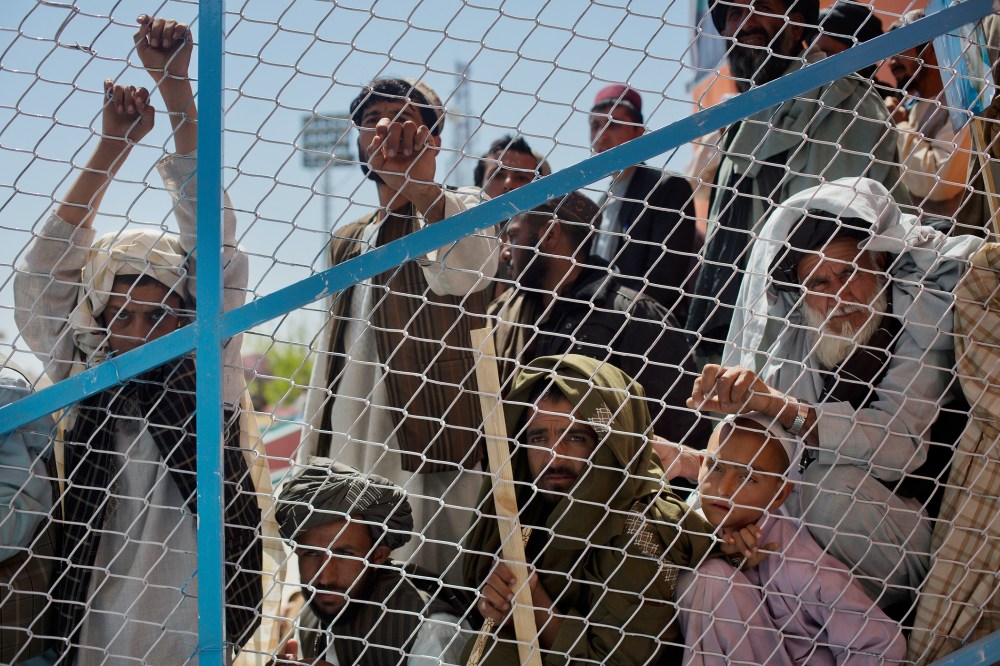
Afghans go to the polls Saturday to pick a new leader, as President Hamid Karzai prepares to step down.
A peaceful transition of power would be an important milestone for the war-ravaged nation. But with ongoing violence likely to keep many Afghans from the polls and massive fraud a major threat, the election underlines—13 years after the U.S. toppled the Taliban—just how far the country remains from being a stable and well-functioning democracy.
The stakes are high: 30,000 U.S. soldiers remain in Afghanistan, but with the international presence gradually winding down, Saturday’s election marks a crucial stage in the troubled country’s ability to govern itself peacefully and avoid once again falling into the hands of extremists.
And the deep uncertainty surrounding the vote is also a reminder of how the Bush administration’s confident promises that the country was on the verge of freedom and stability—”Democracy is flourishing,” President Bush assured the world as a stood next to Karzai at the White House in 2005—time and again proved premature.
By all indications, Afghans are eager to participate in Saturday’s $100 million, Western-funded contest, in which 11 candidates, representing a wide range of positions and interests, are competing. Three in four respondents to a recent surveysaid they want to cast a ballot. Campaign posters dot the walls of buildings in cities and villages across the country, witnesses report, rallies are well attended, and the news media features heavy campaign coverage.
“We have an election for mayor in Washington (earlier this week) and it’s not dissimilar,” said Jed Ober of D.C.-based Democracy International, who has spent extensive time in Afghanistan lately.
But how many Afghans will end up feeling safe enough to turn out, and whether their votes will count, are very much open questions.
Two Associated Press journalists were shot by an Afghan police officer—one, photographer Anja Niedringhaus, was killed—while traveling with election workers in eastern Afghanistan Friday. The incident followed a high-profile Taliban attack last week on the Kabul office of the government’s election administration panel, the Independent Election Commission (IEC), which provoked an exodus of western aid workers and diplomats from the country.
The Afghan Army has deployed 60,000 soldiers across the country to bolster election security, but the ongoing violence still threatens the prospects for a full and fair vote. Already, 10% of the 7,500 voting sites across the country have been shut down as too dangerous to protect. In Charkh, near the eastern border with Pakistan, where the Taliban is waging an ongoing battle against government forces, “it has become clear that no one is going to vote,” The New York Times reported Wednesday.
Then there’s an even thornier problem: the threat of large-scale, government-sanctioned fraud.
Allegations of such fraud—said to have been orchestrated on behalf of Karzai by the IEC—marred the last presidential election in 2009. The president’s chief rival, Abdullah Abdullah, claimed the election had been stolen, triggering months of crisis that threatened to spiral into civil war.
Peter Galbraith, the second-ranking U.N. official in Afghanistan at the time, was essentially exiled by the Karzai government after loudly echoing Abdullah’s complaints. (“Word came to me that I would be arrested if I went back. That might be the least,” he told msnbc.) According to Galbraith, now a state senator in Vermont, there’s little reason to think this year’s election—in which Abdullah, a doctor and vocal Taliban critic, is among the leading candidates again—will be cleaner.
First, said Galbraith, the members of the two main panels charged with running the election— the Independent Election Commission the Electoral Complaints Commision— are appointed by Karzai, raising concerns about their independence.
“Last time it was the Independent Election Commission that basically organized the fraud at Karzai’s behest,” said Galbraith.
It did so, he charged, by reporting phantom results from “ghost” polling centers—sites that never opened because they were in insecure or Taliban-controlled areas. Galbraith—who as a Senate staffer in the ‘80s helped expose Saddam Hussein’s Kurdish genocide, and during the ‘90s played a key role in the Balkan peace process as U.S. Ambassador to Croatia—says there’s a good chance of that happening again. Ober, of Democracy International, offered a more optimistic take, but said how the two panels handle the weeks-long post-election counting and complaints process will be crucial in determining how much confidence voters have in the results. “That, in my eyes, is the most important part of the process: Their ability to manage the tabulation and complaints process in a transparent way,” he said. “They want to get it right, and they should get it right.” Still, the west’s gradual disengagement, including diminished roles for the U.N. and U.S., could make things worse. In January, the U.S. Embassy stopped paying for pre-election polling, which it funded in 2009. That eliminated a key tool that observers might use to flag potential fraud, and to build public confidence that the vote was fair. If Karzai, who has been in office since 2002, were thought to be content to fade into the background after leaving office, concerns about his or his allies’ ability to manipulate the results might have less traction. But reports suggest he aims to continue to exert influence: He’s played an active role in shaping the field of candidates, and has given one, former Foreign Minister Zalmay Rassoul, his implicit blessing. Karzai, whose relations with the U.S. have grown increasingly strained lately, has even begun building a new compound right next to the presidential palace. But in a country where large areas remain under Taliban control, there’s an ongoing low-level insurgency, and the threat of full-scale civil war can never be discounted, some set the bar lower. It’s more important, they argue, for the results to be broadly accepted by Afghans than for the vote to be a model of a democratic election. “We shouldn’t necessarily expect that these elections go off without any problems whatsoever,” said Ober. “What we want is an outcome that can be respected by all the political actors in the country, and also by the citizens. That’s the real goal—that at the end of this process, a new leader is elected through a democratic process.” Ober continued: “And I think there are a lot of people that if you told them that in 2014 the country has the opportunity to go through a democratic transfer of power, I think that could be seen as a real step in the right direction.” But just how democratic that process will be is up for debate.
Zachary Roth Recommended


