








This summer, the future of abortion access in vast swaths of the country is in the hands of federal courts. And with the exception of Texas – where one provision of an anti-abortion law has already shut down half of the state’s clinics, and another that would close even more is currently on trial – abortion opponents are having a pretty bad run.
A federal appeals court kept the doors of Mississippi’s last abortion clinic open against a law requiring that abortion providers have admitting privileges at local hospitals – an impossible task there. In Alabama, a district court judge exhaustively laid out all the reasons the state could not force the closure of three of its five abortion clinics with the same law. Earlier in the year, there was a preliminary defeat for Wisconsin’s version of the admitting privileges law, resting on the utter lack of evidence that the law would make any woman safer, and a decision after the trial is expected soon.
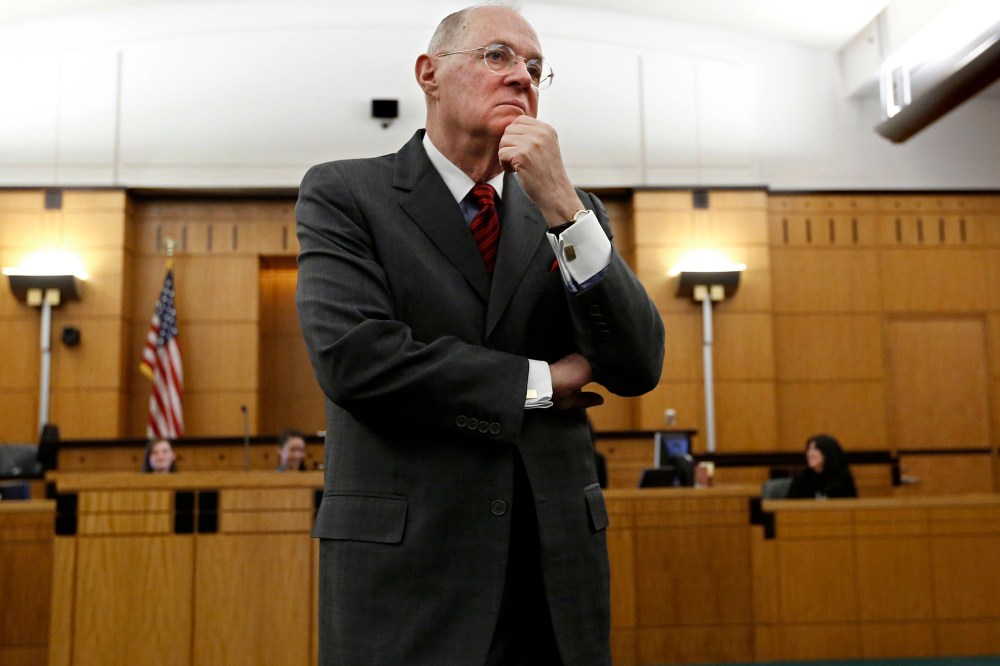
But all this is just a dress rehearsal for what will likely be the final show at the Supreme Court. And as usual, the star will be Justice Anthony Kennedy.
It’s often said that this is Kennedy’s country — everyone just lives in it. When it comes to abortion rights and access, that’s particularly uncertain terrain. In 1992, Kennedy, an appointee of President Ronald Reagan, had the opportunity to overrule Roe v. Wade entirely with a decision in Planned Parenthood v. Casey. He instead chose a middle ground with Justice Sandra Day O’Connor, a fellow swing voter on the Court. The decision in that case confirmed that states couldn’t ban abortion, but said they can put restrictions on the procedure unless they pose an “undue burden.”
State governments hostile to abortion rights have been pushing at the boundaries of what, exactly, an “undue burden” is ever since. While the court declined to hear a preliminary challenge of the Wisconsin admitting privileges law and the current cases have a ways to go before they get to the top, Supreme Court consideration seems inevitable.
Indeed, when five members of the court — including Kennedy — allowed the Texas admitting privileges law to go into effect last year on apparently technical grounds, Justice Stephen Breyer wrote in his dissent, “The underlying legal question—whether the new Texas statute is constitutional—is a difficult question. It is a question, I believe, that at least four Members of this Court will wish to consider.” It takes four votes for the Supreme Court to take a case.
%22Justice%20Kennedy%20doesn%E2%80%99t%20like%20abortion%2C%20regardless%20of%20whether%20it%E2%80%99s%20compared%20to%20guns%20or%20tooth%20extraction.%22′
The issues at stake were in stark relief in Judge Myron Thompson’s decision last Monday striking down Alabama’s admitting privileges law as an undue burden. Thompson’s opinion was remarkable in several ways, not least because, at the end, there was a direct shout-out to Justice Kennedy himself.
At the end of the 172 pages, which included a detailed discussion of the violence and intimidation faced by abortion providers and how it contributed to their inability to get hospital admitting privileges, Thompson made a provocative comparison of abortion rights and gun rights. Both, he said, were fundamental rights that, however contested, could be regulated but not obliterated.
“The Supreme Court recognizes that some regulation of the protected activity is appropriate,” Thompson noted, “but that other regulation may tread too heavily on the right.”
Thompson pointed out that Kennedy had signed on with the majority in two major gun rights decisions, as well as in Casey. Then, apparently unrelatedly, he quoted Kennedy on the role of the courts: “The power of a court, the prestige of a court, the primacy of a court stand or fall by one measure and one measure alone: the respect accorded its judgments.”
“It seems strategic,” said Adam Winkler, a professor at the UCLA School of Law. “It does seem like (Thompson) was reaching out trying to appeal to Kennedy.” He pointed out that the judge didn’t even quote an opinion the justice wrote, but rather a 1996 law review article.
But simply saying Kennedy’s name may not be enough. “Kennedy is accused of being vain,” said Helen Knowles, visiting professor at Skidmore College and the author of “The Tie Goes to Freedom,” a book on Kennedy’s jurisprudence, “but I’m not sure the connection the judge was making there was sufficiently strong to appeal to Kennedy in a real manner.”
Still, Knowles said, “I think Kennedy would have great problems with this state regulation,” partly on the belief that the Justice is disinclined to so undermine his own precedent in Casey.
Others are more pessimistic. David Cohen, a professor of law at Drexel University and author of an article on “Kennedy’s Gendered World,” points out that since the 1992 Casey decision, which only struck down a requirement that women notify their partners of their abortion decision, Kennedy has upheld every single abortion restriction that has come before him. He has also expressed his ample distaste for the procedure, as well as condescension to women who have abortions.
While there’s a chance, Cohen said, that Kennedy sees admitting privileges in the same way — as the hospitals exercising a third-party veto on women’s rights, much as a male partner could have on a woman’s abortion decision – Cohen is skeptical.
“Justice Kennedy doesn’t like abortion, regardless of whether it’s compared to guns or tooth extraction,” Cohen said. Reva Siegel, a professor at Yale Law School, suggested there might have been a different kind of appeal to Kennedy in the Alabama decision. Judge Thompson’s discussion of violence against providers — the history of bombings and shootings, doctors compelled to testify at trial behind black curtains — was in jarring contrast to the idealized view of the abortion debate held by members of the court, including Kennedy. That view was on display most recently in the court’s unanimous decision in McCullen v. Coakley, which struck down a law establishing buffer zones around abortion clinics. Massachusetts said it had passed the buffer zone law to keep patients and staff safe after a history of violence and intimidation. But the court said it violated the rights of anti-abortion protesters to have “close, personal conversation” with women seeking abortions, or to deliver their “compassionate message.” That opinion was written by Chief Justice John Roberts, but Kennedy has long and furiously opposed such protective zones on free speech grounds. The Alabama case isn’t about free speech, but it offers a rebuke to that rosy vision of what happens around abortion clinics. There, said Siegel, “the opinion is trying to make concrete, graphic, and visceral how profoundly attacks on abortion, by public and private actors, shape the lived experience of medical professionals and women citizens in Alabama.” The anti-abortion movement has formally tried to move away from that violent imagery. It helps that abortion opponents have found they can have the most impact in simply closing down clinics through the legislature, if not changing many women’s minds about their choice. As for the surprising gun comparison in Thompson’s Alabama decision, both Siegel and Neil Siegel, a law professor at Duke (no relation), suggested that may have been intended for another audience entirely: The public at large. “This a district judge in Alabama doing something that will be very unpopular there,” said Neil Siegel. “This is trying to appeal to a public or to a politics that may not be sympathetic to abortion rights, but might be to gun rights. If Alabama can pick and choose which right it can respect, why can’t New York do the same with guns?” Even if the comparison made some liberal supporters of abortion rights recoil, Winkler said, “In one sense that’s how the law should be. It should not be too doctrine-specific. The right to choose abortion shouldn’t be its own right that has no analogy with other rights. The more you treat a right as singular and unique, the more likely you are to allow excessive regulation of it.” Whether there are any moderates or undecided voters out there on this topic, particularly in Alabama, is an open question. And whether Justice Kennedy constitutes such a voter is the ultimate one. For now, it’s all theoretical. “If only abortion were like gun rights,” said Cohen. “You’d be able to get an abortion in 20 different places in every town.”
Irin Carmon Recommended


