








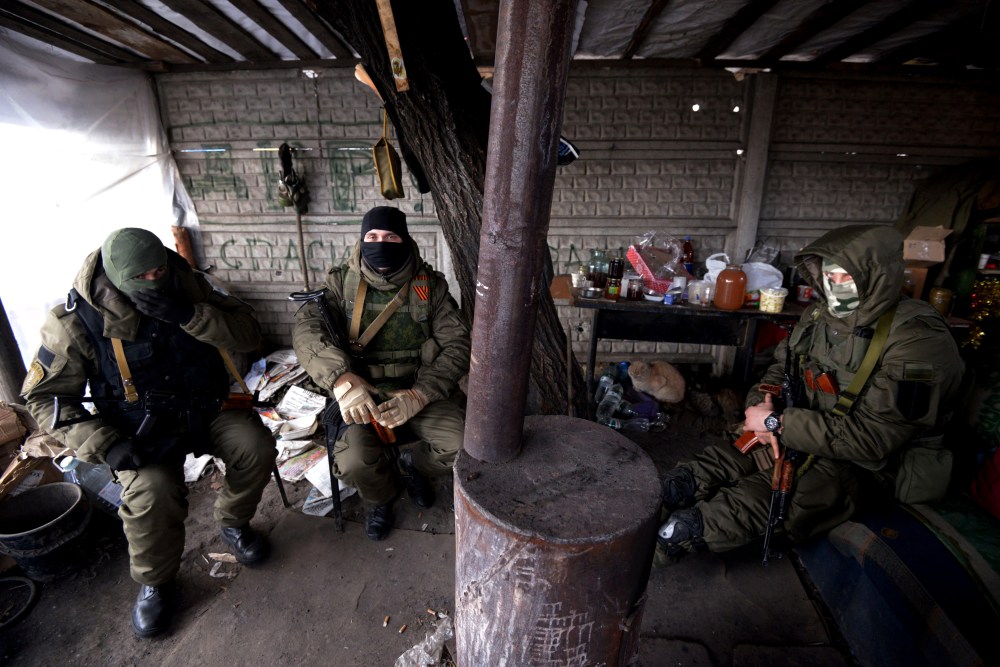
It’s been almost a year since protesters in Ukraine chased the president from office and Russian troops, on orders from President Vladimir Putin, began seizing the Crimean peninsula.
Fighting between Ukrainian government forces and Russian-backed separatists is still raging in the country’s east, and a cease-fire in September fell apart. Now there’s a fresh diplomatic scramble to stop the violence.
Here’s what you need to know about the crisis.
1. It’s getting worse in the east
More than 220 civilians have been killed there in the past three weeks, or about 10 per day, according to the United Nations. And 5,350 people, counting civilians and troops, have been killed there since April.
The separatists hold the city of Donetsk, where the airport has been destroyed, as these striking pictures show. And this week they appeared to take control of the town of Vuhlehirsk and move closer to Debaltseve, a rail hub.
2. The U.S. says Putin is trying to have it both ways
The American point of view is that the Russian leader is simultaneously calling for peace and eagerly sending his tanks and troops through the Ukrainian countryside to cause more trouble.
This is nothing new. Vice President Joe Biden said in Brussels on Friday that Putin “absolutely ignores every agreement that his country has signed.” He said that Russia must not be allowed to “redraw the map of Europe.”
3. The U.S. is thinking about arming the Ukrainians
And President Barack Obama’s nominee for defense secretary, Ashton Carter, is behind the idea. The United States has provided Ukraine body armor and other supplies but has stopped short of weapons.
That may change soon. Carter told a Senate hearing this week that he was “inclined in the direction” of providing lethal arms. “We need to support the Ukrainians in defending themselves,” he said.
4. Not everybody thinks it’s a good idea
European ministers are saying that American arms for the Ukrainians will only make the whole mess worse. “Political dialogue is the only way out of the crisis,” said the Dutch defense minister, Jeanine Hennis-Plasschaert.
Not surprisingly, Russia is opposed, too. The Russian ambassador to France, Alexander Orlov, told a European radio network that it would be “madness” and “like pouring oil on the fire.”
5. Germany and France are pushing Putin
Chancellor Angela Merkel and President Francois Hollande arrived in Moscow on Friday to talk with the Russian leader. On Thursday, they talked into the night with President Petro Poroshenko of Ukraine. They have not disclosed the details of what they are suggesting to Putin, but the Ukrainian government is demanding that any cease-fire follow the geographical lines spelled out in the cease-fire from last September — and not include gains by the separatists since then. A French presidential source told Reuters Friday that the talks were “substantial and constructive.” Putin and his Ukranian counterpart will discuss a proposal to end the fighting during a four-way telephone call Saturday, according to The Associated Press. 6. The Ukrainian economy is hurting … The currency, the hryvnia, has been losing value for a year. It plunged 30 percent on Thursday, raising the risk of runaway inflation, after the central bank allowed the value to float more freely. Banks have all but stopped lending, and the Ukrainian economy is expected to shrink by 5 percent this year. Ukraine is desperate for money to close a $15 billion budget gap, and 7. … but so is Russia’s Putin has a three-way economic problem of his own to wrestle with. The value of the ruble has withered, Western sanctions are hurting his friends in the oligarchy, and the price of oil, the lifeblood of the country, has tumbled. Some analysts have speculated that Putin might try a sort of sleight-of-hand trick — diverting the Russian people’s attention from his own failed leadership by causing more trouble in Ukraine. This story originally appeared on NBC News.com. The Associated Press and Reuters contributed to this report.
Erin McClam Recommended


