








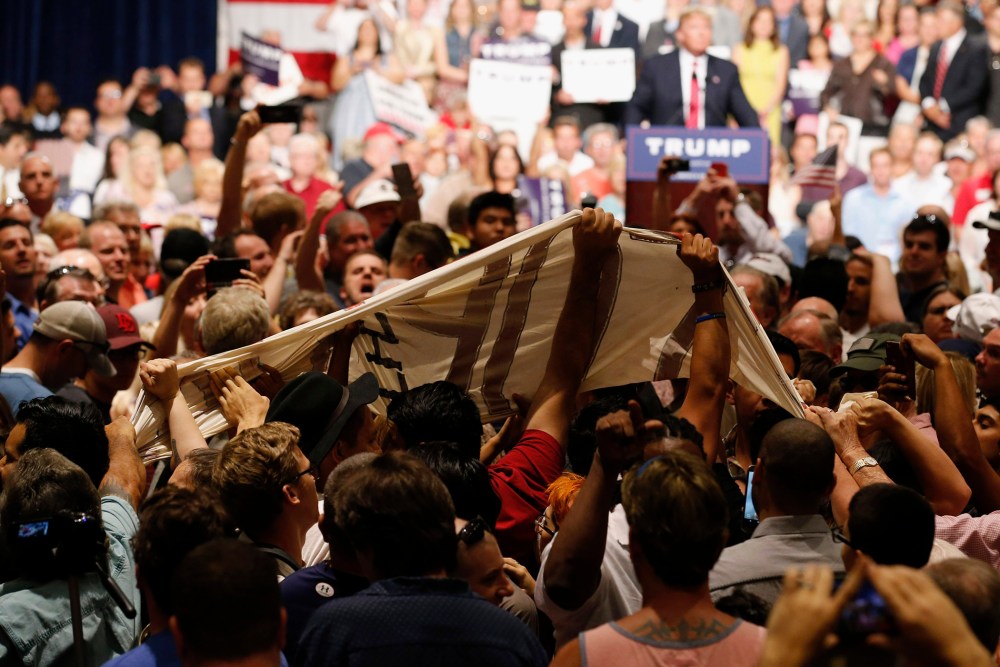
At the final Republican presidential debate of 2015, former Pennsylvania Sen. Rick Santorum, a lower-tier candidate who has struggled to gain traction in a crowded race, attempted to take a page from the party front-runner’s playbook and say what he felt everyone was thinking, but was too afraid to utter out loud. Two armed assailants, both suspected of harboring motives rooted in terrorism, had recently shot up a holiday party in San Bernardino, California. Meanwhile fears were still fresh from the large-scale terror plot that roiled Paris just weeks earlier. The tragedies compounded panic in the U.S. and produced hysteria that put a bulls-eye on Syrian refugees and the Muslim community, including those who are American citizens.
And so Santorum attempted to inject some straight-talk into the debate with his view of what people really thought was the root of the problem.
RELATED: 2015: A year of great reform or great resignation
“I know this is going to come as a shock to a lot of people, and I mean this sincerely — Islam is not just a religion,” he said. “The fact of the matter is, Islam is different.”
Santorum’s statement suggested that the people who practice the faith are somehow distinct, as well. The candidate used the differentiation to justify denying even Americans their First Amendment rights. And he wasn’t alone. That night, candidate after candidate expressed few problems with monitoring mosques, schools or individuals, as well as a willingness to stretch the boundaries of constitutional protections for the sake of national security.
The perspective follows a line that was started by Donald Trump when he claimed that Mexico is sending murderers and rapists into the U.S. Or when Jeb Bush blamed Asian immigrants for exploiting policies to have “anchor babies” in order to become American citizens. Islamophobia has materialized in nefarious shapes and forms throughout the campaign season — almost to the point that racially charged or openly bigoted remarks now seem like the new normal.
“It goes to the fact that they consider Muslims to be a category other than American. Somehow by virtue of their beliefs they are not afforded the protections that are granted to all of us,” said William McCants, a fellow in the Center for Middle East Policy at the Brookings Institute.
That sense of otherness has defined the Republican presidential race and made 2015 the start of a new era of racial politics in America. We’re now clearly seeing the complicated and oftentimes ugly ways that race plays into politics. What’s truly unique though about 2015 is that ethnic and racial minorities — Latinos, Asians and Arab Americans — are being pulled into public discourse in ways we’ve never seen before. Just about none of these issues are new — heated rhetoric toward the most politically marginalized minority groups has been around since our nation’s founding. Even those who ardently believe that we live in a post-racial society don’t have to read between the lines to see overt racism. But we’re now litigating where Americans draw the line on how far is too far.
“It makes people uncomfortable when you get really explicitly racist,” said Helen Marrow, professor of sociology at Tufts University. “It brings to light the underlying ‘colorblind” language, that everyone likes to pretend they’re colorblind when they’re actually talking about race.”
Conservatives have rebelled against the constraints of “politically correct” culture for years. What’s different now is that the spectrum of racially coded and overtly offensive political rhetoric has not only expanded rapidly, it has been been widely accepted by a voting bloc that currently enjoys outsize political clout during a crucial juncture in the presidential election.
RELATED: 2015: The year in criminal justice
“We have to get rid of all this PC stuff. And people are worried about if somebody’s going to say that I’m Islamophobic or what have you,” retired neurosurgeon Ben Carson said during the last debate. “This is craziness because we are at war.” Conventional wisdom would have said that Trump’s political career would be over the day it started. Instead he tapped into the Id of disillusioned white voters frustrated by underemployment and resentful of seeing the America they once knew vanish. Before Trump, mainstream political discourse around immigration would seldom focus on actual immigrants, but rather coded complaints about abstract issues involving law enforcement. Calls to strengthen the border were in the name of national security; deportation was in the name of fairness under the law — the refrain “illegal is illegal” is popular among conservative circles. “Latinos know that when it comes to issues of immigration, it’s really not a policy issue. It has to do with race,” said Chris Zepeda-Millán, professor of ethnic studies at UC Berkeley. There’s a reason why the rhetoric has escalated so quickly — in many senses, it works. Trump surged in South Carolina primary polls immediately after he said he would support establishing a database to monitor all Muslim-Americans. His national appeal has resonated with nativists within the Republican Party who see minority groups becoming the majority of the U.S. population and who fear that change. But there’s likely a ceiling to that success. The GOP’s alienation toward virtually all minority groups is likely to backfire on the Republican Party. Zepeda-Millán noted that Latinos tend to mobilize when they feel threatened. The damage will likely hang over the eventual Republican nominee, cutting their chances with the fastest growing voting bloc in key swing states, and handing over Democrats momentum to take a more inclusive tact. “Donald Trump is the best thing that could happen to Hillary Clinton,” Zepeda-Millán said.
Amanda Sakuma Recommended


