








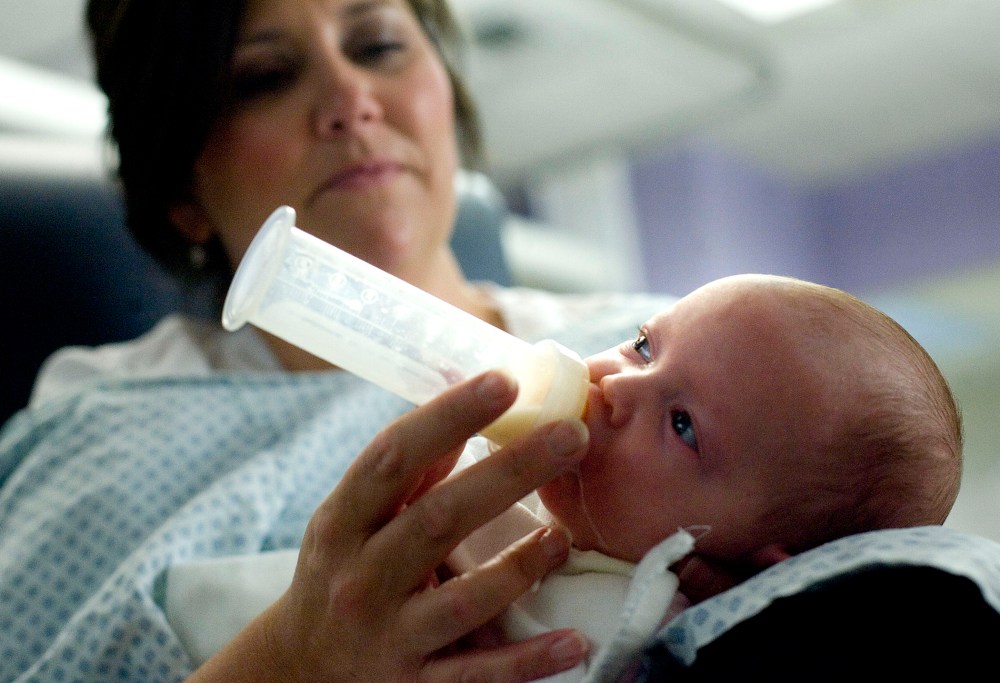
The United States received a “C” grade for preterm birth rates and ranks behind other developed countries despite the number dropping for the sixth consecutive year.
The 2012 nationwide rate for premature babies dropped to 11.5%, a 15-year low, according to the March of Dimes Premature Birth Report Card published Friday. The number rose from the 1980s until 2006, but once leveled off at 11.5% in 1998.
“We would like to see them go down at a faster rate, but we are pleased,” Dr. Edward McCabe, chief medical officer of March of Dimes Foundation, told msnbc.
Almost half a million U.S. babies are born prematurely, or before 37 completed weeks of pregnancy. They are at higher risk for experiencing health problems, including apnea, respiratory distress syndrome, and anemia, than babies born later. The United States has the worst premature birth rate out of the 30 industrialized countries defined by the Convention on the Organization for Economic Cooperation and Development.
Without the recent decreasing rates, 176,000 more babies would have been born preterm, Dr. McCabe said.
The March of Dimes is leading the Prematurity Campaign to reduce the nation’s preterm birth rate to 9.6% by 2020. The interim goal is to decrease the number by 8% before the start of 2015. Every state, as well as Washington, D.C., and Puerto Rico, agreed to work toward the goal.
The foundation rates each state in its progression toward the pledge. New Hampshire, Maine, Vermont, Alaska, California, and Oregon earned an “A” grade with rates less than or equal to 9.6%. Louisiana, Mississippi, Alabama, and Puerto Rico received an “F” because their numbers were greater than or equal to 14.6%.
Vermont ranked highest with a rate of 8.7%, but Mississippi placed in last with 17.1%.
March of Dimes urges policymakers to expand insurance coverage for pregnant women, and pursue initiatives that prevent tobacco use and help women to quit smoking. In addition, the foundation asks hospitals and health professionals to eliminate early elective deliveries before 39 weeks of completed gestation to decrease the risk of death and disability.
This year the foundation added a fourth factor to analyze preterm birth rates by race and ethnicity because of concern about healthcare inequalities. On this year’s report card, African-Americans received a rate of 16.8%, followed by Native Americans with 13.6%, Hispanics with 11.7%, whites with 10.5%, and Asians with 10.3%. “I think it’s important that we as a nation recognize that there are things that we can do to make a difference,” said Dr. McCabe, adding that California received an “A” even with its diverse population. The United States is the only industrialized country not to have full healthcare coverage, which contributes to the nation receiving a low ranking worldwide, he said. The United States lags behind the rest of the developed world in other areas as well. Life expectancy and survival rates have improved “dramatically” over the past century, according to a recent report published by the National Research Council and the Institute of Medicine. But Americans experience more injuries and illnesses–and don’t live as long–as some people in other high-income countries. “We can do better,” McCabe said. “But we have a lot of more work to do.”
Michele Richinick Recommended


