








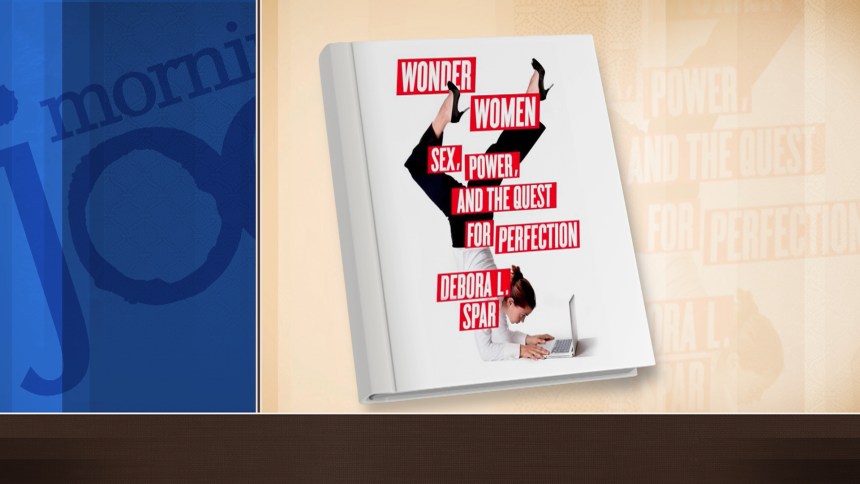
Here’s an excerpt of Wonder Women.
I began working on this book in the summer of 2009 one year after I left my job as professor at Harvard Business School to become president of Barnard College. It was a radical change. I left teaching for administration, MBA students for undergraduates, and a very large endowment for a perilously small one. I left my garden, and my kids’ schools, and even my husband, who was stuck commuting loyally up and down the eastern seaboard. The biggest change, however, was hor- monal. At Harvard, I had been surrounded for over twenty years by alpha men of the academic sort—men with big egos, and big attitudes, and an awful lot of testosterone. At Barnard, suddenly, I wasn’t. At Harvard, I was almost always the only woman in the room. At Bar- nard, an all-women’s college, there was barely a male in sight. I found the change fascinating—not better or worse, necessarily, and not a cause for either celebration or alarm. Just plain fascinating.
Gradually, I started thinking more and more about how women in the workforce differ from men, and about why women’s work lives remain still so complicated. I started thinking about my own career path, and about why I had chosen—unconsciously, perhaps, but stubbornly—to steer far clear of any explicitly feminist agenda. And when, as the newly minted head of an all-women’s college, I began to interact with hundreds and hundreds of extremely diverse women, I began to suspect that there were certain patterns at play, patterns determined not only by social structures and embedded norms, but by biology and preferences and the sheer random chance of being born in a particular time and place. I also became increasingly convinced that the goals of the early feminists remain relevant for women today, even for those like me who had either ignored the struggle or disagreed with its tactics.
Consider the facts: even today, women in the United States still earn only 78 cents on average for every dollar earned by men. They occupy only 15.2 percent of seats on Fortune 500 corporate boards and serve as CEO for only 3 percent of the country’s largest corporations.6 Fifty-one percent of families living below the poverty line are headed by women, as are 83 percent of single parent families.7 More than a quarter of a million women are sexually assaulted each year in the United States alone and, in 2008, nearly twelve thousand reported suffering from sexual harassment.8 Studies confirm that when a female professor enters the classroom, students presume her to be less competent than an equally certified male and pay more attention to whether she smiles.
Despite what feminism promised, therefore, and what my generation believed, women in the United States still face distinctive challenges that cannot be explained solely by reference to class or race or socioeconomic status. Instead, women live their lives differently simply on account of their sex.
Wonder Women, therefore, is a tale of just that. It is partly my own story and partly a cultural survey, examining how women’s lives have— and have not—changed over the past four decades. It is an exploration of how women born after the tumult of the 1960s grew up, and why the dreams of our childhood proved so elusive. It is a study of how we thought we could have it all and why, in the end, we cannot.
The goal of the book is to take a new look at feminism, reconsidering it, ironically perhaps, from the perspective of women who have disdained its entreaties in the past. Tracing through the ages and stages of contemporary women, Wonder Women espouses a revised and somewhat reluctant feminism, one that desperately wishes we no longer needed a women’s movement but acknowledges that we still do. It argues that women of my generation got feminism wrong, seeing it as a route to personal perfection and a promise of all that we were now expected to be. Instead of seizing upon the liberation that had been handed to us, we twisted it somehow into a charge: because we could do anything, we felt as if we had to do everything. And by following unwittingly along this path, we have condemned ourselves, if not to failure, then at least to the constantly nagging sense that something is wrong. That we are imposters. That we have failed.
Meanwhile, in exploring the nooks and crannies of a woman’s life, Wonder Women also advocates for a feminism based at least in part on difference. Put simply, it acknowledges (along with many earlier versions of feminism) that women are physiologically different from men and that biology is, if not quite destiny, nevertheless one of those details in life that should not be overlooked. Only women can bear children. In the state of nature, only women can feed those children through the most critical months of their lives. From these two unavoidable facts—wombs and breasts—come a vast series of perhaps unfortunate events. We can rue these events, or the gods who apparently predestined them, or we can come to terms with our differences and focus on ways of making them work.
Wonder Women takes this latter tack. Rather than examining the power hierarchies that undeniably still separate men from women, I focus on the practical issues that confound even the most powerful women. Rather than demanding that women be treated always as equivalent to men, I assume that women are actually quite different from men and explore the various ways—from body image to Barbie dolls, baby making and sex—in which these differences manifest themselves. And rather than trying to add to the canon of feminist theory, I concentrate instead on what these theories suggest, where they’ve been helpful, and where, on occasion, they’ve steered us wrong. Because the book stems from my own personal journey, it is organized roughly along the cycle of life, starting with girls and girlhood and ending where I stand today—in middle age, reflecting on teenagers and husbands, life choices and careers. Let me be clear about the biases I bring to this work. I am a working mother of three children, so my view of women is very much taken from this particular perspective. I therefore focus, perhaps overly, on the fates and fortunes of women juggling kids and jobs, the women who so infamously try to have it all. I have been very happily married for twenty-five years, so I write also as a contented wife and a woman who remains extremely fond of men. I believe that most men today want women to succeed; they want them in their firms and in their legislatures and even, generally, on their golf courses. They just don’t know quite how to make it work. And how can they, if women don’t help to figure it out? Intellectually, I am an interloper in the area of feminist theory. I didn’t study it until recently; I didn’t grow up with it; and my interest has developed only later in life. Even worse, I am interloping as a critic, someone who agrees with the goals of feminism but not necessarily with its tactics and assumptions. I also approach this area, as we all do, I suspect, with my own socioeconomic status wrapped tight around me. I am a product of white, upper-middle-class American society; I have never been poor, never had to worry about the provenance of my next meal. I have studied and written about poverty, particularly in the developing world, but I have never personally experienced it. So, insofar as this book draws heavily on my own experiences, it is a book mostly about American women who have been blessed, as I have, with both economic and educational opportunities. I wish I could be farther-reaching in examining women’s lives, stretching to explore the vast number of women who every day face struggles that dwarf my own. Women who worry, not about breast pumps, but about breasts too malnourished to feed their infants. Women denied education on the basis of their sex. Women shunned or even killed for daring to look at a man—let alone another woman. Theirs are the real stories of women’s struggle and the real motivation for an action-oriented feminism. But I haven’t lived their stories and I don’t have the means to tell them here. Instead, I am writing from what I know, and hoping that it will find some broader relevance. Excerpted from WONDER WOMEN: Sex, Power, and the Quest for Perfection by Debora L. Spar, to be published in September 2013 by Sarah Crichton Books, an imprint of Farrar, Straus and Giroux, LLC. Copyright © 2013 by Debora L. Spar. All rights reserved.
MS NOW staff Recommended


