








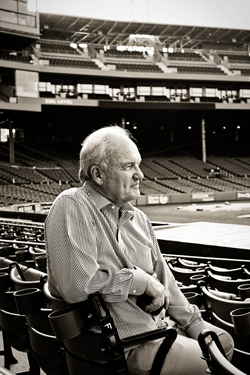
Our man Mike Barnicle has talked a lot and written a lot about Fenway Park over the years. Lately, he’s been talking a lot about the park’s 100-year-anniversary, which will be celebrated Friday, April 20th with a game against the Yankees that begins at 3:05 p.m. (the time the Sox began their game against the New York Highlanders). Hearing Barnicle discuss his first visit to the park in the mid-1950s is hearing his rite of passage story. It seems safe to say he views Fenway as his second home, if not maybe his first home.
I spoke with Barnicle this Wednesday about the big anniversary, his relationship with the park, why he doesn’t heckle the team during a game, if there’s any rival to Fenway, and whether it was his father or his mother that was the big baseball fan in his family.
Morning Joe: Why does Fenway hold such a special place in the hearts of not just Bostoners, but seemingly all New Englanders?
Mike Barnicle: I think, in large part, it’s because of the permanence of the facility itself. When you consider the fact that we live in a time now where people move almost relentlessly. Very few people live in the same house they move into when they’re married or the same neighborhood when they’re married. Very few people certainly live in the neighborhood they grew up in. We change all sorts of things in rapid time. We sit here in front of TV sets with clickers in our hands, and change channels. We change spouses and partners; divorces are epidemic considering to what the divorce rate was 30 or 40 years ago. All of these things that we’re used to today, these elements of change that are around us, to some people and maybe to most people at some level within them, can be kind of disconcerting. Like ‘Jeez, that place used to be a drug store when I grew up.’
MJ: And now it’s a parking lot.
Barnicle: Now it’s a parking lot or a high rise or a McDonald’s or whatever. And then you get to Fenway Park. And it is the same today in large measure as it was the first day you walked into that park when you were seven years of age holding your father’s hand. And there’s a sense of permanence to the ball park that gives people, I think, a feeling of security or a sense of sameness to the area; that gives a lot of people a sense of happiness. It’s still the same today coming up out of the subway stop at Kenmore Square. Walking through the square, up across the bridge on Brookline Avenue to Lansdowne Street. The light stands. It’s the same. The bricks are the same. And I think in an age of constant change and great change, I think that brings a huge measure of relief to people.
MJ: And it’s something you hand down from generation to generation.
Barnicle: Yeah. As your father or grandfather, depending on your age, took you 40 years ago, 60 years ago, whatever, however old you are, 20 years ago, you can take your son or daughter to the game today and then hopefully 20 or 25 years from now, they can take your grandchildren to the game, and it will be the same.
MJ: I don’t know the reasons why it has stayed where it is and parks like Yankee Stadium or Shea Stadium have not. Can you give a general primer why Fenway Park hasn’t moved in a 100 years, given that it’s a very busy, bustling area now?
Barnicle: There are a couple of reasons why it has remained where it is and remained pretty much the way it has always looked. The biggest reason right now is after the sale of the team in 2001. The debt service to build a new ball park in another area of the city – say down by the waterfront – would have been too heavy for the present ownership group to carry. They didn’t want to carry the debt service, having just paid a record amount of money for the team and for the ball park. They didn’t want then to transfer the debt service that they were already carrying to the increased debt service of construction for a new ball park. That’s one reason. That’s a financial reason, obviously.
But there’s another reason, and it is this: That one of the members of the ownership group, Larry Lucchino, who came in in December 2001, was the guy who built Camden Yards in Baltimore. And built it in the early ‘90s; I think it opened 20 years ago. It’s been open since 1992. Built it with an idea that a ball park around Camden Yards – the old railroad yards in Baltimore – would create, he hoped, the establishment of a brand new urban neighborhood, which it did. And the refurbishing and rebuilding of Fenway Park since 2001 has created a new urban neighborhood in Boston. It is now a very hot neighborhood and is continuing to grow hotter and will only increase in attractiveness to both residents and businesses. Because the ball park is a magnet. It is the single largest tourist attraction in Boston now and it’s not just a six or seven-month-a-year facility. It’s open all year round. You can have a wedding at Fenway Park.
MJ: Have you been to a wedding there?
Barnicle: I have. I’ve been to bar mitzvahs at Fenway. It’s created a thriving, fairly young and affluent neighborhood around the ball park, which is something that did not exist prior to rebuilding the place.
MJ: And it is centrally located in the city.
Barnicle: That’s part of the magic of the park as well. If you’re there for just a few days in Boston, you can walk to the park. You can be staying around Boston Common; you could be staying with friends in Jamaica Plain. It’s easy to get there. It’s not exactly great to park around there, but what ball park is great to park around? You can get there fairly easily.
MJ: It seems safe to say you’ve done this many, many times in your life, but I have to ask about your memories of your first time at the park. And where did you sit in the park as a child? And where do you sit now?
Barnicle: The first time I went to Fenway Park was probably 1950. It was the early ‘50s, and it was my father taking me to the game. And what I have full retention of is of the electric sight of coming up the ramp on the first-base side (and it’s still the same sight today), and you come up into the splendor of green that you see in front of you. The lawn, the wall, the sun sparkling on both. And when you come up the same ramp today for a day game or night game, it’s still shockingly beautiful. At least it is to me. The ball park itself…where did I sit? We used to sit when I was a kid – tickets were obviously cheaper then – we’d sit in the Grandstand section. Maybe section 15 or 16, which is along the right field foul line.
But you know, things change. You go to work; you get lucky; you do well; you make a little money. Some people buy beachfront property. I buy season tickets. So, I have and have had for quite some time, ten season tickets in various locations around the ball park, all pretty good seats. The seats I sit in are right by the Red Sox dugout. And I’ve sat there for years.
MJ: Where you proceed to heckle the team all season?
Barnicle: You know what, not only do I NOT heckle the team, because I have an appreciation for how difficult that game is to play. But if you would watch me during a game — and please don’t — I only rarely show any emotion at all. Like standing up or cheering or clapping. I like to just watch the game. And I do not enjoy taking people to the game who want to talk about anything other than baseball and who don’t get the fact that, you know, ‘Hey, I’m trying to watch the game. You want to talk about what’s going on in the game, feel free. But don’t be talking to me about your hedge fund.’ But that would be very unlikely for me bringing a hedge fund guy to sit with. But you get the point.
MJ: So there’s a hierarchy of mental involvement when it comes to watching the game, and you like to focus is basically what you’re saying.
Barnicle: Yes.
MJ: If you’re going to Fenway for the first time, what are the rules of going to a game?
Barnicle: You should enjoy where you are, first of all. Because there’s not a facility like it in the country for baseball.
MJ: What do you mean by that?
Barnicle: The field is quirky in its arrangement. It’s not like a cookie cutter field. It’s not like 325 down the line at left, shoots out to 345 at left center, 410 in center, 345 in right center, 325 down the line at right. It was designed at an earlier, easier time. You’ve got the famous wall, and they post it at 310, but it’s probably about 300 feet from home plate. Not a big distance for a major league hitter. The wall was put up to prevent mud slides, really. The park was built on a landfill. There’s a crazy, cookie-cutter design to center field. There’s a corner of the bull pen that makes it one of the deepest center fields in the major leagues. It’s got a wide, horseshoe-shaped right field that if the right fielder misses the ball on the bounce, the ball can carom like a pinball all the way around. You can get yourself an inside-the-park home run. It’s interesting. And it’s different from most parks. MJ: Is it safe to say Fenway is your favorite park? Is there a rival in your mind? Barnicle: Wrigley Field [in Chicago] is pretty nice. Almost as old. Where the Cubs play with the vines on the wall on left field. And it’s in a great neighborhood, as well. Like with Fenway, it’s a magnet for a younger crowd. That’s a nice ball park. Some of the newer ball parks are really nice. The ball park in Pittsburgh is a spectacular ball park. Again, it’s right downtown. The Denver ball park, built in the LoDo area, completely brought back that neighborhood. San Francisco has a fabulous ball park. It’s right down in the Embarcadero. You can walk there from downtown San Francisco. And there’s a difference, too. If you want to play baseball, you want to play in a park and not a stadium. It’s nothing but rhetorical, but a stadium symbolizes something larger. You’re going to play football in a stadium. A park connotes someplace you come, it’s smaller and more comfortable. MJ: What do you remember about the team when you first went to a game? Barnicle: I can remember many specific players. Jimmy Piersall, Number 37. Sammy White, the catcher, Number 22. Ted Williams, Number 9. Harry Agganis, Number 6, died of pneumonia in Santa Maria hospital in Cambridge after a road trip in 1955. I can remember all of that. I can’t remember what I had for breakfast this morning, but I can remember that. They were a dreadful team then. Always finished in fourth place. There was an A-team American League division then. There were only 16 major-league teams. I could remember most of the teams. Most of the teams that played the Red Sox would stay in the Hotel Kenmore in Kenmore Square. You could camp out and get autographs because the players would just walk the 150 years to the ball park. Every team stayed there with the exception being the Yankees. They stayed at the old Statler Hilton in Park Square in Boston. I can remember vividly much of that period of time. MJ: You mentioned your father taking you to your first game. What kind of a Red Sox fan was he when you were younger? Barnicle: He was not a huge fan, turns out thinking back on it. He took me because I loved baseball. MJ: So you asked him to take you? Barnicle: Yeah. He liked baseball, but he was nowhere near the baseball fan that I was then and obviously became. He was like most people his age in that era. Newspapers cost two cents each, so we used to get six or seven newspapers a day in the house. And you’d follow almost everything through the newspaper, baseball included. My mother was a big baseball fan. She loved Ted Williams. She would sit on the front porch of our home, with the radio on and listen to the ball game. MJ: Would she go to games with you when you were younger? Barnicle: No. We didn’t have a lot of money. And it was a huge treat. And I assume, looking back on it, that a few economic tricks took place for us to be able to go to a ball game. MJ: When you were younger, how many games would you be able to see in a season? Barnicle: I didn’t go to that many when I was that young. But I was also lucky in that my uncle played major league baseball for the then-Boston Braves (now the Atlanta Braves), and he was a pitcher for the Boston Braves. And so growing up, my cousins and I had an entrée into that world that very few kids did. By the time I was 12 or 13, and given the ease of access to get to the games and the fact that they weren’t selling out, we went to a lot of games. And a lot of the guys that he played with, they were coaches on major league teams. MJ: When did you start bringing your own kids to Fenway? Did you want them to be massive Sox fans at a young age? Barnicle: Here’s the deal on that. I would take our two oldest boys to games from the time that they were five and six. And I would take them, first of all, because I was in charge of taking care of them on a particular day, so I’d take them to the ball park. And we would sit upstairs. And I never took them with the idea that I’m going to inculcate them. I don’t think you can do that. They are either going to like it or not like it, but I wasn’t going to force it on them. And luckily for me, they not only liked it, but loved it. They played it at a very high level throughout their young lives and still play it. They play hardball in a hardball league in the Bronx. One of them played a year of minor league baseball. They both played college baseball. And they do film stuff now, they have a production company for ESPN’s “Baseball Tonight.”
Drew Katchen Recommended


