








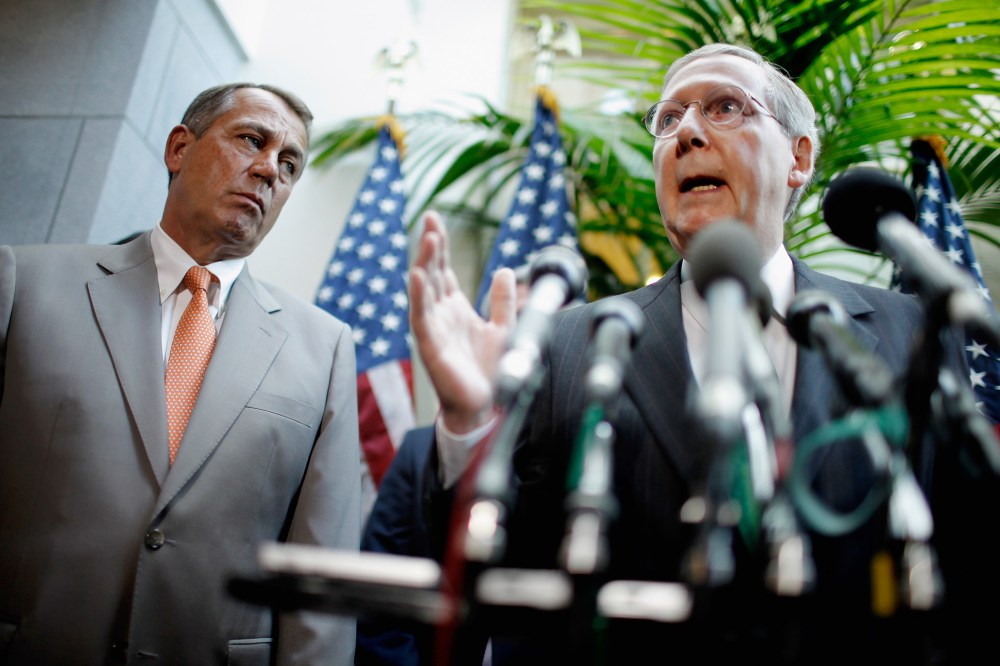
Riding high on a spate of electoral victories, the GOP’s top leaders vowed to push their agenda through Congress in the wake of the midterm elections that gave their party control of the Senate.
House Speaker John Boehner and the soon-to-be Senate Majority Leader Mitch McConnell published an op-ed in Thursday’s Wall Street Journal promising to aggressively pursue their legislative agenda, including building the Keystone pipeline and repealing Obamacare.
“The American people have made it clear they’re not for Obamacare. Ask all those Democrats who lost their elections on Tuesday night,” Boehner said Thursday afternoon in a press conference. “The House, I am sure, will move next year to repeal Obamacare because it should be repealed and it should be replaced with common sense reforms that respect the doctor-patient relationship. Now, whether that can pass the Senate, I don’t know.”
Boehner, in admitting that such a bill might not pass the Senate, said, “just because we may not get everything we want, doesn’t mean we should try.”
The op-ed — another turn in Republican Party leaders’ victory lap — outlines a series of legislative plans that could predict the policy battles between President Obama and the GOP in the coming two years.
“Looking ahead to the next Congress, we will honor the voters’ trust by focusing, first, on jobs and the economy. Among other things, that means a renewed effort to debate and vote on the many bills that passed the Republican-led House in recent years with bipartisan support, but were never even brought to a vote by the Democratic Senate majority,” the leaders wrote. “It also means renewing our commitment to repeal Obamacare, which is hurting the job market along with Americans’ health care.”
The op-ed pushes the Keystone XL pipeline in particular, arguing that the Canada-to-Texas pipeline would pump 830,000 barrels of oil a day and “will mean lower energy costs for families and more jobs for American worker.” The State Department has released several reports on the proposed pipeline, concluding that it would create 42,100 jobs, though many would be temporary construction jobs; critics say the true number would be far less. The department’s analysis also found that while mining Canadian oil sands would release greenhouse gases, blocking the pipeline wouldn’t stop them from being mined by someone else. That distinction could leave an opening for Obama, who has said he would sign off on the project only if it “does not significantly exacerbate the climate problem.”
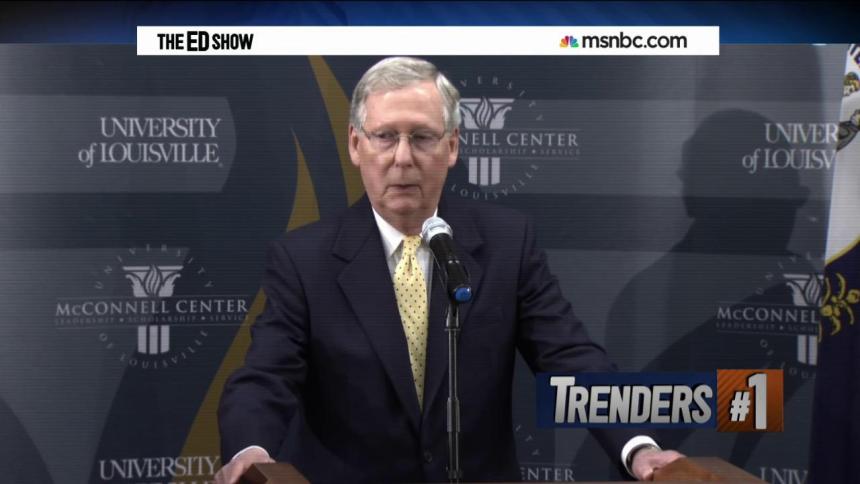
Later on Thursday, in his first post-midterm interview, McConnell told the Lexington Herald-Leader that his top priority as Senate majority leader will be “to try to do whatever I can to get the EPA reined in.” The Kentucky senator expressed a sense of “deep responsibility” to keep the Environmental Protection Agency from regulating carbon dioxide emissions at coal-burning power plants, particularly in his home state.
“I’m absolutely convinced from the people I talk to around the country, not just here but around the country, that coal has a future,” McConnell told the Herald-Leader. “The question is whether or not coal is going to have a future here. It’s got a future in Europe. It’s got a future in China, India, Australia. But not here?”
According to the National Oceanic and Atmospheric Administration, the summer of 2014 was the warmest on Earth since records began in 1880.
Meanwhile, on Wednesday, the president addressed the GOP’s big win, acknowledging that Americans had sent a clear message that they “want us to get the job done,” though he also acknowledged the “two-thirds of voters that chose not to participate in the process,” saying he heard them too. Obama promised to cross party lines to work with Republicans, but it’s clear that the president and the GOP have very different ideas on what they want to accomplish. While the president reiterated in his remarks that repealing the health care law’s individual mandate was “a line I just can’t cross,” Boehner and McConnell offered no quarter in their op-ed, promising a full repeal of the law. And while the president asked for a “no drama” budget, the GOP leaders wrote that they would push to drastically reduce the national debt, something Democrats and Republicans have clashed over before. Photo essay: The pioneers of a health care revolution Other top GOP priorities outlined in the op-ed range from the specific (build the Keystone pipeline) to the vague (reform the tax code). Boehner and McConnell also list stopping the “global terrorist threat,” improving school choice (read: more Charter schools, less Common Core), improving the functionality of the Veterans Affairs department and Centers for Disease Control, and reducing health care costs. Notably absent from the op-ed was immigration reform, an issue the president has pledged to address through executive order in the coming months. However, in a press conference Wednesday, McConnell said it would be a “big mistake” for Obama to act unilaterally, setting up immigration as a major flash point for the two parties in the months ahead. Boehner said if the president moves forward he will “poison the well” and “there will be no chance of immigration reform moving” in the next two years.
Jane Timm Recommended


