








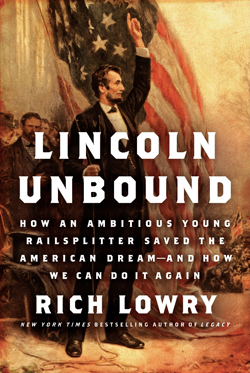
Introduction “An Inestimable Jewel”: Lincoln’s America
“He knew the American people better than they knew themselves.”
—Frederick Douglass, “Oration in Memory of Abraham Lincoln,” 1876
In the summer of 1864, President Abraham Lincoln welcomed the 166th Ohio Regiment to the White House. His words that day didn’t make it onto the Lincoln Memorial. No schoolchildren ever recited them. But they capture the essence of Lincoln and of his idea of America.
“I suppose you are going home to see your families and friends,” he said by way of greeting the regiment. These men were representatives of the Union army, whose camps and hospitals he visited, who were fighting and suffering for the Union and who would vote for him in overwhelming numbers in the November election, a contest that, at that moment, Lincoln believed he would lose. The day after seeing the regiment on August 22, Lincoln wrote his “blind memorandum” stipulating that it is “exceedingly probable that this Administration will not be re-elected.”
The Ohio troops had been mustered for a hundred days in the spring and had done garrison duty around Washington, D.C. Lincoln offered the soldiers “sincere thanks for myself and the country,” and then got to the point. “I almost always feel inclined, when I happen to say anything to soldiers,” he told them, “to impress upon them in a few brief remarks the importance of success in this contest.”
“It is not merely for to-day,” he said of the significance of the war, “but for all time to come that we should perpetuate for our children’s children this great and free government, which we have enjoyed all our lives.” This was a more pedestrian expression of the rousing sentiment from the finale of the Gettysburg Address the prior November—“that government of the people, by the people, for the people, shall not perish from the Earth.”
“I beg you to remember this,” he continued, “not merely for my sake, but for yours. I happen temporarily to occupy this big White House. I am a living witness that any one of your children may look to come here as my father’s child has.” Lincoln characteristically refrained from saying “as I have,” with its whiff of immodesty. Free government is so valuable, he insisted, because it affords us an open, fluid society where anyone can ascend to the highest office in the land. Or at least ascend higher than where he started.
“It is in order,” Lincoln said, “that each of you may have through this free government which we have enjoyed, an open field and a fair chance for your industry, enterprise and intelligence; that you may all have equal privileges in the race of life, with all its desirable human aspirations. It is for this the struggle should be maintained, that we may not lose our birthright—not only for one, but for two or three years. The nation is worth fighting for, to secure such an inestimable jewel.” The priceless treasure is opportunity. It is the cause so dear that it was worth a conflagration that made the country, in the title of historian Drew Gilpin Faust’s moving book on wartime death, “this republic of suffering.” In Lincoln’s telling, America exists to give all people the chance to rise. We are, by birthright and through our free institutions, a nation of aspiration. This theme wasn’t patriotic pap for the boys. Lincoln believed it in the marrow of those strong bones with which he had labored all during his youth. It had suffused his determination, as a boy and into his early adulthood, to read and to learn, so he could do something besides chop and plow all his life. It had been the touchstone of his politics as a Whig and then as a Republican, in the Illinois House of Representatives, in Congress, and in his antislavery leadership in the 1850s that marked the beginning of the heroic phase of his career. From LINCOLN UNBOUND by Rich Lowry Copyright © 2013 by Rich Lowry. Reprinted courtesy of Broadside Books, an imprint of HarperCollins Publishers.
Morning staff Recommended


