








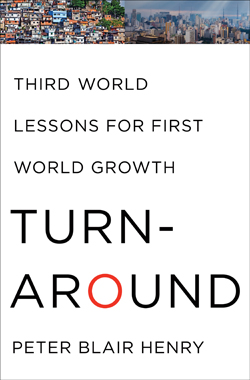
An excerpt from the Introduction:
Times have changed. China now has the second-largest economy in the world. Mexico, following almost twenty years of economic stability, now boasts 1.9 million manufacturing jobs, thriving innovation centers, and a burgeoning high-tech industry. Between 2001 and 2011, Brazil lifted 20 million people out of poverty and into its growing middle class, and in the last quarter of the twentieth century Botswana’s gross domestic product per capita grew faster than that of any other country on the planet. The once-labeled “Third World” is edging its way into the “First World.” Add to these observations the recent debt and financial crises that have battered the United States and Europe, and it becomes clear that the future prosperity of the global economy depends as never before on sustained growth in emerging markets as well as on the stabilization of our own shaky ground. Interdependence is paramount. In the years ahead, everyone will win or everyone will lose, and the outcome hinges critically on whether advanced nations muster the humility required to absorb and embrace the Third World’s lessons for First World growth.
How did we arrive at this reversal of fortune? Not so long ago China seemed hopelessly mired in poverty, Mexico triggered the Third World Debt Crisis, and Brazil experienced one of the world’s highest rates of inflation. How did these countries, and many others like them, engineer such a stunning economic turnaround? The answer, in a word, is discipline. Just as an individual’s ability to delay gratification at a young age is a powerful predictor of future academic and professional achievement, discipline is also central to the long-run economic health of nations. The point sounds almost too obvious to state, but the definition of “discipline” that emerges from a historical analysis of the Third World’s remarkable transformation may take you by surprise.
In the current economic and political climate, pundits and policy-makers of all stripes erroneously equate discipline with possessing the courage to adopt extreme measures. In the fiscal debate raging across the United States and Europe, British prime minister David Cameron and German chancellor Angela Merkel assert that austerity now—massive deficit reduction—is the way to get advanced economies back on track, while Nobel Prize–winning economist Paul Krugman argues that governments need to maintain deficit spending until robust growth resumes. A government decision that slashes spending at the wrong time and sends a weak economy into a tailspin can be just as undisciplined as one that unleashes a wasteful spending spree in an overheated environment. Discipline does not call for crash diets or binge eating, but rather for healthy habits practiced consistently over a lifetime.
Discipline occasionally calls for extraordinary measures, but most of the time discretion is the better part of valor. Good economic pol-icy requires not so much the bravado to implement drastic change as the strength and wisdom to make reasonable trade-offs over the many years it takes to transform a country’s standard of living. Discipline in this context means self-control and a sustained commitment to the future, resisting the temptation to adopt policies that tilt entirely in one ideological direction or another and opting instead for the vigilant pursuit of a pragmatic middle road to prosperity.
Discipline also has a certain periodicity. Fluctuating across time and location, it is not an inherent trait forever present in some countries and permanently absent from others. Germany, a country that many people view as the epitome of self-control, printed radically large quantities of money during the 1920s, plunging the nation into record hyperinflation and economic chaos. More recently, the US government’s acrimonious disagreement over the federal debt ceiling and near-default on its financial obligations in the summer of 2011 displayed a level of reckless behavior that few people would previously have thought possible for Uncle Sam. Developed countries are no longer the paragons of restraint that they imagine them-selves to be.
As patterns of discipline change, we need to acknowledge the shifting landscape. Developing countries have made astonishing progress. No reasonable observer of Brazil during the 1970s and 1980s would have described the country’s economic policy as disciplined, and yet, since 1994, Brazil has made consistent strides in that direction under the successive governments of Presidents Cardoso, Lula, and Rousseff. The policy pendulum now swings in the direction of prudence, self-control, and sustained commitment to the long term. In the early 1970s, few people in the Chinese government understood the basic principles of a market economy. Forty years later, Chinese policymakers responded decisively to the global recession of 2008–2009 with accelerated investment in infrastructure.1 As a result, China not only maintained its astonishingly high rate of growth but also contributed more to the global recovery than any other nation. Some observers attribute the new attitude and attendant success of emerging countries to the free-market policy reforms prescribed by the US Treasury, the International Monetary Fund (IMF), and the World Bank, beginning in earnest in the 1980s. Others counter that the reform agenda, unleashed on the developing world during the Reagan presidency and carried forward by subsequent US administrations bred resentment through its heavy-handed implementation and did more harm than good. These critics of the economic reform and globalization agenda sometimes known as “the Washington Consensus,” insist that the emerging-market success stories of today occurred in spite of, not thanks to, the changes foisted upon developing countries by the Western power elite. If discipline means a steadfast commitment to policies that tread a consistent and pragmatic path between ideological extremes, how should countries in search of prosperity navigate between the growth narrative of reform enthusiasts, on the one hand, and the strident skepticism of reform critics, on the other? Because advanced nations unilaterally pushed reforms in the past, I understand the tendency of books like Joseph Stiglitz’s Globalization and Its Discontents to frame the debate in stark terms and to portray rich countries as the villains of globalization and developing nations as victims. I also appreciate the passion with which Jeff Sachs (The End of Poverty), Bill Easterly (The White Man’s Burden), and Dambisa Moyo (Dead Aid) state their differing views on the effectiveness of aid. When the stakes are high, it is natural to find ourselves drawn to clear, unyielding positions, particularly those tinged with a moral argument of one kind or another. After all, we are talking about helping millions of people, some of whom live on less than a dollar a day, lift themselves out of an existence where food and water are very much in doubt and into a reasonable standard of living. Yet precisely because the stakes are so high—for everyone, in rich and poor nations alike—we need less polarization and more focus on facts so that we may reliably answer the following question: which policy reforms, implemented under what circumstances, actually increase economic efficiency and help countries make the most of their limited resources? Excerpted with permission from Turnaround: Third World Lessons for First World Growth by Peter Blair Henry. Available from Basic Books, a member of The Perseus Books Group. Copyright © 2013.
Morning staff Recommended


