








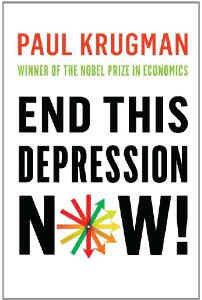
Introduction — What Do We Do Now?
This is a book about the economic slump now afflicting the United States and many other countries—a slump that has now entered its fifth year and that shows no signs of ending anytime soon. Needless to say, many books about the financial crisis of 2008, which marked the beginning of the slump, have already been published, and many more are no doubt in the pipeline. But this book is, I believe, different from most of those other books, because it tries to answer a different question. For the most part, the mushrooming literature on our economic disaster asks, “How did this happen?” My question, instead, is “What do we do now?”
Obviously these are somewhat related questions, but they are by no means identical. Knowing what causes heart attacks is not at all the same thing as knowing how to treat them; the same is true of economic crises. And right now the question of treatment should be what concerns us most. Every time I read some academic or opinion article discussing what we should be doing to prevent future financial crises—and I read many such articles—I get a bit impatient. Yes, it’s a worthy question, but since we have yet to recover from the last crisis, shouldn’t achieving recovery be our first priority?
Read more Morning Joe book excerpts
For we are still very much living in the shadow of the economic catastrophe that struck both Europe and the United States four years ago. Gross domestic product, which normally grows a couple of percent a year, is barely above its precrisis peak even in countries that have seen a relatively strong recovery, and it is down by double digits in several European nations. Meanwhile, unemployment on both sides of the Atlantic remains at levels that would have seemed inconceivable before the crisis.
The best way to think about this continued slump, I’d argue, is to accept the fact that we’re in a depression. No, it’s not the Great Depression, at least not for most of us (but talk to the Greeks, the Irish, or even the Spaniards, who have 23 percent unemployment—and almost 50 percent unemployment among the young). But it’s nonetheless essentially the same kind of situation that John Maynard Keynes described in the 1930s: “a chronic condition of subnormal activity for a considerable period without any marked tendency either towards recovery or towards complete collapse.”
And that’s not an acceptable condition. There are some economists and policy officials who seem satisfied with avoiding “complete collapse”; but the reality is that this “chronic condition of subnormal activity,” reflected above all in a lack of jobs, is inflicting enormous, cumulative human damage.So it’s extremely important that we take action to promote a real, full recovery. And here’s the thing: we know how to do that, or at least we should know how to do that. We are suffering woes that, for all the differences in detail that come with seventy-five years of economic, technological, and social change, are recognizably similar to those of the 1930s. And we know what policy makers should have been doing then, both from the contemporary analysis of Keynes and others and from much subsequent research and analysis. That same analysis tells us what we should be doing in our current predicament.
Unfortunately, we’re not using the knowledge we have, because too many people who matter—politicians, public officials, and the broader class of writers and talkers who define conventional wisdom—have, for a variety of reasons, chosen to forget the lessons of history and the conclusions of several generations’ worth of economic analysis, replacing that hardwon knowledge with ideologically and politically convenient prejudices. Above all, conventional wisdom among what some of us have taken to referring to, sarcastically, as Very Serious People has completely thrown away Keynes’s central dictum: “The boom, not the slump, is the time for austerity.” Now is the time for the government to spend more, not less, until the private sector is ready to carry the economy forward again—yet job-destroying austerity policies have instead become the rule. This book, then, attempts to break the hold of that destructive conventional wisdom and to make the case for the expansionary,job-creating policies we should have been following all along. To make that case I need to present evidence; yes, this book has charts in it. But I hope that this doesn’t make it seem technical, or keep it from being accessible to intelligent lay readers, even if economics is not their usual thing. For what I’m trying to do here is, in effect, to go over the heads of the Serious People who have, for whatever reason, taken all of us down the wrong path, at immense cost to our economies and our societies, and to appeal to informed public opinion in an effort to get us doing the right thing instead. Maybe, just maybe, our economies will be on a rapid path to true recovery by the time this book reaches the shelves, and this appeal won’t be necessary. I surely hope so—but I very much doubt it. Instead, all indications are that the economy will remain weak for a very long time unless our policy makers change course. And my aim here is to bring pressure, by means of an informed public, to get that course change, and bring an end to this depression. “Reprinted from End This Depression Now! by Paul Krugman. Copyright © 2012 by Paul Krugman. With the permission of the publisher, W.W. Norton & Company, Inc.”
The place for in-depth analysis, commentary and informed perspectives. Recommended


