








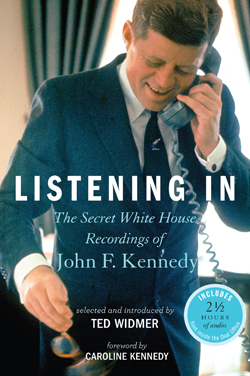
Foreward by Caroline Kennedy
All my life people have told me that President Kennedy changed their lives—they decided to join the Peace Corps, run for office, volunteer in the inner city or outer space because he asked them to—and convinced them that they could make a difference.
The generation he inspired changed this country—they fought for Civil Rights, women’s rights, human rights, and nuclear disarmament. They passed that inspiration down to us—their children and grandchildren. As the first truly modern president, my father redefined America’s timeless values for a global audience, and asked each individual to take responsibility for making this a more just and peaceful world.
As we mark the fiftieth anniversary of his presidency, my father’s time is becoming part of history rather than living memory. Yet President Kennedy’s words, his example and his spirit, remain as vital as ever. At a time when young people are often disillusioned with politics, we need to reach across the generations and recommit ourselves and our country to these ideals.
During times of uncertainty like the present, the future appears threatening and the challenges to our nation can seem almost insurmountable. Yet history reminds us that America has faced difficult and dangerous times before—and that we have triumphed over them.
Listening to these tapes now is a fascinating experience because historical perspective informs our understanding of events that were unfolding in real time for the participants. Moreover, many of the issues that defined that tumultuous time—racial justice, economic fairness, and foreign intervention—continue to dominate our national debate today. Studying a legacy of strength in the face of conflict and examining the leadership of past administrations, we can identify warning signs, critical turning points, and guiding principles that can help us deal with current crises.
I was always told that my father installed secret Oval Office recording devices after the Bay of Pigs disaster so that he could have an accurate account of who said what, in case of any later disputes as to the exact nature of the conversations. And as an avid reader of history, and a Pulitzer Prize–winning author, he intended to draw upon this material in his memoirs. The full 265 and a half hours of tape-recorded conversations that have now been made available by the Kennedy Presidential Library in Boston provide insight into the magnitude, the complexity, and the range of issues confronting a president on a daily basis. They also give a sense of the human side of the presidency—the exhilaration, the frustration, and the sense of purpose that were part of my father’s commitment to public service.
The unedited conversations are fascinating but somewhat difficult to decipher and navigate. The sound quality is often poor, and at times it is hard to figure out who is talking. Our family and the Kennedy Library are committed to making the record of my father’s presidency widely accessible, so we decided to compile significant excerpts and make them easily available to the public.
We are fortunate to have Ted Widmer as our editor and guide through this material. A historian with a comprehensive knowledge of the historical and the modern presidency, Ted also served as a speechwriter to President Clinton, edited the Library of America’s two-volume anthology of American speeches, and has written numerous books and articles on American history. We wanted this collection to include the most significant moments caught on tape, as well as snippets of conversation that give insight into the President’s mind at work and the human qualities that made him who he was: serious, purposeful, curious, skeptical, impatient, probing, principled, amused. Ted has done a masterful job of listening, transcribing, selecting, and illuminating this audio record. As always, I am deeply grateful to the archivists and staff of the John F. Kennedy Presidential Library and Museum and the entire National Archives, who preserve, catalogue, archive, and study the documents, tapes, films, memorabilia, and ephemera that form the stuff of history. Their dedication and their commitment to excellence is something all Americans should find inspiring. For me, listening to these conversations is a powerful experience. Although at the time, I was too young to understand much of what was happening, I recall spending happy afternoons eating candy and making paper-clip necklaces under my father’s desk while men talked in serious voices. The delight in my father’s voice when my brother and I appear is something I treasure. I especially hope young listeners will find these selections interesting enough that they will want to further study the Kennedy presidency, and I trust that those who remember these times will gain new perspective. I hope that people will be drawn into the drama and the daily routine of the presidency, that they will feel they have learned something about the kind of person my father was, and most of all, I hope they will be inspired to serve our country as he did. Excerpted From “LISTENING IN: The Secret White House Recordings of John F. Kennedy” selected and introduced by Ted Widmer; Foreword by Caroline Kennedy. Copyright © 2012 The John F. Kennedy Library Foundation, Inc. Published by Hyperion. Available wherever books are sold. All Rights Reserved.
Drew Katchen Recommended


