








Arjun Khan straightened his tie, brushed a lint ball off the charcoal gray suit he’d bought for $179 at Lord and Taylor to wear to his high school graduation, gave his hair a final pat, inspected his teeth for food in the bathroom mirror, and bounded out the door of his apartment and into the elevator of his downtown high-rise.
A confident, bright-eyed twenty-two-year-old with an aquiline nose and a slight belly paunch, Arjun was on his way to his first day of work as a mergers and acquisitions analyst at Citigroup. His neck muscles were tense and his stomach was turning over, but those were just surface nerves. Mostly, he was filled with the flinty resolve of the newly emboldened. After thousands of hours of preparation, dozens of interviews and expertly crafted e-mails, and one extremely lucky break, he had finally become a junior investment banker at a major Wall Street firm — the job he’d been chasing for years.
Nine months earlier, Arjun’s plans had been derailed by the financial crisis. The Queens-born son of a data engineer father and a social worker mother who had both emigrated from India to New York as young professionals, he headed into the fall of his senior year with a prestigious job offer at one of the best banks on Wall Street: Lehman Brothers.
Arjun felt lucky to have gotten Lehman’s attention in the first place. He attended Fordham University, a Jesuit school in the Bronx that, while strong academically, wasn’t among Wall Street’s so-called target schools, a group that generally included the Ivies, plus schools like Stanford, New York University, Duke, and the University of Chicago. That meant he had to work harder to get his foot in the door — joining the Finance Society at Fordham, attending lectures at Columbia Business School, spending his free time watching CNBC to pick up the cadence of the investor class. And his strategy worked. He secured a junior-year internship at Lehman, and he did well enough that at the end of the summer, he was offered a fulltime job beginning after his graduation. His recruiter told him, sotto voce, that he had been the only Fordham student to get an offer from Lehman that year.
During Arjun’s internship, things began to go south. Ever since the Bear Stearns collapse earlier that year, industry watchers had been speculating that Lehman would be the next bank to fail. The firm’s stock price had tumbled, thousands of workers had gotten laid off, and one well-regarded hedge fund manager jolted Wall Street that summer by proclaiming that Lehman wasn’t properly accounting for its real estate investments. Still, Arjun assumed that Lehman would be fine.
He was wrong, of course. In September 2008, while Arjun was starting his senior year at Fordham, Lehman filed for bankruptcy. (Most of its U.S. operations were bought several weeks later by Barclays Capital, the investment banking arm of the large British firm.) The same day, Merrill Lynch, which had also been pummeled by the housing collapse, announced it was selling itself to Bank of America for $50 billion. AIG, an insurer weighed down by towering piles of credit default swaps, had to be given a massive $182 billion bailout, and Goldman Sachs and Morgan Stanley, the last freestanding American investment banks, turned themselves into bank holding companies in order to give themselves better access to the Federal Reserve’s emergency lending window. Congress passed a $700 billion bailout package that gave a lifeline to banks and kept the markets afloat, and the entire country sunk into a recession that would cost millions of jobs, engulf every sector of the economy, and…well, you can probably fill in the rest.
From the Fordham campus, Arjun watched reports about Lehman’s bankruptcy with a knot in his stomach, knowing that it would probably cost him his job. And several weeks after the bank’s sudden death, he was in chemistry class when he got a call from an unfamiliar number with a 212 area code. He let the call go to voice mail, then checked it in the hall after class.
“Hi Arjun, this is John from Barclays Capital,” the voice on the message said. “Obviously, you know why I’m calling. I just wanted to let you know that I’m very sorry, but we’re not going to have a seat for you next summer.”
After the bankruptcy, Barclays Capital’s human resources department tried to help Lehman’s spurned analysts find new jobs. But that just salted the wound. One human resources staffer pointed Arjun to a job at a small private wealth management firm in Miami — the financial sector equivalent of being cut from the Yankees’ starting lineup and offered a benchwarmer spot with the Toledo Mud Hens.
“I’m just interested in investment banking,” Arjun told the staffer. “I don’t care what city it’s in.”
Arjun knew that Wall Street operated on a strict power hierarchy. Within every firm, there were so-called back-office workers who cleared trades, maintained the firm’s computer systems, and performed all other kinds of technical and administrative work. One step up was the middle office, which comprised lots of disparate jobs that were important to the functioning of the bank but were not revenue-generating in their own right: legal, compliance, internal risk management. And then there was the promised land: the front office. The front office was what everyone pictured when they thought of Wall Street — pinstripe-clad deal makers and red-faced traders, making millions and getting their work on the front page of the Wall Street Journal. And when he decided to pursue a job in finance, Arjun decided he would accept nothing less.
But now, everything had changed. With the failures of Bear Stearns and Lehman Brothers and the sale of Merrill Lynch, the so-called bulge bracket of top-tier American banks was whittled down to just five firms: Goldman Sachs, Morgan Stanley, Citigroup, Bank of America Merrill Lynch, and JPMorgan Chase. And even those firms looked to be in jeopardy. All around the financial sector, the markers of success and failure were shifting. Tiny boutique firms were weathering the changes better than global financial conglomerates. In some cases front office bankers were being laid off while back-office IT workers were being promoted. Up was down. Down was up.
That year, as the crisis unfolded, the message boards at Wall Street Oasis, a popular finance-industry website, filled with posts from confused young finance aspirants, wondering what the industry’s changes would mean for them:
Reconsidering Wall Street?
Will banking recover? How long?
Are banks really not hiring for the fall?
In September, one poster summarized many of the fears about what would happen to the financial industry: “I think it’ll be a long time, if ever, before the swagger returns to Wall Street. The ‘Masters of the Universe’ image has been shattered.”
Newly jobless, Arjun spent the rest of his senior year looking for work. He applied to financial internships on Craigslist, sent out dozens of résumés and cover letters, and pressed on every finance-industry connection he had. But nothing materialized — nobody was hiring. Finally, in late spring of his senior year, Citigroup contacted him about a last-minute opening in the bank’s mergers and acquisitions division, where they needed another analyst to help with a bigger-than-expected workload going into the summer. Citigroup, like most banks, had been battered by the financial crisis, losing billions of dollars and being saved only by a massive government bailout. But the bank was alive, and it was doing deals again. Arjun knew that with the year’s recruiting cycle already over, it was likely to be the only front-office offer he would get. So a few weeks before his college graduation, he accepted.
Throughout college, Arjun had drawn inspiration from the lives of people who had made it big on Wall Street despite not having the advantages of privilege or pedigree. The most famous example was Sidney Weinberg, a working-class Jewish kid from the slums of Brooklyn who started as a janitor’s assistant at Goldman Sachs in 1907 and eventually worked his way up to become the senior partner of the firm. But there were more recent role models, too. Arjun knew, for instance, that there had been a Lebanese-American executive who had gone to Pace University — not exactly a finance feeder school — yet had become the vice chairman of Bear Stearns and one of the most powerful deal makers on Wall Street. Even Citigroup’s CEO, Vikram Pandit, was an Indian-born outsider who had trained as an electrical engineer before breaking into finance. On Wall Street, he thought, it didn’t matter whether you were a blueblooded WASP with degrees from Exeter and Harvard or, like him, an Indian kid from Queens with no family connections. If you were talented, if you could make money, and if you were willing to kick down every obstacle in your path, you could qualify as what is known in certain parts of the financial world as a “PHD” — a “poor, hungry, and driven” worker — and, eventually, you could make it to the inner circle.
But now, as he surveyed the wreckage of the crisis, Arjun felt even less sure than ever that the old social compact still held. After all, who knew what would happen to Wall Street in a year? More banks could go under. Entire lines of business could be wiped out by new regulations. There was no telling whether New Wall Street would look anything like Old Wall Street, or whether the traits that had mattered in American finance for the better part of three hundred years — hard work, hustle, and commercial instinct — would still be rewarded in the future.
As he got ready for work on his first day, though, Arjun’s anxiety was trumped by excitement. In the worst Wall Street hiring climate in a generation, he’d finally gotten a seat at the table. He was proud of how far he’d come. He knew he’d made his parents proud, too, by getting a job at a prestigious bank they recognized by name and reputation. And he was determined to prove to his new colleagues that he could work every bit as hard as they did, even if he didn’t have an Ivy League degree behind him or a trust fund lying in wait.
As he walked out into the brightly lit Manhattan streets that morning, Arjun gave his building’s front desk attendant a smile and a wave. Then, he walked through the open door, pointed his cap-toe shoes toward the bank, and started to strut.
Chapter 3
After my Excel boot camp was over, I decided to back up a bit and try to answer a more basic question about young financiers: namely, how do they get to Wall Street in the first place? So I booked a ticket to a place where the vast majority of financial careers are born — the campus of an elite university — and went to see the finance recruiting machine in action.
I wound up in Philadelphia, on the campus of the University of Pennsylvania. On the day I arrived, it was raining buckets, but a biblical flood wouldn’t have kept a small army of students from making their way to Houston Hall. There, in their illfitting suits, their leather padfolios clutched tightly to their sides, hundreds of eager Penn sophomores, juniors, and seniors filed into a recruiting session for Morgan Stanley, where they would hear a one-hour pitch for the bank’s virtues and, hopefully, score a business card or two.
When most of the seats were filled, the lights inside the room dimmed, and a Morgan Stanley recruiter pressed Play to begin a promotional video. Upbeat pop-rock music played as the screen filled with text banners:
IN THE FINANCE WORLD, EVERY DAY IS A NEW DAY.
SOME DAYS, FORTUNES WILL BE MADE. OTHER DAYS, HISTORY WILL.
THE STORY OF A NEW GENERATION OF LEADERS.
FROM THE FIRM THAT BROUGHT YOU GOOGLE, UPS, AND JETBLUE COMES THE OPPORTUNITY OF A LIFETIME.
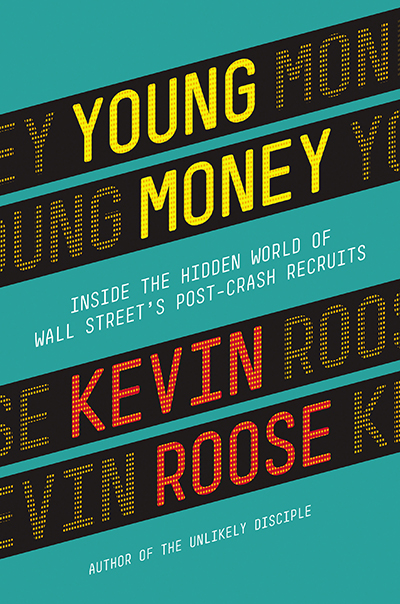
BOUNDARIES WILL BE SHATTERED. EVERY VOICE WILL BE HEARD. AND THE FUTURE WILL BE BRIGHT. When looking at schools to visit, I singled out Penn for a reason. Like all Ivy League schools, Penn sends a chunk of its graduating class into the financial services industry every year — about 30 percent in 2009. But Penn’s link with Wall Street is particularly tight because its Wharton School, a business program that contains both graduate students and undergrads, is considered America’s primo farm team for budding young financiers — a sort of West Point for Wall Street. More than half of Wharton’s six-hundred-person undergraduate class typically heads to banks, hedge funds, private equity firms, and other financial services companies after graduation. Among the celebrity financiers the school has churned out are SAC Capital billionaire Steven A. Cohen, the junk-bond impresario Michael Milken, and real estate megagoon Donald Trump. Wharton’s list of famous alumni, and the fact that its graduates emerge armed with advanced finance training, has made it a place where recruiters are prone to drooling. “Penn, and especially Wharton, is in a league of its own,” one hiring manager at a top Wall Street firm told me. “It’s the only place where you go to campus and it’s already done and dusted — it’s a matter of which financial services firm students want to go to, not whether they want to go into finance.” (Patricia Rose, the head of Penn’s career services department, gave a slightly milder diagnosis: “To come to Penn is to, at some point in your undergraduate years, ask yourself the question, ‘Should I think about investment banking?’”) These days, financial firms — as well as top-tier management consulting firms like Bain and McKinsey — court Wharton students in a manner reminiscent of very polite stalking. They barrage students with information sessions, interview workshops, lavish restaurant meals, “sell days” in New York City, followup calls, and follow-up calls to the follow-up calls. At Wharton, these firms behave less like faceless corporate entities than like insecure middle schoolers, desperately fishing for clues about whether their favorite students like them back. Getting a job at a top firm on Wall Street, even with a Penn degree in hand, is never easy. But it’s especially hard when the financial industry is in turmoil, since a similar crowd of applicants competes for fewer spots. (In one recent year, Morgan Stanley received 90,000 applications for 1,200 full-time analyst positions — an acceptance rate of 1.3 percent.) And most banks draw between 50 and 90 percent of their full-time hires from the previous year’s pool of summer interns, meaning that competition for the best offers is often all but locked up by junior year. The race for Wall Street jobs is so cutthroat that an entire cottage industry has sprung up to give aspiring bankers a boost. You can now buy the “Investment Banking Interview Prep Pack” for $79.99 from Wall Street Oasis; the “Ace the Technical Investment Banking Interview” webcast and PDF guide for $99 from Wall Street Prep; or, if you’re really playing catch-up and don’t mind shelling out, a four-day “Intern Core Skills” workshop from Adkins Matchett and Toy for $3,000. Wharton students generally don’t need these study aids, since they already learn advanced financial skills in their classes. Still, in an attempt to garner offers from their financial firms of choice, they spend months burnishing their résumés, practicing their interview skills and elevator pitches, and poring over the Money and Investing section of the Wall Street Journal in order to arm themselves with sufficient knowledge to impress the recruiters. And then, every year, they head off to information sessions to begin closing the deal. It wasn’t always such an ordeal. For many years, Wall Street banks recruited like any other corporation — hiring a handful of graduates from top colleges to fill their junior ranks and employing them indefinitely. But in the early 1980s, banks began instituting what became the modern Wall Street recruiting program, in which college seniors are hired for two-year stints as analysts. After their two years are up, analysts are expected to find work at a hedge fund or private equity firm, or, in a few cases, get an offer to stay on for a third year of banking. The ones who don’t are gently shown the door. This new plan, nicknamed “two and out,” was a brilliant tactical move. Selling Wall Street jobs to undergraduates as a temporary commitment rather than a lifelong career enabled banks to attract a whole different breed of recruit — smart, ambitious college seniors who weren’t sure they wanted to be bankers but could be convinced to spend two years at a bank, gaining general business skills and adding a prestigious name to their résumés in preparation for their next moves. The strategy also created a generation of accidental financiers — people who had graduated from elite colleges with philosophy or history degrees, had no specific interest in or talent for high finance, yet found themselves still collecting paychecks from a big bank three decades later. At Penn, though, most of the enthusiasm was genuine. “Finance is a great industry filled with great people,” one revved-up student told me. “Traders are probably the coolest people you’ll ever meet!” raved another. Morgan Stanley’s actual recruiting pitch was a fairly unremarkable collection of corporate banalities (“culture of excellence,” “world-class mentoring opportunities”) and promises of prestigious “exit opps” once the analyst years were over. But few words were given to describing the actual, day-to-day work of being a first-year analyst. And nobody from the bank mentioned the biggest reason a college senior might be attracted to Wall Street — namely, the fact that first-year analyst jobs pay a starting salary of around $70,000, with a year-end bonus that can be upwards of $50,000. The lack of overt focus on money surprised me, though perhaps it shouldn’t have. As strange as it sounds, a big paycheck may not in fact be central to Wall Street’s allure for a certain cohort of young people. This possibility was explained to me several weeks before my Penn trip by a second-year Goldman Sachs analyst, who stopped me short when I posited that college students flock to Wall Street in order to cash in. “Money is part of it,” he said. “But mostly, they do it because it’s easy.” He proceeded to explain that by coming onto campus to recruit, by blitzing students with information and making the application process as simple as dropping a résumé into a box, by following up relentlessly and promising to inform applicants about job offers in the fall of their senior year — months before firms in most other industries — Wall Street banks had made themselves the obvious destinations for students at top-tier colleges who are confused about their careers, don’t want to lock themselves in to a narrow preprofessional track by going to law or medical school, and are looking to put off the big decisions for two years while they figure things out. Banks, in other words, have become extremely skilled at appealing to the anxieties of overachieving young people and inserting themselves as the solution to those worries. And the irony is that although we think of Wall Street as a risk-loving business, the recruiting process often appeals most to the terrified and insecure. “It’s incredibly risk averse,” the Goldman analyst told me. “Think about it: if you go to a bank, you make as much money as anything except hedge funds, private equity, or possibly a tech startup. Those things are wildly more risky and a lot harder to do. So if a bank comes to me with an opportunity to lock down a good, high-paying job in September of my senior year without working too hard for it, I’m going to privilege that over anything else I might be thinking about doing.” After watching Penn students line up to nab precious seconds of face time with Morgan Stanley recruiters that night, I couldn’t help feeling like not much had changed since the financial crisis. Whether because of the structured, well-timed nature of recruiting or simply Penn’s finance-centric campus culture, the fact remained that these jobs were still objects of intense desire. Even a financial near-Armageddon, it seemed, hadn’t been able to dislodge Wall Street from its pedestal. And I wondered: if students at Penn couldn’t be swayed from their synchronized march to big banks by the worst economic crisis since the Great Depression, was the financial sector’s allure simply irresistible? Excerpted from the book Young Money by Kevin Roose. Copyright 2014 by Kevin Roose. Reprinted by permission of Grand Central Publishing. All rights reserved.
Morning staff Recommended


