








Introduction
The world is now interactive and interdependent. it is also, for the first time, a world in which the problems of human survivalhave begun to overshadow more traditional international conflicts. Unfortunately, the major powers have yet to undertake globally cooperative responses to the new and increasingly grave challenges to human well-being—environmental, climatic, socioeconomic, nutritional, or demographic. And without basic geopolitical stability, any effort to achieve the necessary global cooperation will falter.
Indeed, the changing distribution of global power and the new phenomenon of massive political awakening intensify, each in its own way, the volatility of contemporary international relations. As China’s influence grows and as other emerging powers—Russia or India or Brazil for example—compete with each other for resources, security, and economic advantage, the potential for miscalculation and conflict increases. Accordingly, the United States must seek to shape a broader geopolitical foundation for constructive cooperation in the global arena, while accommodating the rising aspirations of an increasingly restless global population.
With the foregoing in mind, this book seeks to respond to four major questions:
1. What are the implications of the changing distribution of global power from the West to the East, and how is it being affected by the new reality of a politically awakened humanity?
2. Why is America’s global appeal waning, what are the symptoms of America’s domestic and international decline, and how did America waste the unique global opportunity offered by the peaceful end of the Cold War? Conversely, what are America’s recuperative strengths and what geopolitical reorientation is necessary to revitalize America’s world role?
3. What would be the likely geopolitical consequences if America declined from its globally preeminent position, who would be the
almost-immediate geopolitical victims of such a decline, what effects would it have on the global-scale problems of the twenty-firstcentury, and could China assume America’s central role in world affairs by 2025?
4. Looking beyond 2025, how should a resurgent America define its long-term geopolitical goals, and how could America, with itstraditional European allies, seek to engage Turkey and Russia in order to construct an even larger and more vigorous West? Simultaneously, how could America achieve balance in the East between the need for close cooperation with China and the fact thata constructive American role in Asia should be neither exclusively China-centric nor involve dangerous entanglements in Asian conflicts?
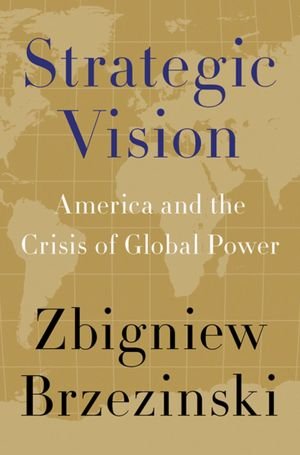
In answering these questions this book will argue that America’s role in the world will continue to be essential in the years to come. Indeed, the ongoing changes in the distribution of global power and mounting global strife make it all the more imperative that America not retreat into an ignorant garrison-state mentality or wallow in self-righteous cultural hedonism. Such an America could cause the geopolitical prospects of an evolving world—in which the center of gravity is shifting from West to East—to become increasingly grave. The world needs an America that is economically vital, socially appealing, responsibly powerful, strategically deliberate, internationally respected, and historically enlightened in its global engagement with the new East.
How likely is such a globally purposeful America? Today, America’s historical mood is uneasy, and notions of America’s decline as historically inevitable are intellectually fashionable. However, this kind of periodic pessimism is neither novel nor self-fulfilling. Even the belief that the twentieth century was “America’s century,” which became widespread in the wake of World War II, did not preclude phases of anxiety regarding America’s long-range future.
When the Soviet Union launched Sputnik, its first orbital satellite, during the Eisenhower administration, Americans became concerned about their prospects in both peaceful competition and strategic warfare. And again, when the United States failed to achieve a meaningful victory in Vietnam during the Nixon years, Soviet leaders confidently predicted America’s demise while historically pessimistic American policy makers sought détente in exchange for the status quo in the divided Europe. But America proved to be more resilient and the Soviet system eventually imploded. By 1991, following the disintegration both of the Soviet bloc and then the Soviet Union itself, the United States was left standing as the only global superpower. Not only the twentieth but even the twenty-first century then seemed destined to be the American centuries. Both President Bill Clinton and President George W. Bush confidently asserted as much. And academic circles echoed them with bold prognoses that the end of the Cold War meant in effect “the end of history” insofar as doctrinal debates regarding the relative superiority of competing social systems was concerned. The victory of liberal democracy was proclaimed not only as decisive but also as final. Given that liberal democracy had flowered first in the West, the implied assumption was that henceforth the West would be the defining standard for the world. However, such super-optimism did not last long. The culture of self-gratification and deregulation that began during the Clinton years and continued under President George W. Bush led to the bursting of one stock market bubble at the turn of the century and a full-scale financial crash less than a decade later. The costly unilateralism of the younger Bush presidency led to a decade of war in the Middle East and the derailment of American foreign policy at large. The financial catastrophe of 2008 nearly precipitated a calamitous economic depression, jolting America and much of the West into a sudden recognition of their systemicvulnerability to unregulated greed. Moreover, in China and other Asian states a perplexing amalgam of economic liberalism and statecapitalism demonstrated a surprising capacity for economic growth and technological innovation. This in turn prompted new anxiety about the future of America’s status as the leading world power. Indeed, there are several alarming similarities between the Soviet Union in the years just prior to its fall and the America of the earlytwenty-first century. The Soviet Union, with an increasingly gridlocked governmental system incapable of enacting serious policy revisions, in effect bankrupted itself by committing an inordinate percentage of its GNP to a decades-long military rivalry with the United States and exacerbated this problem by taking on the additional costs of a decade-long attempt to conquer Afghanistan. Not surprisingly, it could not afford to sustain its competition with America in cutting-edge technological sectors and thus fell further behind; its economy stumbled and the society’s quality of life further deteriorated in comparison to the West; its ruling Communist class became cynically insensitive to widening social disparities while hypocritically masking its own privileged life-style; and finally, in foreign affairs it became increasingly self-isolated, while precipitating a geopolitically damaging hostility with its once-prime Eurasian ally, Communist China. These parallels, even if overdrawn, fortify the case that America must renew itself and pursue a comprehensive and long-term geopolitical vision, one that is responsive to the challenges of the changing historical context. Only a dynamic and strategically minded America, together with a unifying Europe, can jointly promote a larger and more vital West, one capable of acting as a responsible partner to the rising and increasingly assertive East. Otherwise, a geopolitically divided and self-centered West could slide into a historical decline reminiscent of the humiliating impotence of nineteenth-century China, while the East might be tempted to replicate the self-destructive power rivalries of twentieth-century Europe. In brief, the crisis of global power is the cumulative consequence of the dynamic shift in the world’s center of gravity from the West to the East, of the accelerated surfacing of the restless phenomenon of global political awakening, and of America’s deficient domestic and international performance since its emergence by 1990 as the world’s only superpower. The foregoing poses serious longer-term risks to the survival of some endangered states, to the security of the global commons, and to global stability at large. This book seeks to outline the needed strategic vision, looking beyond 2025. Zbigniew BrzezinskiMarch 2011
The place for in-depth analysis, commentary and informed perspectives. Recommended


