Imagine a system with hundreds of billions of dollars in revenue, one that is rapidly expanding and taking up more and more market share. Imagine that this system claims to be charitable, but in practice “provides only an average amount of charity care,” and serves fewer low-income people than comparable institutions. At the same time, this system offers legal protection for denying women life-saving healthcare.
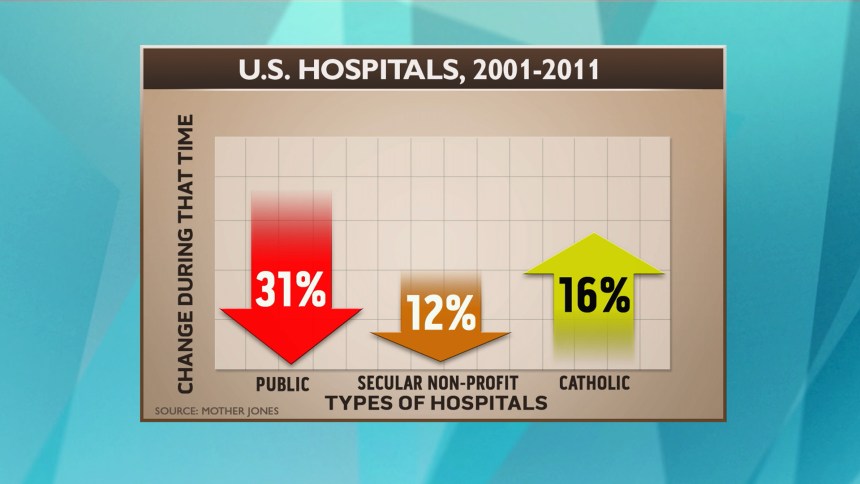
The system in question is the array of Roman Catholic-affiliated hospitals in the United States, which, according to a new report from the American Civil Liberties Union and MergerWatch, now are responsible for one in nine hospital beds. In the past decade, the number of such hospitals has risen by 16%, thanks to mergers that often leave the new combined organization under Catholic health care directives.
According to the authors of Miscarriage of Medicine report, released Thursday, such hospitals “have organized into large systems that behave like businesses – aggressively expanding to capture greater market share – but rely on public funding and use religious doctrine to compromise women’s health care.” The report notes that “if these 10 Catholic systems were viewed as one, they would constitute the largest health system in the country.”
Most people are familiar with Catholic prohibitions on elective abortion, but don’t realize how the directives affect a range of reproductive services. They encompass denying access to emergency contraception to rape victims, refusing to perform tubal ligations on women who are having cesarean sections, declining to offer prenatal diagnosis if there is an “intention of aborting an unborn child with a serious defect,” and putting miscarrying women at risk of infection by refusing to end a non-viable pregnancy.
The ACLU recently brought a suit against the United States Conference of Catholic Bishops, on behalf of a woman who miscarried at a Catholic hospital in Michigan. They charge that Tamesha Means was put at further risk by Catholic directives prohibiting abortion that were also applied to involuntary miscarriage. Many of these Catholic health organizations are the same ones who say their own religious values are being trammeled by the Obama administration. Under the Affordable Care Act, religious institutions like churches, which primarily employ or serve fellow members of their religion, can opt out of the requirement to cover contraception if it violates their beliefs. Medical associations and universities that are affiliated with the Catholic church but have employees that don’t follow its teachings on contraception were granted an accommodation that allowed employees to get their contraception directly covered by the insurer. But several such organizations have sued the administration, claiming their religious freedom rights are still being violated by the third-party accommodation because they’re still technically involved in their employees getting contraception. On Monday, a federal district court judge in New York agreed, saying the accommodation still violates the religious freedom of the Roman Catholic Archdiocese of New York, and granting them a permanent injunction. Last month, MergerWatch director Lois Uttley participated in a discussion about Catholic hospitals and women’s healthcare on Melissa Harris-Perry. Watch:
Irin Carmon Recommended