








Ed. note: Today, on the third anniversary of the Haiti earthquake, host Melissa Harris-Perry took a fresh look at what remains a disaster. After doing some accounting for where things stand now in “Go Figure” (above), she opened up a frank discussion concerning the faulty recovery, much of which is laid at the feet of the non-governmental organizations and volunteers flooding into the country.
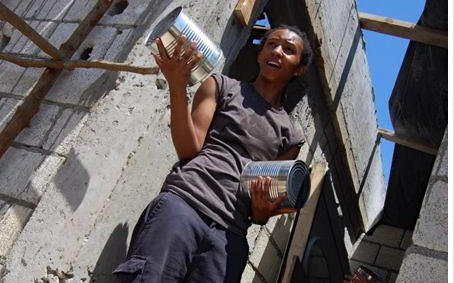
Harris-Perry’s niece, college student Christina Smith, served as a volunteer in Haiti, and offers her perspective below.
I worked as a volunteer for a week in Port-au-Prince shortly after the earthquake hit. Heading there, as I looked out of the airplane window, I searched for houses and buildings. I saw only rubble. I searched for people in their cars on highways, but found only dirt roads.
The only thing I saw was destruction and miles of blue tarp, known as a “tent city.” Those tent cities that I saw, and touched, still stretch across the country sides of Haiti while many people remain homeless and unemployed as the country is still in the phase of rebuilding. Knowing this, I start to look back on the time I spent helping in Haiti and wonder if I really made a difference.
While we did many things as volunteers, from making food kits for surrounding villages to unloading imported relief supplies from crates, my most life-changing experience was working with a medical team from Nebraska at a small church by the name of New Jerusalem. New Jerusalem is an orphanage for the deaf and mute located in a small town called Mirebalais where the population more than doubled due to the earthquake, and where medical care was in high demand. We set up a small medical clinic where whoever could get there would be seen. We saw sickness and death, but one thing that I will always remember is that the hope and the pride of their country never left their hearts.
My efforts felt so minuscule compared to the overall needs that the people required. But now looking back as an adult I understand that I brought the ultimate supply that the Haitian people needed and that was hope. I was not just doing my daily work, I was also staying awake through the night with the hotel employees learning Creole French, and with the United Nations soldiers learning Italian. Often times the people of Haiti would stare when they saw me, the only person of color in my group and would demand of my escorts to tell them who I was; they had never seen an African-American before, and especially not working in relief efforts in their country. (This has to change.) I believe that my time spent in Haiti made a difference. At the three-year anniversary of this tragedy, I only pray that the people I met and grew to love still are able to enjoy life, and that they have still not given up on their country. I want to go back, to find the college students I met, to find the boy that would be my brother’s age now, to find the people we helped in the hospital–and tell them that even though they may seem forgotten, that at least one person will never forget them. Christina Smith is a student at Eckerd College, and a former MHP summer intern.
Christina Smith Recommended


