








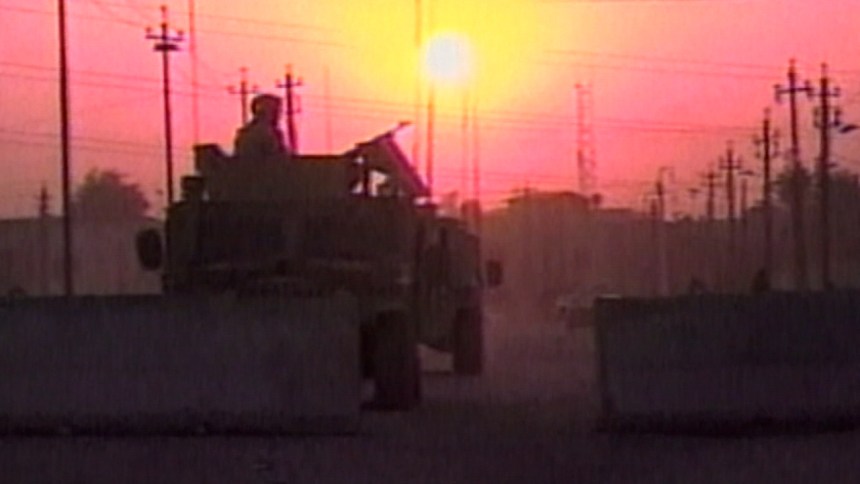
I loved the military. I especially loved the men with whom I served. The fact that 19 of them never made it home from Iraq continues to haunt me today. My reflections on the Iraq War, now almost 10 years after we came home, still seem too raw-–especially when the nation I love has moved on and doesn’t seem to have learned its lesson from an unnecessary war.
In Iraq, I led a BOLT team with the 82nd Airborne Division (Brigade Operational Law Team) in south-central Baghdad. It was my second post-9/11 deployment. We suffered through the 138-degree heat with few showers and the constant threat of danger from mortar fire, roadside bombs, and AK-47s.
One decade later, the greatest lessons of the Iraq War are not about counterinsurgency strategy or military tactics. Rather, we must ask how a great nation like ours could be manipulated by civilian leadership that championed faulty intelligence, ignored its military experts, and had none of their family serving in the military. How could we repeat the lessons that we should have learned from past wars?
When I think of Iraq, I think about every single person on our team and how Iraq changed each of us–for the better and the worse. I think about Sergeant Sean “Stick” Scarborough, a wiry Texan, rail-thin, who loved Notre Dame football and smoking cigarettes. I think about Private First Class Juan “RV” Arevalo, a tall, hysterically-funny Mexican-American who told everyone he met in Iraq how rich he was because his $16,000 salary was tax-free in a combat zone. And I think of Captain Koby Langley, a brilliant and physically commanding African-American who graduated from Notre Dame and was a proud paratrooper in the 82nd Airborne Division. These three men are part of America’s 1% –the population who have served in our nation’s longest wars. Of 330 million Americans, just 2.5 million have served in Iraq, Afghanistan, and the lesser known fronts in the war on terror including the Philippines, Djibouti, or Guantanamo Bay. A total of 4,486 lost their lives in Iraq, but the men I was directly responsible for all made it home alive.
Looking back on the war, I am most struck by how the Bush administration, in its reckless arrogance, broke faith with the men and women of U.S. military and with the American people.
The justification for an offensive war against Iraq was based on intelligence that was known to be faulty. Yet the top-level leadership in the Bush administration played the media, well aware that the information they were promoting was unreliable at best, if not inaccurate as judged by our own intelligence agencies at the time.
The Bush administration said the war would be a short, 18-month campaign–instead it lasted nine years–and that American troops would “be greeted as liberators,” as Vice President Dick Cheney asserted. It belittled the highest ranking Army General, Eric Shinseki, when he warned that a successful occupation would require several hundred thousand soldiers, a prediction that then Deputy Defense Secretary Paul Wolfowitz denounced as “wildly off the mark.”
The administration failed even to adequately equip the troops it sent into harm’s way. In the early years of the war, American troops resorted to using scrap metal to reinforce their vehicles against explosive devices. When asked why the world’s greatest military power was scavenging for armor, Defense Secretary Donald Rumsfeld famously replied, “You go to war with the Army you have.” Meanwhile, military families across the country took matters into their own anxious hands, mailing flak jackets via FedEx to their loved ones in Iraq. That is not how it’s supposed to work.
Just a few days into my tour, I knew firsthand just how true this would be. At 2 am, just setting into my cot, inches away from other paratroopers to my left and right, I was jarred from bed by my executive officer. “Murph, get up and report to the TOC (Tactical Operations Center). We have a KIA.” Paratrooper, Specialist Chad Keith, from Batesville, Ind., was killed by a roadside bomb. My team and I launched an investigation, appointing a personal effects officer in Iraq and another back at Fort Bragg to catalog his possessions. Another paratrooper returned home with the casket. The next night was a makeshift memorial service. Keith’s boots, helmet and M4 assault rifle symbolized his service while TAPS playing in the background.
The price for the Bush administration’s arrogance fell on the shoulders of the men and women of the United States Armed Forces and their families. In 2003, with American troops dying each month, Rumsfeld and other Pentagon leaders supported cuts to combat pay and family separation allowances for active duty troops. The next year, as the insurgency grew, President Bush participated in an outrageous skit showing him searching for WMDs in his office, joking “those weapons of mass destruction have got to be somewhere!” The premise that sent our men and women into combat was now a common White House joke.
As the war in Iraq stretched on, our men and women in uniform endured repeated deployments to fight a war that should never have begun in the first place.
Colleagues like Captain Koby Langley were among the thousands who saw their marriages fall apart from constant deployments. When I asked Koby last week how it happened, he was typically blunt, “When I came home, my own family didn’t recognize me, and my first marriage was already crashing hard against the unforgiving rocks of mistrust and suspicion…The man that left for Iraq would have forgiven my ex-wife…the one that came back couldn’t even breathe the words.”
My friend Jon Soltz, who served with me in Baghdad but in a different unit, founded VoteVets.org. “Coming home is harder than fighting in the war,” he says.
To folks like our friend Stick, this became tragically true. After Stick and his fiancé broke up, he too often found comfort in a bottle of Jack Daniels. Ever the fighter, Stick went through a couple different treatment centers for his alcoholism. In 2009, he had an adverse reaction to his medication when he mixed it with alcohol, and he fell down hard. Killed by blunt force trauma–not in combat but back home where he was supposed to be “at peace.” Like so many others, he left this world too early. Had the architects of the Iraq War served during wartime themselves, or had children serving in the military, perhaps the administration would have better understood the costs of the conflict it chose to create. The four main architects of the Iraq War did not fight their generation’s war in Vietnam. Cheney accepted numerous deferments during the Vietnam War: in his own words, he “had other priorities in the ’60s than military service.” Bush joined the Texas Air National Guard–which, it was clear, would not be called for service in Vietnam. Wolfowitz never served, while Rumsfeld spent three years on active duty during peacetime. Today, the percentage of veterans serving in our nation’s highest public offices is at its lowest ever. Only 20% of the nation’s members of Congress have served in the military; 40 years ago that figure was over 70%. Maybe if more leaders knew firsthand the costs of war, they wouldn’t be so quick to inflict that experience on the generation of young soldiers that follows them. Like most who served in Iraq, RV, Stick, and Koby all made it home alive. RV is doing terrific. He earned his degree from Texas A&M on the GI Bill and serves as a state trooper. He recently bought a home under the VA Home Loan program and is halfway through obtaining his Master’s Degree in agricultural development. After serving with distinction in the VA and Pentagon, Koby is now leading the charge for civilian service in the AmeriCorps and PeaceCorps as a senior adviser at the Corporation for National and Community Service. He’s remarried and raising a daughter in Maryland. I talk to my guys about every month or two, and usually see Koby the most because he’s so active in veterans outreach. I see RV once a year, but like a family member, no matter how long we go without talking, it’s like we saw each other yesterday. Stick may be gone from this Earth, but for those of us who served with him and loved him like a brother, he lives on. We owe it to him, to the 4,486 Americans who made the ultimate sacrifice, the over 100,000 Iraqis who lost their lives, and most important, to the next generation who will serve our nation in uniform, to learn the tragic lessons of this unnecessary war in hopes it never happens again. Read more: Intelligence experts knew the case for war was faulty. Why didn’t they speak out? And where are the architects of the Iraq war now, a decade later?
Patrick Murphy Recommended


