








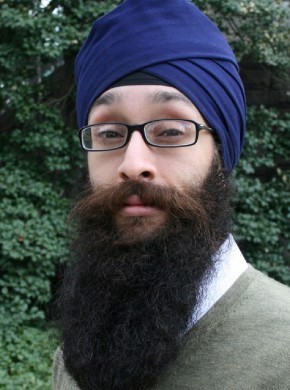
Last Saturday night, a young man dropped his wife and one-year old at home and went for a walk in Harlem. Soon thereafter, he heard “Get Osama!”
Twenty men on bicycles chased him down, pulled his beard, and punched him to the ground. The blows would not stop as his assailants called him a “terrorist.” When bystanders came to his aid, he was rushed to the hospital, his face bloody and bruised, and his jaw fractured.
The victim, Dr. Prabhjot Singh, is a young professor and doctor who also happens to be a leading voice calling for the government to do more to combat hate in America. He is not only a Sikh committed to service, but a model for a new generation of American leadership. As Director of Systems Design at the Earth Institute, an assistant professor at Columbia University, and a practicing doctor in East Harlem, he is a powerful voice for health care justice.
A horrific mass shooting at a Sikh house of worship in Oak Creek, Wisc., 13 months ago became the largest hate-based attack on a faith community since the 1963 bombing of Birmingham’s 16th Street Baptist Church. In response, Dr. Singh argued in the New York Times that the government was wrongfully classifying all hate crimes against Sikhs as anti-Muslim–and so failing to accurately measure the problem and prevent further violence.
Committed to combating hate, now he’s survived the same violence he fights hard to prevent. The irony of this attack is not lost. But it’s hardly isolated. “What happened did not happen in a vacuum,” said Amardeep Singh of the Sikh Coalition. “Here in New York City, we regularly receive reports that Sikh school children are called ‘Bin Laden’ or ‘terrorist’… [and] endure physical violence.”
Prabhjot Singh wears a turban and beard as part of his faith tradition. He is one of more than half a million Sikhs in the United States. Sikhs have been part of American life for more than 100 years, but are often stereotyped as perpetually foreign, automatically suspect–and since 9/11, potentially terrorist. In the last 12 years, the constant threat of discrimination, bullying, profiling, and violence has inspired a new generation of Sikh Americans to advocate on behalf of the community, including the 31-year old Dr. Singh.
Just last month, President Obama announced that the FBI would begin tracking hate crimes against Sikhs, Hindus, Arabs and other minority communities for the first time in history–thanks in no small part to the advocacy of Dr. Singh and other Sikh advocates, including the Sikh Coalition and allies like Groundswell at Auburn Seminary (where I am a senior fellow).
“I’ve talked and written about the need for hate-crime statistics and now, pending the findings of the NYPD, I will become one as well,” he said. “The association between turbans, beards and terrorism is devastation for my faith community and our country, so I want to show people that American values are core Sikh values too.”
Sikhs believe in the oneness of God, equality between all people, and the call to service. But the men who attacked Dr. Singh did not see him as a leader, husband or father, let alone an American. They saw him as a target for violence. Twelve years after 9/11,a majority of American associate the turban with Osama bin Laden, as found in a Stanford University study. Stereotypes in our social landscape show up as bullying in the school yard, profiling at airports, and hate crimes on city streets.
“This is not the Harlem I know,” he said.
Dr. Singh remembers his assailants as African-American youth in Harlem, a demographic also impacted by institutional racism and hate crimes. According to the FBI, African Americans are the target in 70% of race-based hate crimes cases. The information structure that makes us fear young black men is the same that motivated these black teenagers to attack a young turbaned brown man as “the other.” Both communities continue to face the consequences of “othering.”
This is why Dr. Singh does not view his attack as a simple case of “mistaken identity.” While many news outlets have reported that he was attacked because he was “mistaken” as a Muslim, it’s unlikely these youth would have stayed their hand if they knew Dr. Singh was Sikh.
“Mistaken identity” obscures the real issue: that people with brown skin, beards, veils, and/or turbans are stereotyped as foreigners and terrorists. The day after surgery on his jaw, in an act that many people would see as beyond the call of duty, Dr. Singh appeared Monday before media cameras and called for understanding, education, and compassion. “If I could speak to my attackers, I would ask them if they had any questions about me, the Sikh faith,” he said. “I would invite my attackers to the Gurdwara [Sikh house of worship], make sure they have an opportunity to learn who we are, get to know us. So that they too can get past this.” Within 24 hours of his public statement, 2,000 people of all faiths and backgrounds sent him messages in an outpouring of love and support. “I am grateful that I may live out my faith by responding to this attack with love and service,” he said. “I will build relationships with churches, schools, and community leaders to end hate-based violence against all people.” Dr. Singh is already working with civil rights and interfaith groups on community dialogues and events in Harlem. “I want our neighborhood to be safe for my one-year old son. To me, that doesn’t mean locking up more young people but touching hearts, changing minds, and deepening our bonds.” Valarie Kaur is an award-winning filmmaker, civil rights advocate, and interfaith leader. She is Senior Fellow at Auburn Seminary, where she founded Groundswell to help mobilize faith communities in social action. Kaur studied religion and law at Stanford University, Harvard Divinity School, and Yale Law School, where she founded the Yale Visual Law Project. You can find her at her blog and on Twitter at @valariekaur. She was a part of last weekend’s “MHP” panel on Millenials. Read Dr. Singh’s column about his attack in the New York Daily News and watch his 2010 Tedx Brooklyn talk below.
Valarie Kaur Recommended


