








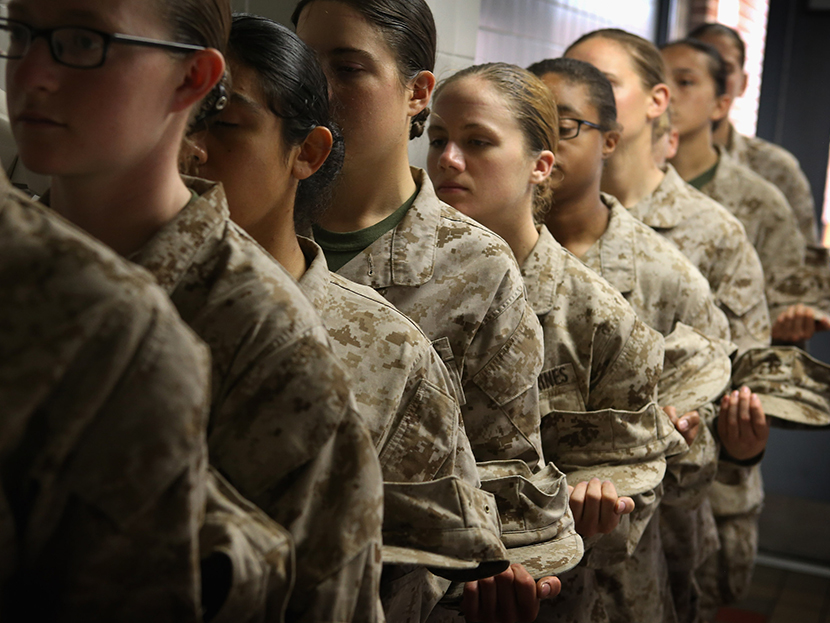
What began as a united front by women senators to end military sexual assault is turning into a political battle of wills with Democratic lawmakers forcing colleagues to pick sides amid heated rhetoric.
Sen. Kirsten Gillibrand of New York and Claire McCaskill of Missouri have staked out competing positions as they court allies in the Senate and within the Pentagon for separate plans aimed at halting what has become an epidemic for the military.
Adding to the pressure is growing discord among former military prosecutors, senior Pentagon officials and victims of sexual assault who have taken sides against one another in their allegiance with congressional opponents. For all involved, the stakes are high. The Pentagon is eager to show that it is responsive, lawmakers are determined to fix what they see as a broken system and survivors want guarantees that the risks they took to speak out were worth it. And time is running out as Congress completes debate on the defense spending bill where real changes can be implemented.
Earlier this year, all 20 women senators–the highest number ever serving in that chamber–spoke with pride of working together, across partisan lines, to end what President Obama has called “a scourge.” But amid the politicking and lobbying, that unity has begun to unravel. Without action after the August recess, military women may have to wait another year for the chance at Congress relief.
Gillibrand has gathered the support of 44 senators–Republicans and Democrats–for her Military Justice Improvement Act. The bill would remove the prosecution of serious crimes, such as sexual assault, from the chain of command. Servicewomen have long argued that having a commanding officer preside over a complaint of abuse between two subordinates has often favored the attacker over the victim.
As Gillibrand gets closer to the 51 votes she would need to add the MJIA as an amendment to this defense spending bill, advocates for a competing plan championed by McCaskill have pushed back hard. At a press conference Thursday, McCaskill appeared with several retired female commanders, non-commissioned officers, and members of the Judge Advocate General’s office who all support retaining the current system.
John LaBombard, a spokesperson for McCaskill, told msnbc that Gillibrand and McCaskill both support a wide range of reforms that are included in McCaskill’s proposal, including ending retaliation against those who report and requiring a dishonorable discharge for those convicted of sex crimes. While both senators have vowed to continue fighting for survivors of military sexual assault–regardless of which reforms end up in the spending bill–the fundamental disagreement over how to fix the system remains.
McCaskill isn’t Gillibrand’s only foe. At an Armed Services Committee hearing in June, at which Democrats were responsible for determining the lion’s share of the witnesses, a dozen members of the military’s top brass testified against the fundamental elements of Gillibrand’s proposal regarding chain of command.
Carl Levin of Michigan, the Democratic chair of the Armed Services Committee chair, made clear where he stood. He killed Gillibrand’s ideas and had McCaskill’s measure approved. Then on Tuesday, Levin went further, releasing two letters from top military officers in an attempt to discredit Gillibrand’s argument that commander involvement in prosecutions prevents cases from being pursued. “The power to initiate a court martial is perhaps the strongest weapon commanders have to back up efforts to change climate in their units,” Levin said in releasing the letters to the public, a move that was widely seen as undermining Gillibrand.
As Gillibrand has long stressed, the defense department’s own statistics show that the vast majority of unwanted sexual contact in the military is not even reported, perhaps for fear of retribution. Of an estimated 26,000 incidents in 2012, fewer than 3,000 were reported, and only 302 were prosecuted. McCaskill and her supporters have argued that commanders must retain the authority to be involved in investigations and convene courts martial in order to ensure accountability and to protect against retaliation. Her, and Levin’s position, is exactly what the Pentagon leadership is pushing for.
Such voices have long held sway over much of the Armed Services Committee which is tasked with oversight, and not accommodation, of the military’s top brass. But Gillibrand has the backing of servicemember groups that strongly disagree with the Pentagon view supported by McCaskill and Levin. Taryn Meeks, Executive Director of Protect Our Defenders and a former member of the Navy JAG corps, noted in an interview that a commander is accountable for far more than just prosecuting criminal offenses. Unit cohesion–the concept of maintaining a positive atmosphere within a unit–can trump the desire to punish one member of the unit over another. “Commanders are responsible for maintaining a healthy ‘command climate,’ which includes all sorts of matters from physical readiness, to professional development, to a workplace free of hostility and harassment,” Meeks said. Meeks’ group, Protect Our Defenders, sharply criticized McCaskill in an open letter from an assault survivor printed in a Missouri paper earlier this week. The Service Women’s Action Network has also backed Gillibrand’s plan as the only way to start solving the problem. On a conference call with survivors of military sexual assault held Wednesday, Gillibrand once again compared the fight against military sexual assault to the fight to end Don’t Ask Don’t Tell, the law that prevented gays and lesbians from serving openly. “We’re hearing a lot of the same excuses” for a lack of progress, Gillibrand said, but added that she was “hopeful” that change is possible. Yet if her measure fails when the Senate debates the defense authorization after the August recess, the next best chance for serious reform won’t come again until next year’s bill. In a hearing in the House last week on how to improve care for veterans who suffer from military sexual trauma, Gillibrand found extra support from a longtime House ally. Rep. Jackie Speier, the California Democrat who tried to move a companion bill to Gillibrand’s in the House, asked four assault survivors testifying if they believed prosecution should be removed from the chain of command. All four raised their hands immediately.
Meredith Clark
Meredith Clark is a freelance writer and editor. She was previously a senior news producer for "Patriot Act with Hasan Minhaj," a reporter with MSNBC.com, the digital politics and culture editor at Glamour and a senior news and politics editor at Refinery29. She has written for Vulture, Rolling Stone, Self, Marie Claire, Cosmopolitan, The Daily Beast and Bustle. Recommended


