The Rachel Maddow Show WEEKNIGHTS 9PM ETMorning Joe WEEKDAYS 6AM ETDeadline: White House with Nicolle Wallace Weekdays 4PM ETThe Beat with Ari Melber Weeknights 6PM ETThe Weeknight Weeknights 7PM ETAll in with Chris Hayes TUESDAY-FRIDAY 8PM ETThe Briefing with Jen Psaki TUESDAYS – FRIDAYS 9PM ETThe Last Word with Lawrence O’Donnel Weeknights 10PM ETThe 11th Hour with Stephanie Ruhle Weeknights 11PM ET
The three-year anniversary of the devastating 7.0 earthquake that left Haiti in physical and economic shambles came and went last Saturday. The country is
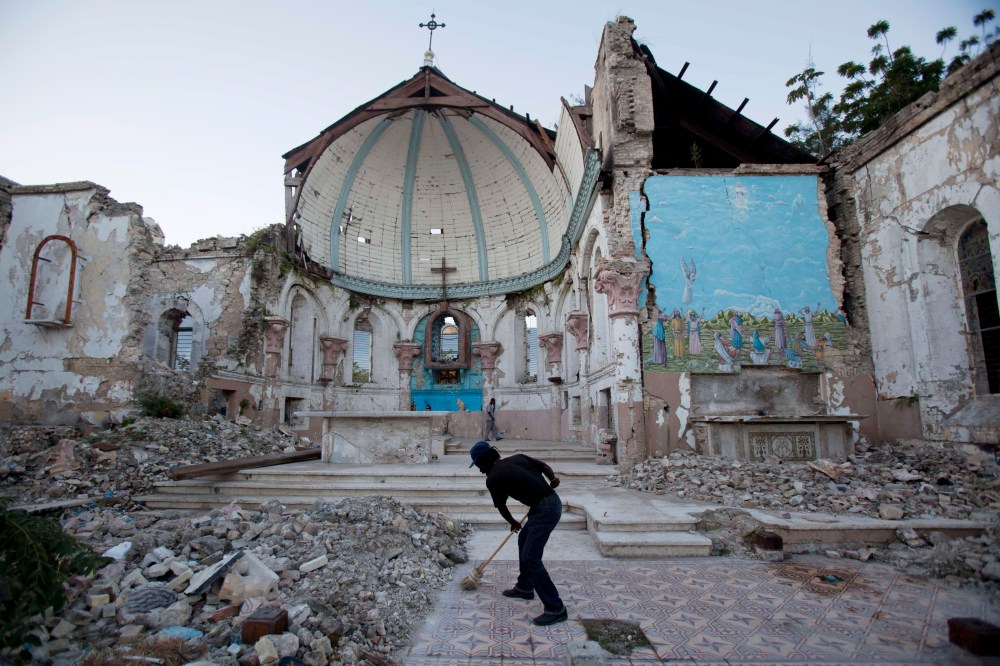
A man sweeps an exposed tiled area of the earthquake-damaged Santa Ana Catholic church, where he now lives, in Port-au-Prince, Haiti, Saturday, Jan. 12, 2013…ASSOCIATED PRESS
By
Traci Lee
The three-year anniversary of the devastating 7.0 earthquake that left Haiti in physical and economic shambles came and went last Saturday. The country is still not only suffering the effects of the disaster much in the same way they were three years ago, but solutions remain elusive. Are the United Nations and the non-governmental organizations (NGOs) working, ostensibly, to help Haiti the ones who are holding it back?
There is no doubt that the earthquake provoked an enormous international response: since December 2012, $13.34 billion in humanitarian and recovery funding from various countries have been planned for earthquake response, and roughly 48% of that has been disbursed to help the Haitian survivors.
But money and a large ground presence—there are 560 registered NGOs working within Haiti, and likely many more—does not fix everything (and in one important respect, likely made things worse). On Saturday, host Melissa Harris-Perry and her guests took a look at the disaster that came after the disaster and discussed the ramifications of the flood of international aid that has come into the country since 2010.
The U.S. military reported distributing 2.6 million bottles of water, including at least 120,000 gallons of deluxe Fiji water from ‘the remote Yaqara Valley of Viti Levu,’ bottled 8,000 miles away. You can still find the containers in the great plastic dams of debris in the capital, blocking canals when it rains.
“There was so much hope. There were such big promises made that things would get better, not just that things would get back to the level they were before the earthquake struck, but that the country would be better off than it had been before,” Katz said on Melissa Harris-Perry on Saturday. “The sad truth is that were another earthquake to happen today, exactly three years later, in the same spot on the same fault, it would pretty much be the same story all over again.”
Katz, who himself survived the quake, added that the way aid was done after the Haiti earthquake was similar to the way aid had been handled for decades before, which reflected the need for new policies and a real understanding of the underlying circumstances that made the earthquake in Haiti so destructive.
As MHP guest Garry Pierre-Pierre, founder of the Haitian Times, elaborated:
The system went back from when Papa Doc [François Duvalier] was president in the 1950s. The U.S. felt he was a scoundrel and he was really counterproductive to the development of Haiti. And as a way to isolate Papa Doc’s government, the U.S. in a way of working directly with the USAID and other NGOs in the country as a way to give direct aid to the people and not to help the government really misuse the funds. That sounds like a good idea. I think every Haitian at the time supported this because 90% of us did not support Papa Doc.
But over the years, it has evolved to a way where you have a parallel government, and hence, a lot of the problems you see in Haiti because a lot of times when the prime minister or the president sees that Save the Children, for instance, is getting $20 billion to do the work, then they have to work collaboratively. So, therefore, they’ll do everything in their power so that Save the Children does not succeed, because in some ways, it emasculates the government.
Pierre-Pierre said that when the earthquake hit, instead of finding ways to strengthen the Haitian government, NGOs were being formed rapidly and were receiving money to go to Haiti to do development work, which created the mess the country faces today. Writing in Foreign Policy today, Heraldo Muñoz argued that Haiti’s recovery is real in part due to what Haitians are themselves doing:
Haiti’s remarkable recovery, moreover, has been largely driven by Haitians themselves. Within neighbourhoods, community members have set priorities for rebuilding homes and infrastructure, ensuring that the unique risks faced by city-dwellers are satisfactorily addressed. Women, especially, have played an important role in this process. In one program aimed at rehabilitating 16 neighborhoods in Port-au-Prince, Petionville, and Delmas, for example, combating gender-based violence with improved public lighting has emerged as a major priority.
But perhaps that underscores just how much outside help hasn’t been helpful. “This is the larger problem of dysfunctionality of international aid,” said Tatiana Wah, director of Haiti programs for Columbia University’s Earth Institute. “It grew into a massive business itself, and the Haitian people’s view is that it’s disingenuous.”
Aid itself should not be seen as a horrible approach to an international disaster—but Katz noted that while people who donated to relief efforts should not feel as if the Haitians stole their money, it’s because they never got it. “The reality is that, for better or for worse—mostly worse, the way that aid and development and the foreign transfer of money is done, almost none of the money actually ever touches or gets within sniffing distance of the Haitian government,” he said.
And perhaps worst of all, Katz argues in his book, the cholera epidemic that hit Haiti about 10 months after the quake was caused by the United Nations. Talk about “not helping.”
Our Go Figure assessing where Haiti stands is above; our discussion is below.