








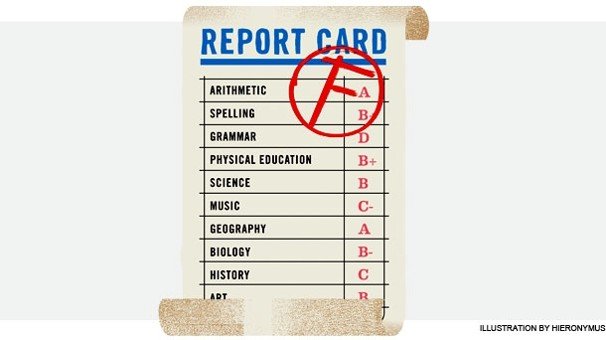
The world would be a better place without grades. My opposition to assigning them grows to a near-religious fanaticism at this point in the semester, when my desk, kitchen counter and handbag are overflowing with students’ papers that must be graded. They call to me at night, those earnest words and eager political analyses from young people, awaiting my assessment.
But not grading these mini-masterpieces would not lessen my workload. In fact, it would complicate teachers’ lives if we could no longer array our students along an alphabetic continuum.
Without grades, we would be forced to offer detailed, critical assessments of our students’ strengths and weaknesses, both to them and to future schools and employers. We would need to pay closer attention to their process and their progress rather than just their final products.
Grades encourage students to focus on the external assessment of a single person — or a small group of people — rather than on true exploration and learning. What would happen if students were free to experience classes, retain information and build connections without fear that their futures hung in the balance of a single imperfect product?
Students often feel deflated when their best efforts lead to only mediocre grades. I feel for the ones who complain: “But I worked soooo hard!” It’s true that some students can put forth great effort but achieve only average results, while others can barely lift a finger and manage near-perfection. An A for effort barely soothes the C at the end of the semester.
There is an inverse relationship between maximizing grades and exploring intellectual interests. A conscientious student focused on her future, who knows that she must demonstrate mastery through good grades, is less likely to try something challenging, to take the hard class or to venture into unfamiliar territory. Educators want students to take the hardest classes, to attempt the tough skill, to risk the great failure. How can they when their futures hang in the balance of a B? And let’s face it, grades are not very good predictors of accomplishment, curiosity, happiness or success. Remember President George W. Bush assuring Yale’s Class of 2001 that the C students could aspire to the Oval Office? I borrow my philosophy of education from Antoine de Saint-Exupery, the author of “The Little Prince”: “If you want to build a ship, don’t drum up people together to collect wood and don’t assign them tasks and work, but rather teach them to long for the endless immensity of the sea.” Grades get in the way of our longing for the sea and encourage us to put down anchors safely near the shore. Let’s see what happens when imaginations are unfettered by the terror of a C. Ed. note: This column appeared first in today’s Washington Post as part of their fourth annual “Spring Cleaning” series.
Melissa Harris-Perry Recommended


