








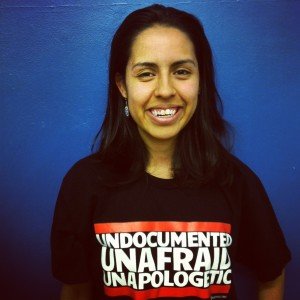
Recently, Senator Marco Rubio of Florida has been hinting at stripped-down version of the DREAM Act — the legislation which sought to provide a path to legal status, through collegiate study or military service, for undocumented immigrants who came to the United States at a young age. 23-year-old Rosario Quiroz is one of those immigrants, and she wants her own DREAM Act in New York State.
Rosario, a 2011 Columbia University graduate, remains undocumented. Earlier this week, adopting the slogan “Undocumented, Unafraid, Unapologetic,” she joined with two other members of the New York State Youth Leadership Council (NYSYLC) — Janet Perez and Sara Martinez — in a peaceful protest intended to urge the as-yet unresponsive Governor Andrew Cuomo to include the New York DREAM Act in the upcoming state budget. They were arrested, and now face charges of disorderly conduct.
Melissa today recognized these three women as Foot Soldiers, and my interview with Rosario is below. The “Foot Soldiers” segment is embedded at the bottom.
First things first — what led you to become involved in this cause?
I moved to the United States when I was seven, and I’ve been through the whole process of applying to college and just feeling the anxiety of not know whether I’d be able to pay for it because I knew I wouldn’t be eligible for any financial aid and even for many scholarships. I worked very hard throughout high school. I feel that I empathize with people who are for the New York Dream Act, which would allow undocumented students accessibility to state funds for college. (In other words), state financial aid would be made available to undocumented youth.
I know that you’re a recent Columbia grad. How did you end up paying for school?
Columbia is a private university, and they have what’s called needs-blind admissions. When I applied, it was for all North American citizens. So this meant if you’re from Canada, or you’re from Mexico, you can go to school there regardless of your financial situation and regardless of your citizenship. So, if your parents made below a certain amount, Columbia University covers the costs. There’s a student contribution, but no parent contribution — so I did have to work throughout the summer to get that money together. I was also awarded work-study, which was crazy because I wasn’t eligible to work for the university. I had to work through the summer to make sure that I had the money to work throughout the year, and just making it last. I had an outside, private scholarship through a sponsor that was renewable for all four years, so I (also) had that support.
I understand that Mayor Bloomberg has endorsed the New York DREAM Act, but that Governor Cuomo has been unresponsive so far. How is the effort going so far?
First, there was a huge push for the federal DREAM Act, which was shot down, again, at the end of 2010. After that, that is when the NYSYLC decided to push for this (state) act specifically. In terms of the process, it was presented over a year ago. Governor Cuomo has had the opportunity to look at ways to include it in the budget, but he hasn’t made any mention of doing so.
Tell me about how you got involved with advocating for the federal DREAM Act.
I got involved, probably, in my freshman year in high school. This was because my mom was very involved with the community, and I remember, one time, going to a statewide forum for Latinos — and they talked about this DREAM Act. At that point, I was already of the situation, but not fully aware of how it would impact me. I wanted to go to college, so I saw this as a possibility for the future, thinking, “if it passes before I go there, I’ll have the means to go to college, and a pathway to citizenship.”
We talked about the DREAM Act a lot (in one of my high school clubs) and we advocated for it with petitions. I grew up in North Carolina, and I went to a school that was very small — 400 students total. I remember it was a huge thing for us that we got half of the student body to sign (our petition) — during lunch, after school, having a table with information about the DREAM Act, what it would do, how it would impact people — and so, yeah, it started there. Then it turned into calls to senators and to representatives.
Then I got to New York, and I saw the work that was being done by (the NYSYLC), and they were doing more than talking. They were letting undocumented youth know that they were here as a support system for us, that it’s OK that we’re undocumented, and that the stigma that’s been there isn’t fair. We can get past that. We can get past this.
Last week was the third-annual coming-out rally, which was probably the most powerful thing I’d ever seen. Before that, my closest friends knew that I was undocumented, close friends that I’d known for a decade or more, a select few people. You don’t know who to trust; there’s this idea that people could call immigration on you at any moment, so if it’s talked about, it’s talked about behind closed doors. That’s a matter that is kept very private.
Is that how you had to grow up — having to live your life on pins and needles all the time?
It was. For me, I had a good childhood; I had friends who are undocumented who didn’t even find out their status until they were applying to college, and that wasn’t my case. My parents were very open with us, such as when we asked why can’t we go to Mexico to visit my grandparents, and see my family, we knew that it’s because if we leave, we’re not coming back. (It was like,) “This is just the sacrifice we have to make for the time being. Hopefully, eventually something will come up where we can apply for citizenship, but right now, there’s no way. This is just something that we have to do.”
The first time that it hit me was when I won a competition with a Boys & Girls Club that I was part of, and I had to travel to the state competition…eight hours away. It was in the state, but it’s such a long state that it was a lot of travel time, and I needed to fly. And for that, I needed an ID. I tried to go to the DMV with my tax ID number and my expired tourist visa, and I remember getting there and — at this point, the laws in North Carolina were changing to the point where undocumented immigrants were no longer able to get their licenses there. So I remember they turned my tourist visa around and said, “Look, it says right here this is not valid six months from your point of entry, this is expired, and it’s not valid 100 miles north of the border… I’m gonna call immigration on you.” I was 15 years old, and just terrified. My mom was there with me, thank God. He wrote the number down and told us to leave. I bolted out the door, got in the car, and just started crying.
That was my first experience with knowing that being undocumented would have more effects than just not being able to go visit family.
After Columbia, what happens? Are you dealing with obstacles in your job search after your graduation? Yeah. The job obstacle is always there. I am working right now. I have a part-time job babysitting, and a part-time fellowship with an organization that does know my situation, and they have been very supportive. You have this degree; it just seems that you’re unable to use it. Why do you feel Governor Cuomo has been so reticent about adding the New York DREAM Act to the state budget? I guess it just depends upon what you prioritize. I guess it’s easy to forget undocumented folks, because for a long time, our communities have been scared to stand up for themselves. A lot of undocumented immigrants pay taxes, and contribute to this society — and it’s not like we’re getting those benefits back, in terms of things like Social Security. As far as the economic situation in the country, everyone is worried, and everyone is struggling. But at the same time, I don’t know — I don’t know if it’s just easier to view the undocumented community as a very powerless section of society, so it’s easy to overlook our needs. But at the same time, I think that it needs to be made a point of that we are contributing to society, and our labor is essential, and at the core of making a lot of other things possible. That needs to be recognized. I wish that I could ask Governor Cuomo this question: why haven’t you included this? To me, it’s shameful. What his inaction is saying is that we youth are worthless. We’re not going to contribute. And how can they say this, when we’ve worked so hard? An educated society is (inherently) going to contribute more. Tell me about your arrest. The street was blocked off, the banners were dropped, and we each sat on a banner. There were other people who were sitting on them, but the cops arrived and warned us that we would be arrested. Some people got up and went back to the sidewalk. We stayed there, we were arrested, and taken to the 17th precinct. We were held there for two hours, then we were booked and went through the system, because we didn’t have state IDs. Our student IDs, they really couldn’t do anything with that. We were fingerprinted, and our pictures were taken. Then we were taken to central booking, went through that whole process, spent the night in jail — and then we saw the judge in the morning. We are taking the case to trial. We were charged with disorderly conduct, and we have court on April 25. We’ll follow up with you to find out what happens. I know you did this for the movement and other people in your situation, but is there any personal fulfillment you’ve gotten out of this? Yes. It’s been beneficial personally. Throughout the process, through the uncertainty, the selfless aspect of it kept me strong. I was able to say to myself, “you’re going to be fine regardless; what will come out of this will be beneficial to others, and it could pay off more than it could even cost.” But in terms of personal fulfillment, it was almost a test for myself: a test of my courage, because I feel that these are things I’ve been talking about — the cause, the movement, social justice — and these are things I’m constantly thinking about and pushing for, even in conversations with friends. I’ve always been so frustrated because it always ends in talk. Even within academia, there’s so much focus on what’s wrong with the system, and with sociology (her collegiate major), it was always so frustrating. I feel like I wanted to get past that. It’s like, no, we can’t just focus on the problems; what’s the point of that? No, we have to start focusing on alternatives — but how do we get to alternatives? By taking action! To me, this action shows that it’s possible. I can’t expect anyone to have the courage to step forward, and really start pushing for alternatives, and holding politicians accountable for things that they believe to be right. It was a testament to (my being able) to do this. In terms of my career goals, I’m still kind of at a place where I have no idea what I want to do, but I do know that I want to help people in a very real way. I want to help them in a way that empowers them, that shows them their own light. So, I’m just going to continue pushing for change, and it’s going to take a lot of acting from a place of selflessness, and not anger, because I was angry for a long time. This feels like my first step towards what I want to do with my life.
Jamil Smith Recommended


