








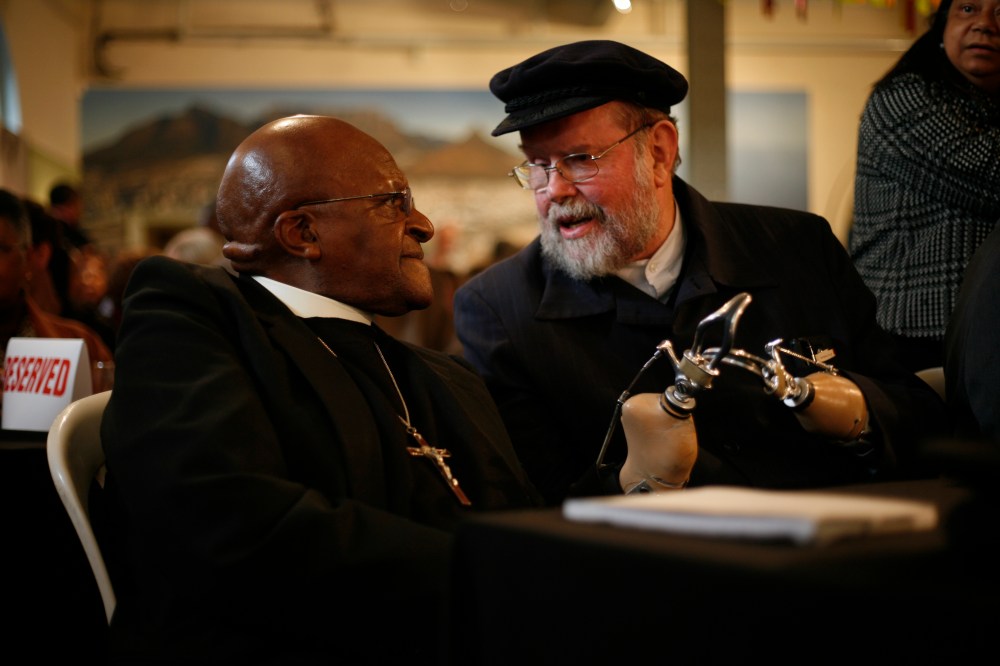
The “Foot Soldier” for Melissa Harris-Perry this week is Father Michael Lapsley, an Anglican priest and social-justice activist who serves in South Africa. As a young man, he was called to the priesthood, but was not particularly political. Then he found himself in the maelstrom of South Africa’s apartheid, serving as a chaplain for the African National Congress. Losing both of his hands and the use of one of his eyes to a letter bomb did not deter Father Lapsley from continuing his work, including here in America. I spoke to him about that earlier this week.
Lorena Ruiz: What initiatives are you working on/ have you worked on here in the United States?
Michael Lapsley: In New York City we have cooperation with an organization called Barrier Free Living, which works with women who have been abused who are also disabled. We’ve worked with them over a period developing their capacity to offer Healing of Memories workshops themselves. In Minnesota, where we have just been for the last two weeks, our particular work has been with homeless war veterans. We’ve had a number of workshops with that community. There we combine with what’s called a Warrior to Citizen Program. In Hawaii, in Honolulu, we’ve had workshops with women who have been recently incarcerated, and often in programs of coming out of prison, almost all drug related. Those have been some of the main initiatives. In New York, we have had a series of open workshops. We have had people who have been affected by the Greensboro Massacre, people who were part of 9-11 Families for Peaceful Tomorrows, and also with people who have been long term incarcerated. That’s in summary the scope of our work in the United States.
LR: You said with the Barrier Free Living, it’s not just a program where you are coming in and facilitating, but you’re also promoting that they lead their own workshops?
ML: Yes. In other words, we have trained some of their people to be able to offer Healing of Memories workshops. That’s what we’ve sought to do in each place, is step-by-step, develop capacity so that we train facilitators that can then – and that can become another string in their bow – have something else that they are able to offer. But it takes quite a time to be able to develop that capacity, it doesn’t happen in five minutes. People often say about the Healing of Memories workshops that they are deceptively simple. Simple in the sense that we use things like crayons and storytelling and clay, but it has to be facilitated well if we’re going to actually assist people in their own journeys of healing.
LR: How do you find groups, issues, or people that need this kind of healing?
ML: I’ve been coming to the U.S. and speaking for – we actually had our first Healing of Memories workshop at Riverside Church in New York back in 1998. Often it has been people who have heard me speak about my own journey, and Healing of Memories in South Africa, but for whom it has resonated with their own journeys as well as the kind of work they’re doing. And that’s what happened with Barrier Free Living. Paul Feuerstein, who is the CEO there, heard what I was saying about Healing of Memories, and thought, hmmm, this relates to work with women who have been abused and are also disabled. I think the extraordinary thing about Healing of Memories is it resonates in a wide variety of contexts. But of course it also comes out of South Africa where our work has been around national reconciliation, where we also worked with people in prison, people who are infected or affected by HIV/AIDS, and we work with refugees – particularly female refugees. So that’s in the South African context, but that’s informed the kind of work that we’ve done here in the United States. Presently we are visiting Colorado, and we’re hoping to set up a kind of chapter in Boulder and Denver to do Healing of Memories here.
LR: Why Colorado? Is it specifically because of recent tragedies?
ML: In fact it was somebody that was part of our team in New York who had been trained, who has come to be a minister in Colorado, but I think that some of the recent events… One of the things I will be doing while I’m here is talking to veterans. Because that’s an ongoing commitment that we have, is around issues of veterans. My own view is that the United States is infected by the unending wars that we are part of. That, for us, manifests in a type of commitment to work with people directly affected by war or that are veterans.
LR: What are some future issues you would like to be more involved with here in the United States?
ML: I think one of them that we’ve always had a commitment to that comes from our work in different parts of the world, is with indigenous people, with Native Americans. For example, we’ve worked with indigenous people in the center of Australia over a period, and the issues of pain and hurt of the indigenous people. When I was in Minnesota, an issue kept on being brought up, how 150 years ago the largest executions in the U.S. history had taken place with the Dakota. I think that’s another of area of the pain and hurt of indigenous people and how they relate to their own descendants and the descendants of Central Minnesota communities relate to each other. I think part of our work is also trying to provide space where people can hear each other’s pain and “the other” disappears and I feel it becomes just “us.”
LR: Can you tell me a bit about the Healing of Memories workshops in your own terms?
ML: Where they came from was a reflection of South Africa’s journey, but also my own personal journey. In terms of South Africa’s journey, I had been with the liberation movement in exile for 16 years, and I came back to South Africa in 1992, and I discovered a damaged nation. A nation damaged in our humanity. Damaged by what we’d done, by what had been done to us, by what we’d failed to do. And all of us with a story to tell, and all of us with stuff inside of us as a consequence of the journey that the nation had traveled. It seemed to me that we had to try and create what we came to call ‘safe and sacred spaces.’ Places where people had the space, the opportunity, and the permission to be able to talk about how the national journey had impacted their own lives, of what they carried inside of them. Particularly of finding ways in which people could detoxify as a consequence. I also reflected on my own journey. I had received a letter bomb back in 1990 and I had lost both my hands, an eye, shattered ear drums, all these other injuries. As well as the physical journey of healing with medical treatment, I was hugely helped on my journey by prayer, love, and support from people around the world. So a way of describing that is to say that my story was ‘acknowledged, reverenced, recognized’ and given a moral content. People said ‘what happened to you was wrong.’ I realized that for millions of people in South Africa and on many continents nobody has acknowledged, reverenced or recognized their story. Nobody has said to them that what happened to them was wrong. And I realized that reflection of my journey as well as the nation’s journey informed the development of this experiential process that we spent a year developing, which is a process taking place over two and a half days where people collectively have the opportunity to deal with how wide a context have impacted on their own lives. LR: How can people who are interested in this type of workshop find out more information? ML: One thing is to refer to our website, which is healing-memories.org. But also I’ve just published my memoir here in the U.S. called “Redeeming the Past: My Journey from Freedom Fighter to Healer.” It’s not just a book about my journey; it’s also a book about Healing of Memories in a variety of contexts around the world. We believe that the actual book itself can be a tool for people to use on their healing journeys. In the second half of the book we give the voices of different people in different contexts around the world, so people can see how it resonates. Whether people have been affected by war, by poverty, by other forms of oppression, by stuff that happened in their family journeys, it all has relevance. LR: Have you done any work with people affected by Hurricane Katrina in New Orleans? ML: No we have not, but we are happy to go with Melissa to New Orleans. Picking up on that point, what we’ve found is that often when terrible things happen like the disaster of the Katrina kind, that many people strangely enough often feel very lonely in the pain they’re carrying. Because they know that many people have been affected, but they don’t know what other people have inside of them. In this they have an opportunity to listen to each other’s stories. So I think there’s a kind of healing that comes from collective journeys. If I go to my therapist and I say ‘this is what has happened to me’ when I finish speaking the therapist doesn’t say ‘just wait till you hear my story. ‘ There’s a kind of solidarity, a connectedness that people feel when they have an opportunity to speak about their own pain, listen to the pain of one another, and then be encouraged and supported in their journeys of healing. And to have their story validated by how other people respond to it. LR: The South African story is particularly interesting because in that case, based on skin color, people were put on two different sides. They were basically pitted against one another. Yet you brought them together. Do you find that situation in other contexts? That you see people who have been separated, sharing their stories together? ML: There is a variety of ways in which there is an “us” and a “them.” Interestingly, we just had a workshop the last couple of weeks with homeless war veterans, and people from the faith community. Some of the veterans were astonished to find that there were people who had never been to war, but they had their own pain. There was an “us” and a “them” of veterans and civilians, which disappeared as they shared each other’s stories. But in our context of South Africa, as you said, color turned you into either the oppressed or the oppressor, but where people were able to share their stories, that barrier then often disappears, and we begin to experience a common humanity. And then and often, a commitment following that to work against the injustices that persist, because you have a vision. We can only do the most terrible things to others because we see them as “the other” and not “us.”
Lorena Ruiz Recommended


