








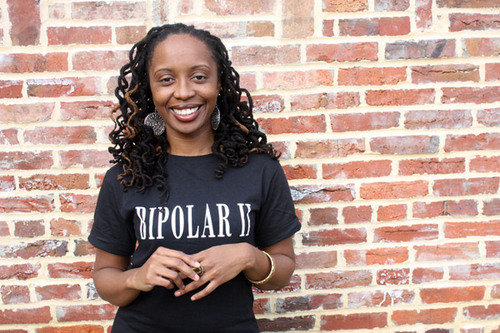
Today, Melissa profiled Nigerian-born writer and poet Bassey Ikpi, who lives with Bipolar II disorder and has founded The Siwe Project — a non-profit organization geared towards educating and increasing awareness of mental health issues, particularly amongst those of African descent worldwide. On July 2, Ikpi and The Siwe Project staged its first annual #NoShame Day, in which their website “host[ed] candid discussions about mental illness stigma, diagnoses, and treatment options.”
Thanks to Twitter, her blog, her poetry, and her many appearances on HBO’s “Def Poetry Jam,” I’ve become familiar with Bassey’s work over the years, and I was thrilled to talk to her about her project, and the broader issue which Melissa addressed: how the global, political emotion called shame is so deleterious to those living with mental illness.
Tell me how this all got started for you. I know you’ve been writing about your Bipolar II disorder for a long time, but how did all of that manifest itself specifically in The Siwe Project?
[On] June 29, 2011, a good friend of mine’s daughter, Siwe Monsanto — a girl that I’d known since she was four years old — committed suicide in Harlem. She leapt from a building. And I realized that I was doing something for myself, in the sense that I was telling my story, and I was hoping that people would be inspired to seek help and to manage their illnesses and to not be afraid or ashamed to talk about it.
What happened with Siwe’s death is that it seemed personal. It became something that sort of morphed from being an abstract sort of thing I was doing into something more concrete. Siwe’s mom, I’ve known for 12 years, and she did everything she possibly could to help her daughter. She had her in special schools, she had her medicated, she did everything she could to help her. She spoke to me at length about ways to help Siwe since she was five years old — she was about five or six when she was first diagnosed. Not everybody has that kind of support, and has that kind of focus — and I was thinking about all the Siwes who didn’t have that support and what I could do to offer them a safe space to tell their own stories and received support from strangers. I’ve seen the impact that social media has had on my treating of my illness, and I wanted people to have that same sort of opportunity…to get that “me, too.” So many people feel that because they can’t talk about it, they feel isolated — and isolation, and shame, and all those things [make it more difficult] to feel better. I had no idea it would morph and grow into what it has become; it was a very small and humble idea that kind of blew up out of nowhere.
As far as the concept of shame, how do you view it in the context of the conversation about mental illness, and how is it that The Siwe Project specifically attacks it?
Shame is a barrier. People don’t want to admit that there’s something wrong. I was a dancer in a former life, and I use dance as metaphor where, if you have an injury, depending upon how you take care of that injury, that’ll determine whether you’ll even walk again, let alone dance again. And if you ignore the injury and continue walking and dancing on it, it becomes worse and you may never walk again. And that’s how I think that shame keeps people from seeking help. If you can’t even admit that there’s a problem, then you absolutely won’t do anything to take care of it.
I’ve noticed that, especially in the African-American community, there’s a real stigma around mental illness. People don’t even want to talk about it. I think that’s the reason why — I hate the term “suffering in silence,” it’s so clichéd — it’s what happens. Just talking about it doesn’t make it go away. It accentuates the problem and makes it worse.
People would secretly email me, and secretly pull me aside at different lectures I was giving and say, “Well, I don’t want anybody to know, but…I feel this-that-and-the-other-thing.” I understand not wanting to broadcast an illness, but not talking about it — and the shame keeps you from doing something about it. I talk about it because I don’t have a job to lose, and I don’t have a promotion to be passed up for, so I don’t have much to lose. For the most part, it doesn’t affect my livelihood. But you, not only won’t talk about it, you won’t do anything about it — and that affects your life.
I realize that even family members of mine don’t want me to talk about this, worried about how this makes the family look. And I’m like, this makes the family look like there’s somebody with an illness who’s taking care of it. There’s something there, and shame is just so…suffocating.
I noticed that when you referred to shame in your PSA (above), and you talk about the “strength you’re accused of having.” I found that very poignant, given that there is so much about mental illness, an internal thing, that is about outward appearance.
There’s the line about shame, and needing sleep and hugs…if you talk about, “I need a hug,” it would help so much to get that contact, but the barrier between here and that point…that’s always fascinated me, because you need that. You need that help, and you need hugs, and you need ot be able to express that you’re having a little trouble right now. That’s the problem: people don’t understand what mental illness is, and they characterize it as a moral defect or a character flaw, as if people don’t want to be associated with those things. I feel like if people would just understand what it is, how it looks, what it looks like when it’s being managed and treated properly, some of that would lessen. And that takes public figures, and speaking publicly, on behalf of those that can’t.
Well, that brings me to #NoShame Day. How did that concept originate? And how did things go [on July 2]? #NoShame Day…I was having a conversation with my brother in the kitchen, and it started from “#NoShame Hour” (laughs) — and it’s like, “why not just make it a day?” Everybody that speaks to me, and gives me a reason why they can’t [talk about his or her illness], it’s about shame and stigma, and not wanting people to know this, and not wanting people to know that. It’s almost like — and I hate to make this analogy, because I don’t think it’s completely parallel — but it’s almost like coming out because you’re afraid of what’s going to change, you’re afraid of how people are going to look at you. This is 24 hours when they can be open, and not worry about any of that, and get that support. There’s a thing that happens [when] someone says to the family, “I need help, and I need this,” and they say, “Well, don’t do anything. Go to church,” and all these different things. It’s almost as if you broke your leg, and your parents said you can’t do anything about it. I wanted to provide a space…I had no idea it was going to be as big as it is. I really thought I’d be sitting on my laptop and re-tweeting and sending people emails…I had no idea that other people were going to pick up on it, and run with it. And that just confirmed something which I already knew: people want to talk about it. They need a reason. They wanted this space. They wanted the platform. They just needed someone to ask them, “How are you? What’s going on?” That kind of empowerment, where they feel that they’re in control of an illness that makes them feel out of control, and to say, “this is what’s happening, this is why it’s been difficult” — and have people hear that, and understand that, and then say, “Wow!” I got so many emails from people saying, “I read these stories…I had no idea that my mother is probably dealing with this, and didn’t tell me.” A woman said, “This is my husband, and I spoke to him, and he told me that he was feeling this way. I sent him some blogs to read, and he’s going to get help tomorrow.” Things like that. I didn’t expect that, but it’s exactly what I wanted to happen. That reminds me of the video Feminista Jones put up. I thought about the fact that despite the fact that she mentioned her past mental health issues, she came at it from the perspective of a mental-health worker, and she talked about the stigmatization. To use the LGBT allegory again, it’s as if those with mental illness need allies. Yes! Exactly. And I wanted to open it up for people who are allies as well, so that those who didn’t have allies in their lives could see that. It took on a life of its own, but when people emailed me asking how to participate, I wanted to have people say at the end [for instance], “I am Bassey Ikpi, and I have no shame.” Someone’s telling the story about their mother, or their cousin…that’s them saying, I’m not ashamed of you. I’m not ashamed of what you’re going through. I’m not ashamed of what you have. The Siwe Project’s tagline is, “It’s not who you are, it’s what you have.” And being able to take people away from discussing illness in a way that defines them — “I have an illness…but I am this other person, and this other person is a person who is going to fight, and win, and manage, and treat, and do what I need to do to take care of this, with no shame.” We’re not judging them, not making them into these monsters that pop culture sort of puts on mental illness, and puts a face to it. It’s everything I could’ve asked for, and more. Melissa’s “Foot Soldiers” segment is below.
Jamil Smith Recommended


