








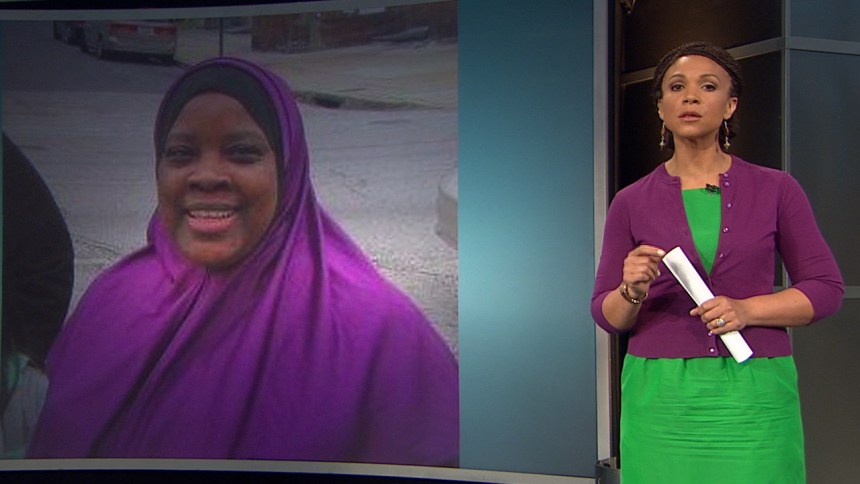
This week’s Melissa Harris-Perry Foot Soldier is Asma Hanif, an advanced practice nurse who has devoted her life to operating Al-Nissa Holistic Health Center, a free clinic for women who are homeless, uninsured, or victims of domestic abuse, and Muslimat Al-Nisaa, a shelter for Muslim women. Asma became interested in medicine after watching her grandmother pass away from a treatable condition because she lacked access to health care. She later went on to become a nurse and establish a center where all women could have access to quality care, regardless of means.
In the teaching hospitals where she trained, Asma noticed that many of the Muslim women who came as patients were treated without respect or cultural sensitivity. She also heard stories from Muslim women who had been in shelters where volunteers encouraged them to undertake a religious conversion. Those experiences helped her identify the need for services that catered specifically to Muslim women.
Asma lives in the shelter with the women, allowing her to dedicate more of her resources to her work and be available for counseling and support. Her vision for her work is clear: “It started with my grandmother, but every time I find another person, maybe another category of individuals whom I can do something to help, then I add them. They become part of the project as well.”
We had the opportunity to interview Asma this week to learn more about the work she does and the critical role it plays.
What is your space called? Is it a center? Is it a shelter?
Asma Hanif: The organization is called Muslimat Al-Nisaa, which means Muslim Women’s Organization. The center is called Al-Nissa Holistic Health Center, and Al-Nissa means The Women. I found a house that was in Baltimore, a multi-family dwelling, a house – and I went ahead and rented that particular house and made it a shelter for the women that were in need of it. But because I couldn’t afford to have my own place – I could have kept the money from the clinic, I was making enough that I was eventually able to move out. I decided to live in the shelter because I could not afford to rent out the shelter and to rent out a place for me. I’m just like the women who come there. I deal with women who weren’t vagrants or who made homelessness a way of life.
The system is designed to help the ones who may look like they’ve never accomplished anything in their life. But homelessness is homelessness. It’s the same. Being a victim of domestic violence, it’s the same. It’s not particular to one socioeconomic group.
What kind of services do you provide at that house?
H.O.M.E. is an acronym for Housing, Occupational, Medical, and Educational. We provide housing. We provide [the women] the help they need to be able to find a job. In order for people to come, they have to have become homeless through no fault of their own, and they have to want to work towards self-sufficiency. However, in order to become self-sufficient, you have to have an address. You can’t go looking for a job, you can’t get into school; you can’t do anything unless you have an address. So we provide that.
The medical part of the acronym is because of the clinic, so if they need to they can come in for medical service. And then educational, whoever is willing to come in and volunteer and provide any of these services, they do it not at the home; they do it at the clinic. They do classes, whether its resumes, self-esteem, conflict resolution, whatever it is they may need. There are individuals, who come and say they are willing to do that, but then they don’t; I tell them they’re not a good fit for the program, because it is a program.
I feel that it is wrong and it is stealing, if I am going around the community and asking people to please help, and you’re going out and working to be able to make that donation while the women sit at home doing nothing. That’s not permitted. Both your clinic and the home are sensitive to the needs of Muslim women and children; they aren’t exclusive to Muslim women and children, correct? The shelter is [exclusive to Muslim women]. The clinic is not. When a person is a victim of domestic violence, sometimes the only thing that they have to hold onto is their belief in God. And so we try to make sure that they have that, and that they’re with other individuals that are feeling the same thing. I did this because when Muslim women would go through shelters, one of their main complaints is the people at the shelters would try to convert them away from Islam. So my shelter isn’t about trying to be exclusive, as in we think we’re better than you; it’s catering to a specific need that Muslim women have. How many women live in the house? Technically the home could house 50 women plus children. What happens is that if my numbers are lower, it’s because I don’t have enough money to have a full capacity, because that means more food, more electricity, more water… Even if we may have some money set aside in the bank, I don’t know what tomorrow will bring. I want to tell you one more thing. I usually don’t do interviews. Even though I might do this stuff, for the world to know that I’m in a shelter… I feel like for the other women, it’s humiliating. Based on how people spin stuff, it’s humiliating and embarrassing. But for the world to know, it’s like you’re naked before the world. People ask me why I continually do this. And I say that I’m afraid that on the Day of Judgment, God will say to me, “One of my servants came to you and you turned them away.” That was my motivation for doing this. Because you don’t know who it is that God has sent on your path to help. So if I had the ability to help someone, I will try to help them. That’s the legacy of my grandmother. She turned no one away.
Lorena Ruiz Recommended


