








What good are GED classes if you can’t afford the glasses you need to study? How would it feel to search for work for a year and lose the job when your car breaks down during the first week? Cities and states across America have some form of job training and housing assistance programs, but they lack the infrastructure to address quickly, without onerous bureaucratic requirements, more immediate needs like work clothes, equipment, or even pots and pans.
Questions like these plagued social worker Megan Kashner for years. “We have systems that prepare people for jobs and no funding in the social safety net to get them over short term hurdles,” Kasher said in an interview with msnbc.com “I thought, ‘This problem had been ticking me off for 20 years, maybe the technology is finally there to do something about it.’”
When Kashner founded the non-profit Benevolent in Chicago in 2011, she’d spent more than 20 years working in the non-profit sector in cities like Washington D.C. and New York. During that time, Kashner watched countless disadvantaged families stumble over problems that would barely register to members of the middle class.
Kashner and her staff decided to use a crowd-funding model reminiscent of Kickstarter, but Benevolent aims to do more than just raise money. “Rather than have people speak about or on behalf of people, we are using crowd-funding as one of a series of tools that allows low-income people to tell their stories,” said Kashner. The tools Kashner put together create a new way of fostering community engagement and expanding the social safety net. A recent grant from the Knight Foundation’s Tech for Engagement initiative will allow Benevolent to expand from Chicago to Charlotte, NC, and Silicon Valley, and additional contributions from Fisher Family will fund a Detroit program. Under budget pressure, cities and states are gutting social programs, leaving low-income Americans with fewer and fewer avenues to meet their often urgent needs.
According to 2011 US Census data, some 46 million people live in poverty. The number has risen drastically since the financial crash, and because it defines poverty as a family of four living on less than $23,021 a year, millions more Americans face serious financial challenges every day.
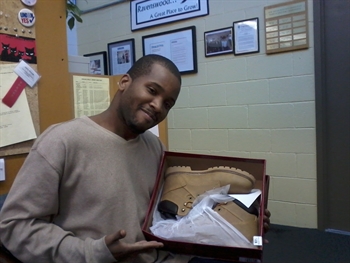
Benevolent defines “low-income” as living on less than 200% of the poverty line, which would mean a family of four subsisting on less than $46,000 year. People like Robert Williams. Williams, a single father, started a job training program through Chicago’s Jane Addams Resource Corporation to become a welder while he worked a dead end job and worried about how to get winter clothes for his daughter. He has used the site twice to get through tough times, first to get his daughter new clothes and then to buy prescription safety glasses. Before getting the funding, Williams had tried drugstore reading glasses, but they weren’t strong enough for him to see the detail he needed to weld properly.
“I just did my 90-day review and was rated as an exceptional employee,” Williams said. “I wouldn’t have been able to get what I needed and I would have been struggling. It was a godsend.”
Benevolent learned through trial and error to keep funding goals relatively modest; the program started with a maximum request of $1,800, but the staff discovered that number seemed too daunting for donors, whose average contribution is $50. Benevolent has since lowered its cap to $700 and has raised more than $45,000 to fund over 80 requests.
While Kashner says most requests fall into four groups–assistance to get or keep a job, secondary medical expenses, computers, and “bridge needs” like furniture or clothing. Julie’s case is one that is harder to categorize; her page on the site is asking for money to pay for gas and a hotel so she can take her grandchildren to visit their mother in prison. As she wrote on the site, “my goal is to make sure that when my daughter is released later this year that she is still connected to and has relationships with her family and loved ones.”
Damian Thorman, Director of National Programs for the Knight Foundation was impressed by the networks that Kashner and Benevolent had created in such a short time. “We want to use tech to engage citizens in solving challenges in communities and to build social capital. Neighbors help neighbors and end up creating a bond.” The personal connection created through the stories and small donations also allows both donors and recipients to rethink what it means to contribute to and receive what could be considered charity. “In the beginning, we wondered if our clients would feel weird putting up videos, but it’s a reminder to them that they’re working hard,” Alex Niemczewksi, an employment coach with the Jane Addams Research Corporation said. The process has helped her clients appreciate exactly how hard they’ve been working in the face of incredible obstacles. “Once people begin to tell their stories, I haven’t had a client worry about getting ‘charity money.’” “Social networking” has become a modern buzzword for nearly every industry, but personalization strengthens the bonds formed between donors and clients. It also challenges assumptions about who deserves help. “It could help change the conversation around giving money,” said Niemczewski. “Some are hesitant to start because they don’t know who ‘deserves’ the money, but that’s not the way to think about people affected by intergenerational poverty.” For the Knight Foundation’s Thorman, expanding programs like Benevolent are the future of community-building. “This is weaving the social fabric that allows people to more deeply engage” with one another, Thorman said. As more people like Williams, the welder, find work that pays well and moves them out of poverty, there will be more avenues to help future generations striving for financial security. “People are going to be called to help each other more and more,” says Thorman, “and with tools that help communities solve their own problems, the stronger and more resilient our communities are going to be.”
Meredith Clark
Meredith Clark is a freelance writer and editor. She was previously a senior news producer for "Patriot Act with Hasan Minhaj," a reporter with MSNBC.com, the digital politics and culture editor at Glamour and a senior news and politics editor at Refinery29. She has written for Vulture, Rolling Stone, Self, Marie Claire, Cosmopolitan, The Daily Beast and Bustle. Recommended


