








Have you heard of Edward Blum? Even if the answer is no, you certainly know his work. Blum is a matchmaker of sorts, bringing together carefully selected plaintiffs, lawyers, and legal battles. A recent Reuters report highlighted how Blum has helped bring at least a dozen lawsuits attacking race-based policies. In the last 20 years, four of those have made it to the Supreme Court. Two have been argued in this term alone and await decisions.
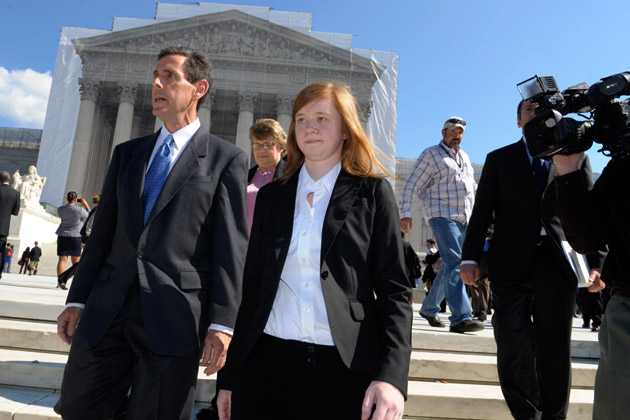
Blum found Abigail Fisher, the lead plaintiff in Fisher v. University of Texas, after spending three years searching for the ideal plaintiff to challenge race-based preferences in college admissions. Blum wanted a white applicant whose test scores and GPA surpassed some of the criteria applied to nonwhite applicants. He also had some less concrete criteria; he wanted someone with patience, willing to wait out the long process of litigation, as well as someone he thought he could work with over a long period of time. Fisher not only had the numbers Blum wanted, but Blum had also known her family since before she was born.
Blum also determined the city of Calera, of Alabama’s Shelby county, to be another ideal plaintiff: Shelby County v. Holder challenges Section 5 of the Voting Rights Act, which mandates federal approval of changes to election laws in any of the states or counties determined to have a history of race-based discrimination. While Blum courted the city of Calera as a potential plaintiff, he simultaneously awaited a decision from the U.S. Supreme Court on another case he had helped fund challenging Section 5: Northwest Austin Municipality Utility District No. 1 v. Holder, argued in 2009.
That same year, the Supreme Court narrowly ruled in favor of Northwest Austin Municipal, stating that the Voting Rights Act permits all forms of political subunits of covered states to seek exemption from Section 5. While finding in favor of the legal team that Blum helped finance, the Court avoided the larger issue of Section 5’s constitutionality. In the wake of that decision, Blum went ahead with the Calera case.
None of Blum’s latest successes–three cases on the docket in four years–measure up to his first trip to the Supreme Court. Blum’s first case made its way to the high court in 1995, Bush v. Vera. The case challenged Texas’ redistricting plans following the 1990 census, which granted the state an additional three congressional districts. Texas legislators drew the additional districts as majority-minority voting blocs that, like other gerrymandered districts, broke up multiethnic neighborhoods in irregular patterns. Blum hasn’t brought a case to the Supreme Court as a plaintiff since that first one. However, he is the guiding hand behind the two cases that may enable the conservative-leaning court to strike down two crucial race-based protections.
Katherine Guthrie Recommended


