








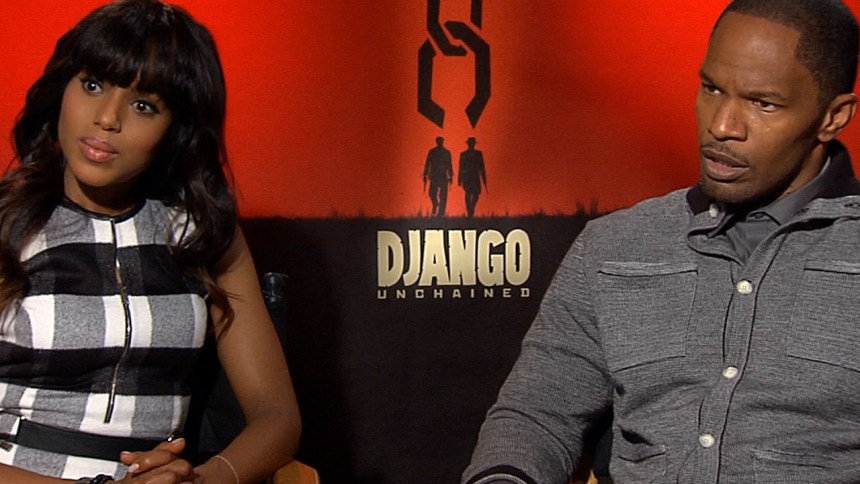
Quentin Tarantino’s Django Unchained opens on Christmas Day — but in the tradition of many a Tarantino film, it’s created its share of controversy well in advance. The film’s title character (Jamie Foxx) goes from slave to bounty hunter and sets out on a mission to save his enslaved wife (Kerry Washington).
The movie takes a look at the brutality of slavery, wrapped in a spaghetti-western package. Director Spike Lee, who called the film “disrespectful” and said he has no plans to see it, tweeted this Saturday:
Lee has taken issue with Tarantino in the past, particularly with his use of the N-word slur. By NBC’s count, that slur is used 110 times in the film. theGrio managing editor Joy Reid, who guest-hosted Melissa Harris-Perry this weekend, asked both Kerry Washington and Jamie Foxx who said the following about the use of the word:
“Whatever you see in this film, as horrible as it may be to hear, or as horrible as it may be to see, it doesn’t come close to how bad it really was,” Washington noted. “When you say the N-word, it’s not supposed to feel good. When you see how they use it, that’s the way it was supposed to, that’s the way it was back then. If Quentin Tarantino or any director had done a movie about slavery and didn’t put it like that, there’s no need to do it in 2012, in 2013 because you ain’t really giving it the real thing,” Foxx said.
Saturday in #nerdland, Reid questioned whether Tarantino’s revenge-style presentation was the best way to present this story or if it potentially risks trivializing slavery. msnbc contributor Ari Melber, who wrote critically about Django in The Atlantic, said on Saturday’s show that “it is one thing to reflect evil and reflect a tragedy and another to luxuriate in it. And my problem with this film having gone in with an open mind and liking some of Tarantino’s previous work is that he takes the evil of slavery — which we will never be done talking about because it is part of our history and is part of our present and is part of our future — he uses it as a license to go on a mass-murder killing spree to, as I said, luxuriate in elements of racism that for me didn’t feel historical, ethical, or judicious… but felt rather slavish.”
Touré, co-host of msnbc’s The Cycle, completely disagreed about the meaning of the movie. “This is a movie about love. Two forms of love. It’s about romantic love. He’s searching for his wife and he’s willing to go through hell to rescue his wife from the worst thing, and he’s willing to become the worst thing imaginable, a black slaver in order to rescue her. That is a very romantic and beautiful story. The violence is just to get through that. We have to go through hell to rescue her.” University of Pennsylvania religious-studies professor Anthea Butler hadn’t seen Django yet, but used a historical perspective to take issue with Touré’s interpretation. “I don’t think it’s romantic,” she said. “The real life slavery wasn’t romantic. When I teach this in my classrooms my students are just dead because I drag them through slavery, to lynchings, to all this stuff, and they’re just like beat up by the time we get to the 1920s.” When it comes to a film about slavery, people often question how much artistic interpretation should be allowed. Michael Skolnik, editor-in-chief of GlobalGrind.com, questioned whether the controversy over Django was about artistic interpretation, or the fact that America still hasn’t reconciled our painful past with slavery: “When I watch this film I think the challenge is that the violence against black people is what’s brutal. That’s the brutality. The burning of the flesh. The torture. These hot boxes. We haven’t seen this before in this capacity. And then the response this revenge killing right that is heroic. That’s triumphant. And the problem that Americans have I think with this film, or will have with this film is that Django’s triumph is our triumph over slavery, but we haven’t reconciled. We talk about it, Ari, you’re right — but we haven’t reconciled slavery.” See below the aforementioned conversation, and let us know what you think after you’ve seen the film — or if you’re refusing to do so.
Shanta Covington Recommended


