








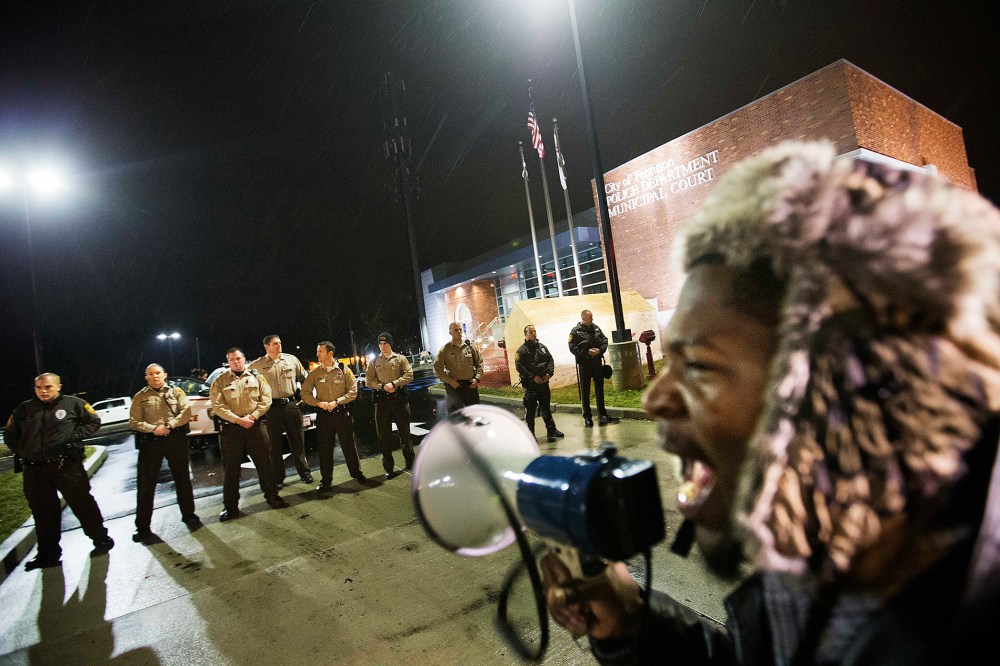
In advance of the grand jury verdict in Ferguson last week, former presidential candidate and former Arkansas governor Mike Huckabee wrote a blog post instructing the protesters in Ferguson to be more like the Rev. Dr. Martin Luther King, Jr. Quoting him:
Some are threatening violence if they don’t get an indictment. I’m old enough to have seen this mob justice mindset before — from lynch mobs who didn’t like the legal process, so they took the law into their own hands. The real heroes of racial justice were peaceful protesters like the Rev. Martin Luther King. Today, every town has a street named after him. You don’t see any monuments to Bull Connor or the killers of Medgar Evers. Look, everyone has the right to protest. But you don’t have the right to become so inflamed that you embrace the very injustice you’re protesting.
Huckabee seems to know or care little about the actual work and perspectives of Dr. King. It is clear that the former Arkansas governor is not alone. There has been a regrettable and persistent tendency in the three months since former Ferguson police officer Darren Wilson shot and killed Michael Brown and a movement erupted in Ferguson to use the civil rights movement as a way to bludgeon and chastise these young protesters.
There is something deeply disturbing and disingenuous about the misuse of King and the civil rights movement to call for peace and quiet. So in the interests of setting the historical record a bit more straight, here are ten ways to be like Dr. King in post-Ferguson America:
Take part in public, sustained, disruptive street protests. Part of why Dr. King went to jail in April 1963 was his refusal to obey a court injunction ordering the cessation of downtown protests.
Engage in disruptive consumer protests. The Montgomery bus boycott was a year-long consumer boycott; black community members also boycotted downtown businesses in Montgomery and Birmingham because of the city’s embrace of public segregation.
Get arrested over, and over. King was arrested 30 times in his civil rights work.
Come to Washington to make clear that America had given black people a “bad check.” In the much-less-quoted part of his March on Washington speech, Dr. King explained:
“America has given the Negro people a bad check, a check which has come back marked ‘insufficient funds.’ But we refuse to believe that the bank of justice is bankrupt. … So we have come to cash this check.”
Remind his Northern liberal allies that their liberalism needed to extend to their own backyards. “The racial issue that we confront in America,” declared Dr. King in a speech to the National Urban League in 1960, “is not a sectional but a national problem. . . .There is a pressing need for a liberalism in the North that is truly liberal, that firmly believes in integration in its own community as well as in the deep South.”
Criticize public “surprise” at black anger and foreground the history of white resistance to change that lead to these uprisings. In the fall of 1965, Dr. King wrote in the Saturday Review criticizing the disingeniousness of public officials’ “surprise” in the wake of the Watts riot “when its officials tied up federal aid in political manipulation; when the rate of Negro unemployment soared above the depression levels of the 1930s; when the population density of Watts became the worst in the nation’’ and when the state of California passed Proposition 14 to repeal a law prohibiting discrimination in housing. Dr. King himself had come to L.A. in 1963 and highlighted the problem of police brutality; in 1964, he had come to California twice in 1964 to work against the passage of Proposition 14, warning that if it passed, it would “be one of the most shameful developments in our nation’s history.”
Link violence at home to American foreign policy abroad. As King explained at Riverside Church in 1967, “I knew that I could never again raise my voice against the violence of the oppressed in the ghettos without having first spoken clearly to the greatest purveyor of violence in the world today: my own government. For the sake of those boys, for the sake of this government, for the sake of the hundreds of thousands trembling under our violence, I cannot be silent.”
Demand that “true peace is not the absence of tension; it is the presence of justice.” Be angry at the constant calls for young people to pull themselves up by their own bootstraps. “Now there is another myth that still gets around,” King explained in 1968, “it is a kind of over reliance on the bootstrap philosophy. There are those who still feel that if the Negro is to rise out of poverty, if the Negro is to rise out of the slum conditions, if he is to rise out of discrimination and segregation, he must do it all by himself. … They never stop to realize that no other ethnic group has been a slave on American soil. The people who say this never stop to realize that the nation made the black man’s color a stigma. But beyond this they never stop to realize the debt that they owe a people who were kept in slavery two hundred and forty-four years.… We must come to see that the roots of racism are very deep in our country, and there must be something positive and massive in order to get rid of all the effects of racism and the tragedies of racial injustice.” Continue this work amidst constant harassment, heckling, death threats and the knowledge that he was being constantly watched by the federal government. King’s work made many in the federal government so nervous that he was heavily monitored, beginning in 1955, particularly in the wake of his galvanizing speech at the 1963 March on Washington. This continued throughout the rest of his life. So in answer to those who continue to try to shame the young people protesting in Ferguson and across the country that they are nothing like the storied days of the civil rights movement, our historically-informed answer must be: they are. They exist in a long tradition of black protest. And like Dr. King, they are asking us to see the legitimacy of black anger and the need for massive societal transformation and public accountability. Jeanne Theoharis is Distinguished Professor of Political Science at Brooklyn College of CUNY and the author of the award-winning “The Rebellious Life of Mrs. Rosa Parks.”
Jeanne Theoharis Recommended


