








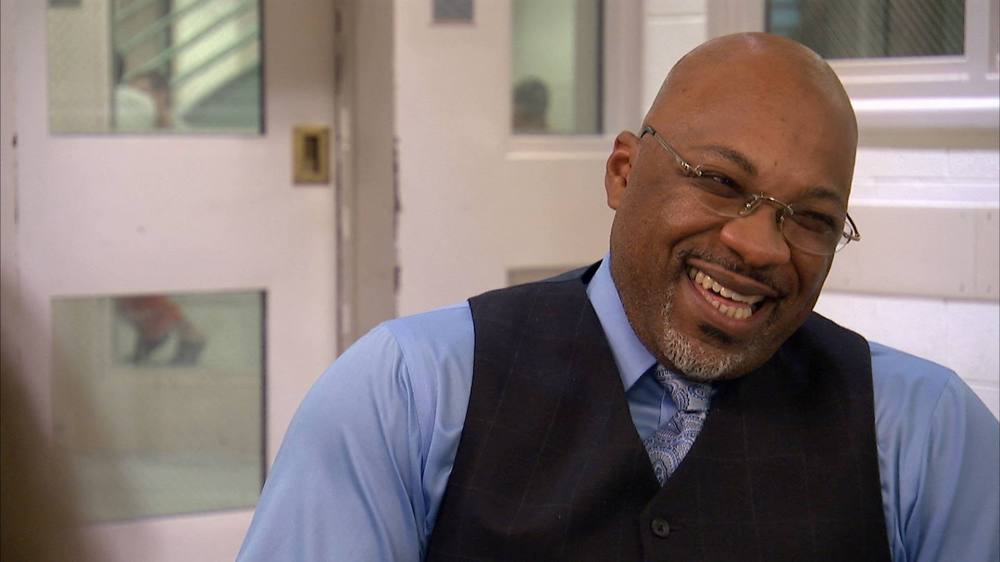
He’s known for his respectful attitude, his loud nature and, of course, his sense of style. He’s Warden Eric Ivey from Lockup’s Cleveland series and he’s answering your questions! First, a little bit about him: as Associate Warden of Cleveland’s Cuyahoga County Corrections Center, Ivey oversees jail operations for approximately 2100 inmates and more than 500 corrections officers. He began his corrections career in 1990, and before that served for six years in the United States Army as a combat engineer. In his free time, Ivey enjoys sports and working out.
Now, here are Warden Ivey’s answers to YOUR questions.
Misty A: You mentioned that your upbringing was hardscrabble. Who inspired you to move from extreme poverty to become a warden of Cuyahoga County? Also, what advice would you give to young people who come from distressed backgrounds to keep them from falling through the cracks?
I believe that I was inspired by the negative things that I grew up around. I also was inspired by the fact that I wanted to make my mother proud of me and put myself in a position to make life a little easier for her. Unfortunately, she passed away in 2008, before I became the associate warden. My advice to any young person that comes from a distressed background is to let that situation be your motivation. Try to find a positive role model and pattern yourself after that person.
Michele V: Do you feel part of your job is to mentor and show inmates proper behavior? How do you accomplish this?
Yes, in some cases when I am dealing with some of the younger inmates I find myself in that role. I try to accomplish that by setting a good example, and that starts by respecting everyone and being professional at all times. It’s difficult to have a huge impact because most inmates are only in the facility for a short period of time.
Quentin S: Who inspired you to be in the criminal justice field?
I don’t think anything inspired me. I was just looking for employment 20+ years ago and here I am. Who would have ever thought?
Kellie G: What are some of the things that really push your buttons in the jail?
It pushes my buttons when inmates are not truthful when filing complaints, whether it’s about an officer or another inmate. Sometimes these things take up a lot of time and manpower just to find out it was all a fabrication.
Nathan A: When an inmate appeals a write up how does your staff figure out if he’s telling the truth? Especially if it’s an inmate’s word against a guard’s?
I first talk with the inmate to try and gather information and see if there are any witnesses that can help validate his/her complaint. I then speak with the officer to hear their side of the story. I try to make the best decision based on information gathered, what I know about the inmate, and what I know about the officer.
Sheila W: With all the chaos you see daily in the jail, how do you keep yourself sane? I’m not saying that every day is chaos, but seeing the things you see and dealing with the different things you deal with day to day, how don’t you become depressed?
After working in the field for so long you become somewhat numb to some of the things that go on around you because they are just part of the job.
Debi S: What is your jail doing in implementing programs to lower recidivism rates in your county? What programs work the best?
The courts have a Prison Diversion Program in which they can sentence inmates to the local incarceration program instead of prison. This allows the inmate to avoid getting a prison number or being on any post-release control upon release. The jail also offers G.E.D classes, parenting classes, drug and alcohol support groups as well as a coping skills group. I believe that the effectiveness of the groups depends on whether or not the inmate follows up and continues the groups once they are released back into the community.
Jennifer K: Have you ever gotten to be good friends with any of the inmates?
Never have become good friends with any inmates.
Nicole W: What is the most rewarding part of your job? Everyone is so quick to point out the negative but I know there has to be a reason you come back to work every day. The rewarding part is the relationships and friendships that I have built over the years with some of my coworkers. Love my job. Angela J: What mistakes have you made as a warden? One of the mistakes that I have made is initially expecting others to have the same work ethics and dedication to the job as I feel I do. I learned that just because people don’t do things the way I would do them, doesn’t necessarily mean they can’t get the same results. Bryan M: Do the clothes and your style of dress ever pose a problem when interacting with inmates? I can imagine prisoners who have very little being distrustful towards someone who flaunts their nice clothes in front of them. Or do you rather see yourself as someone who the inmates can aspire to be? My clothes or my style is never a problem when it comes to dealing with the inmates. My clothes and my style is only a small portion of who I am. I pride myself in treating people with the utmost respect, regardless of their current situation. Some of the inmates have known me for a good portion of my career and even from growing up. I realize that it only takes one bad decision to end up in a bad situation. Debra H: Do you think you’ve had any influence on inmates and how? Looks like they show you respect!! I don’t know if I have ever influenced anyone but I hope that the younger inmates look up to me as a role model. I often see former inmates on the streets. They all usually greet me with a hand shake, and a kind word. That lets me know I have been fair and they respect me. John F: Did you get upset when the production assistant scuffed your shoes? I didn’t get upset about the shoes. We all joked about it. I love polishing my shoes, it’s a hobby I picked up in the military. It relaxes me. Gives me something to do while watching the game. *This interview has been condensed and edited.
MS NOW staff Recommended


