








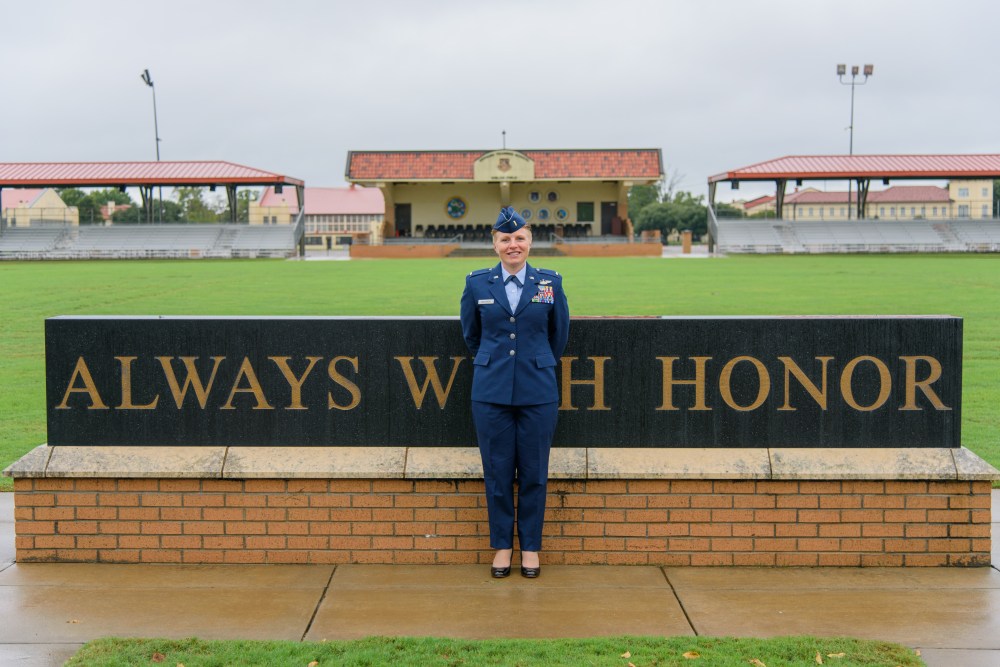
Dec. 22 marks the 10th anniversary of the repeal of “Don’t Ask Don’t Tell,” the Clinton administration policy that ended the formal ban on gay people serving in the military in 1993 — yet forced them to keep part of themselves hidden until the policy’s repeal in 2011.
Ten years later, LGBT military members still face challenges, including President Donald Trump’s 2019 ban on transgender people serving. But they no longer have to live under DADT. And that’s a beautiful thing for not only the individuals, but the military as a whole, according to Christina Wiskowski, a Comcast employee and Captain in the Air Force.

“I’m so grateful the repeal happened, and our younger generation doesn’t have to deal with this,” Wiskowski, senior manager at Internet Essentials from Comcast, told Know Your Value in an interview. “Maintaining readiness as a force is challenging, and when you have a component that’s unable to bring their true authentic self, it’ll affect their ability to serve fully. [The DADT repeal] meant my military self could be a 100 percent accurate representation of who I am.”
But when she enlisted as an Air Force reservist in 2001, Wiskowski didn’t know DADT would have any effect on her life.
She identified as straight at the time, and at age 20, she was feeling restless following a year of college that didn’t feel like the right path for her. Wiskowski had been planning to go the pre-med route in school, so she enlisted as a medical technician to get experience and see where life took her.
As it turned out, life took her not only on overseas deployments and service with three different military units, but also to Margaretta: the woman she met at age 24 who would become her wife, years later.
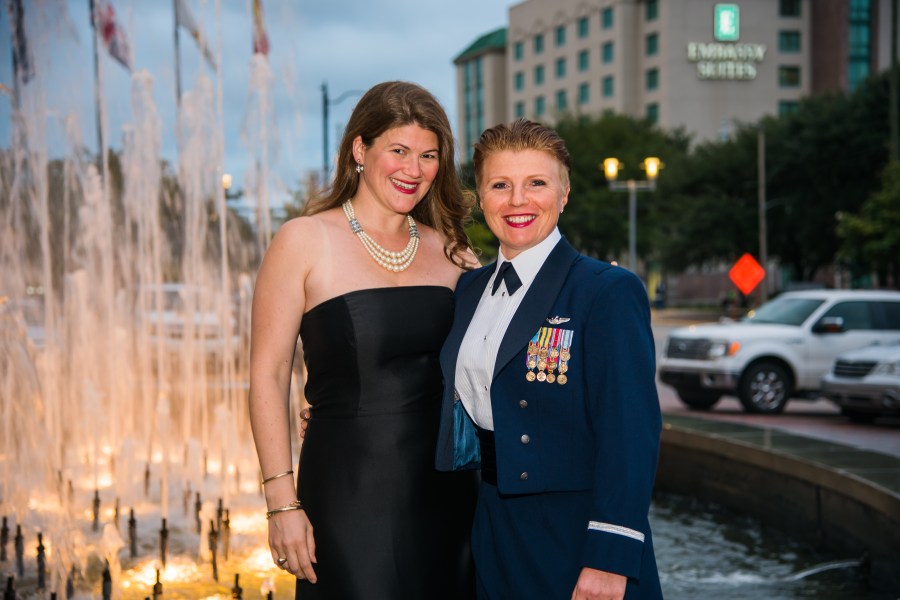
“We were friendly for a while, and that relationship turned into something more,” Wiskowski said. “Through that process, growing that relationship, I had a personal revelation about my own identity.”
For Wiskowski, who now identifies as a lesbian, that revelation wasn’t only personal. It affected her professional life too.
“I had a few close friendships in that unit at the time, my first unit, and they knew about my relationship,” Wiskowski said. “I wasn’t concerned about them. But it was at the back of my mind: If it became public knowledge, I didn’t know what that would do socially or administratively for me.”
That unit shut down in 2007, and Wiskowski moved to another from 2007 to 2015 – one that was even more supportive, with a few friends who were “quietly out, but out,” she said. “It was a great experience and put any fears I had at ease … It was business as usual.”
Wiskowski noted that each unit and each wider branch in the military has its own culture, and she feels “incredibly fortunate” to have the experiences that she did. But the safety of her home turf didn’t protect her when she was deployed.
“When you’re deployed, your administrative control is with the home unit, but the operational control is your deployed unit,” Wiskowski explained. “So even if your home unit is supportive, if your deployed unit finds out you’re in violation of a military policy, that can be a problem.”

So, Wiskowski didn’t make calls home to Margaretta in front of people she didn’t know. And Margaretta didn’t have access to any benefits or services – nor would she be notified if Wiskowski were to be injured.
She sought support in an “underground network” of LGBT military members who could relate, but the added stress took a toll, permeating even casual conversations. During her first Afghanistan deployment, in 2009, Wiskowski was working in an air crew position in a squadron that was half made up of people from her home unit and half people she didn’t know.
“One of the guys from my home unit was asking how my now-wife was doing in a way that clearly identified a relationship,” she said. “I kept making eyes at him, like, ‘hey, you’re outing me!’ In the end the [members of the unit] were all pretty supportive, but at the time I had to be on guard.”
That same year, Wiskowski began working as the deputy manager at the Office of Sen. John Kerry (D-Mass.). There on Capitol Hill, she had a literal front-row seat to the debates over legislation in Congress – including rumblings about a potential DADT repeal.
“I’d be sitting at my desk, tuned into what was happening on the floor, and that’s where I’d get angry – hearing people fight so hard against my human rights,” Wiskowski said. “It motivated me to be more vocal about why this mattered. But while I was highly confident in my leadership in my home unit, I had to be careful as I couldn’t be marching on the street saying ‘I’m a military member, out and proud.’” Wiskowski and Margaretta were engaged in early 2010, as the DADT repeal debate wore on. Wiskowski was excited but realized “even if we got married I wouldn’t be able to put her in the system [as a military spouse], get her an ID card, any of the basic things. It felt like it would be half not mattering.” But then, in December 2010, the House passed a federal statute to end DADT. Then it passed the Senate. President Barack Obama would sign the legislation that led to repeal on Dec. 22, 2011. “When the vote came through it was like, ‘OK, [Margaretta] can now fully be a military spouse and get the benefits, services, communications like everyone else,’” Wiskowski said. “I don’t even remember the moment the vote happened—it was more of a process than it was an event—but I remember that whole time being so emotionally charged.” For Wiskowski, the DADT repeal resulted, in what she described as a meeting of the two Christinas. She had already been “living sort of two lives” as a reservist, one in uniform and one as a civilian. But she no longer had to divide herself further. “In my civilian life I didn’t have many secrets — I was public about my relationship in that life — and I was able to bring that over to the military side,” she said. “I hadn’t been able to do that before.” Wiskowski recognizes that not every LGBT member of the military has received the largely supportive treatment she experienced from her leadership or unit members, pre- or post-repeal. And she feels “we as society still have a lot of work to do. But she’s heartened by the social change in the last decade, pointing to anecdotes like a training classmate of hers who recently came out via a Facebook video. “In the moment, I didn’t realize how challenging it was to hide myself,” Wiskowski said. “I was always focused on moving forward and not dwelling on the negative. But now it isn’t something I have to worry about at all, so I can be fully present to serve.” Disclaimer: Comcast is the parent company of NBC Universal. Know Your Value is part of NBC News.
Julianne Pepitone
Julianne is the senior technology writer for NBC News Digital, covering large consumer tech companies' (Apple, Google, Facebook, etc.) news and trends, as well as cybersecurity. She also writes and appears in original videos for NBCNews.com, and speaks as an expert guest on live shows across the NBC and MSNBC networks.
She previously worked at CNNMoney.com where she covered large techs from a business angle, as well as the intersection of the tech and media industries.
In addition to NBC and CNN online properties, Julianne has written for several national magazines and online publications including Esquire, Self, Popular Mechanics and Cosmopolitan. Recommended


