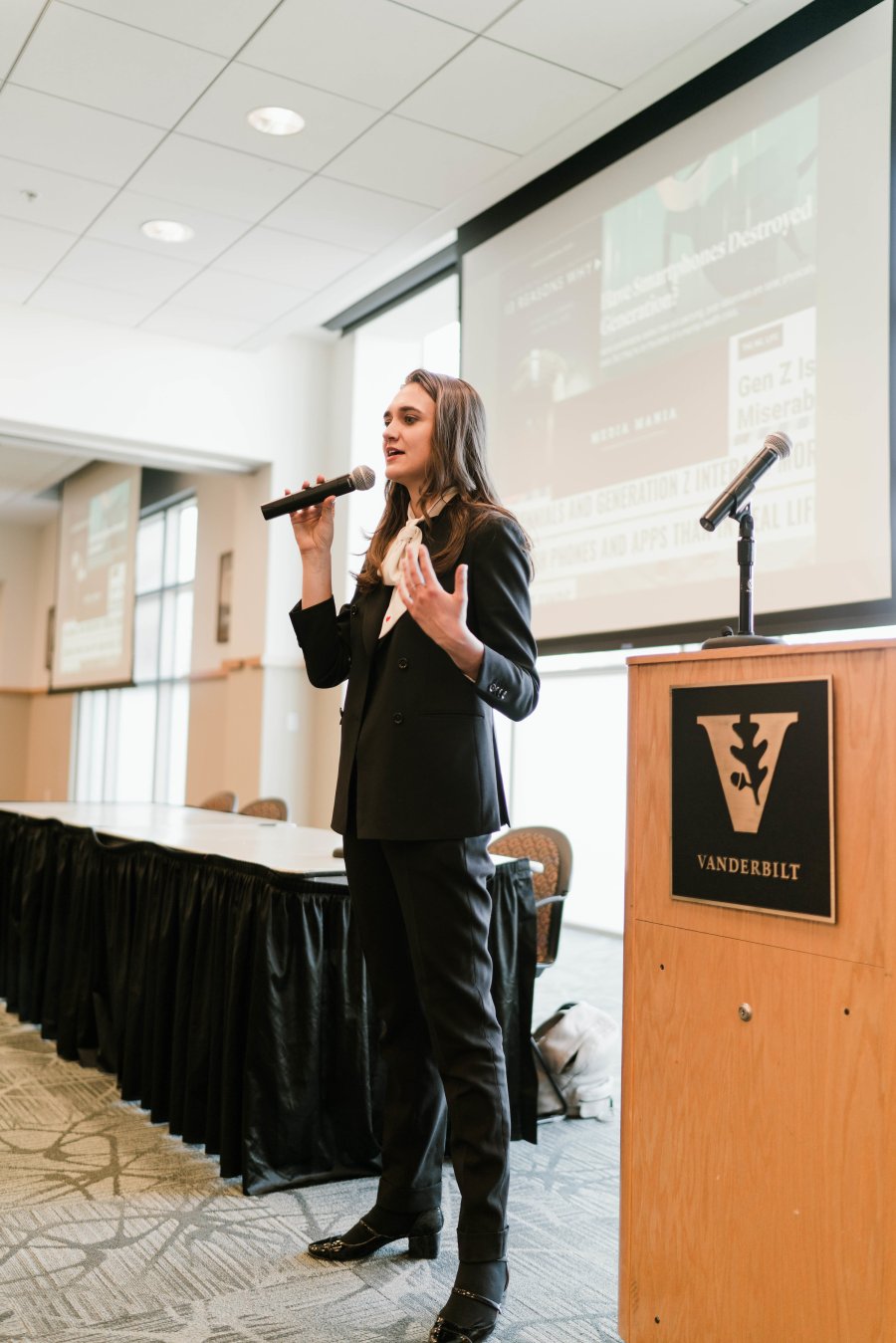
Much has been said about social media’s pitfalls: People tend to post “highlight reels” of life, featuring only the happy and special moments rather than the full picture. Then they compare their real lives with others’ highlight reels, leading them to feel isolated or that their lives are lacking.
That pressure to perform on social media inspired Larissa May to create a nonprofit organization called Half the Story, a global community that encourages people to share “life unfiltered”: their full lives, including the struggles and passions, rather than just the highlights.
In honor of Mental Health Awareness Week, which is Oct. 6-12, May spoke to Mika Brzezinski, “Morning Joe” co-host and Know Your Value founder, about the creation and mission of Half the Story. She described her freshman year at Vanderbilt University, during which she not only took classes but spent 30 hours a week on her fashion blog, Livin Like Larz—which included writing, traveling and other commitments that soon left her feeling overtaxed.

“For me it was really this light bulb moment…what everyone saw on social media was traveling to Fashion Week…being on stage after class,” May said. “But what people didn’t see was the other half of the story: my struggle with depression and anxiety.”
May came close to taking her own life, she said, but came out the other side feeling she “had a responsibility to use my platform in a new way. I started realizing that I, behind the screen, was not the only one alone.”
“You had one Larz, and then there was the real Larz, and that gave you stress,” Brzezinski said, referencing May’s nickname.
“They saw the brightest and the lightest,” May agreed.
The breaking point for May came when she was already seeing a psychologist daily, Skyping into classes on the road and barely sleeping or eating. In 2016, she flew to New York Fashion Week and had what she called a mental breakdown.
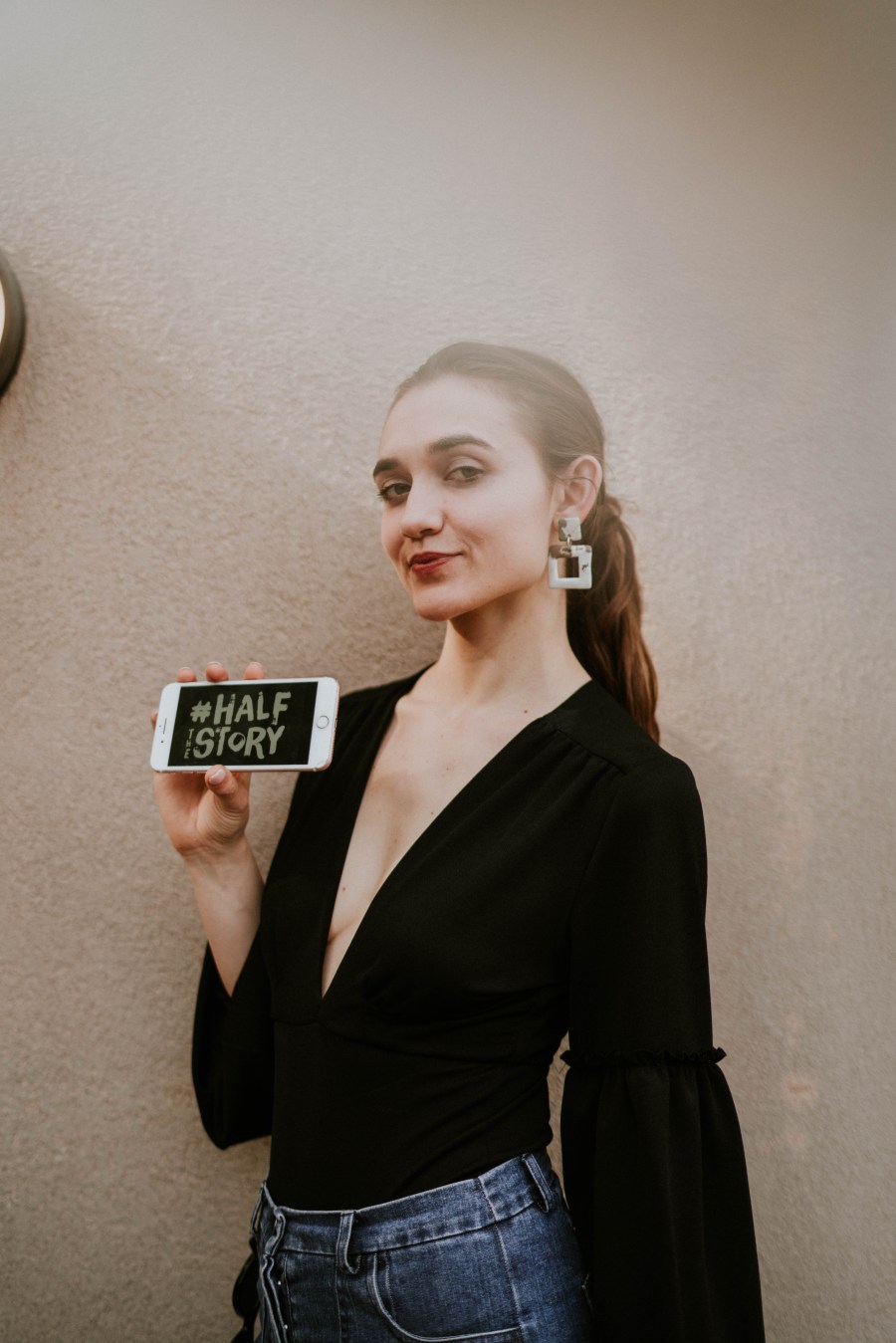
May was sick, she realized, but no one saw that side of her. When she came back from New York Fashion Week, she decided to quit her fashion blog. She drew a Half the Story logo on a piece of paper and created the platform, using her own story about closing down her blog as the first post. Soon afterward, another woman on campus shared the other half of her story, about her sexuality—and Half the Story grew from there.
“Over the past three years it’s become a global platform and nonprofit to actually equip influencers with the tools they need to talk about social media and help their followers shift their own behaviors,” May said.
‘Retraining our minds’
“So what do you recommend—what is the Half the Story message in terms of how people should handle social media? Maybe be off of it?” Brzezinski asked.
“The biggest thing about Half the Story is that social media is not leaving us,” May said. The key, instead, is for people to train their minds to develop healthy behaviors around social media—the same way we develop habits around food, exercise and more at a young age. Specifically, Half the Story encourages users not only to track their social media use but also to assess how they feel after scrolling through those feeds. Also important is creating offline behaviors to replace some of that scrolling time is also important: spending more time with friends, getting adequate sleep, eating healthfully and overall being mindful about taking care of oneself. “Social media is replacing their fundamental human needs,” May said. “One thing at a time—mindfulness…..There isn’t time to really just sit alone with our emotions, feelings and thoughts. And in turn, it’s harder for us to connect with ourselves and others.” A study published last month in the scientific journal JAMA said adolescents who spend more than three hours a day on social media may be at more risk of mental health problems. “We’re the most connected yet disconnected generation,” May said. “For Half the Story, the way we approach this is not only by providing tools on how to reshape your behaviors online, but it’s also taking this model of experiences and bringing people together in real life.” Forging those true connections and being vulnerable with one another stops us from comparing ourselves to lives on social media that don’t really exist, May added. “It’s the things we don’t talk about that actually connect us on a human level,” she said. “It’s those real human struggles, those dreams, those aspirations, that bring us together. And that’s the other half of the story.”
Julianne Pepitone
Julianne is the senior technology writer for NBC News Digital, covering large consumer tech companies' (Apple, Google, Facebook, etc.) news and trends, as well as cybersecurity. She also writes and appears in original videos for NBCNews.com, and speaks as an expert guest on live shows across the NBC and MSNBC networks.
She previously worked at CNNMoney.com where she covered large techs from a business angle, as well as the intersection of the tech and media industries.
In addition to NBC and CNN online properties, Julianne has written for several national magazines and online publications including Esquire, Self, Popular Mechanics and Cosmopolitan. Recommended